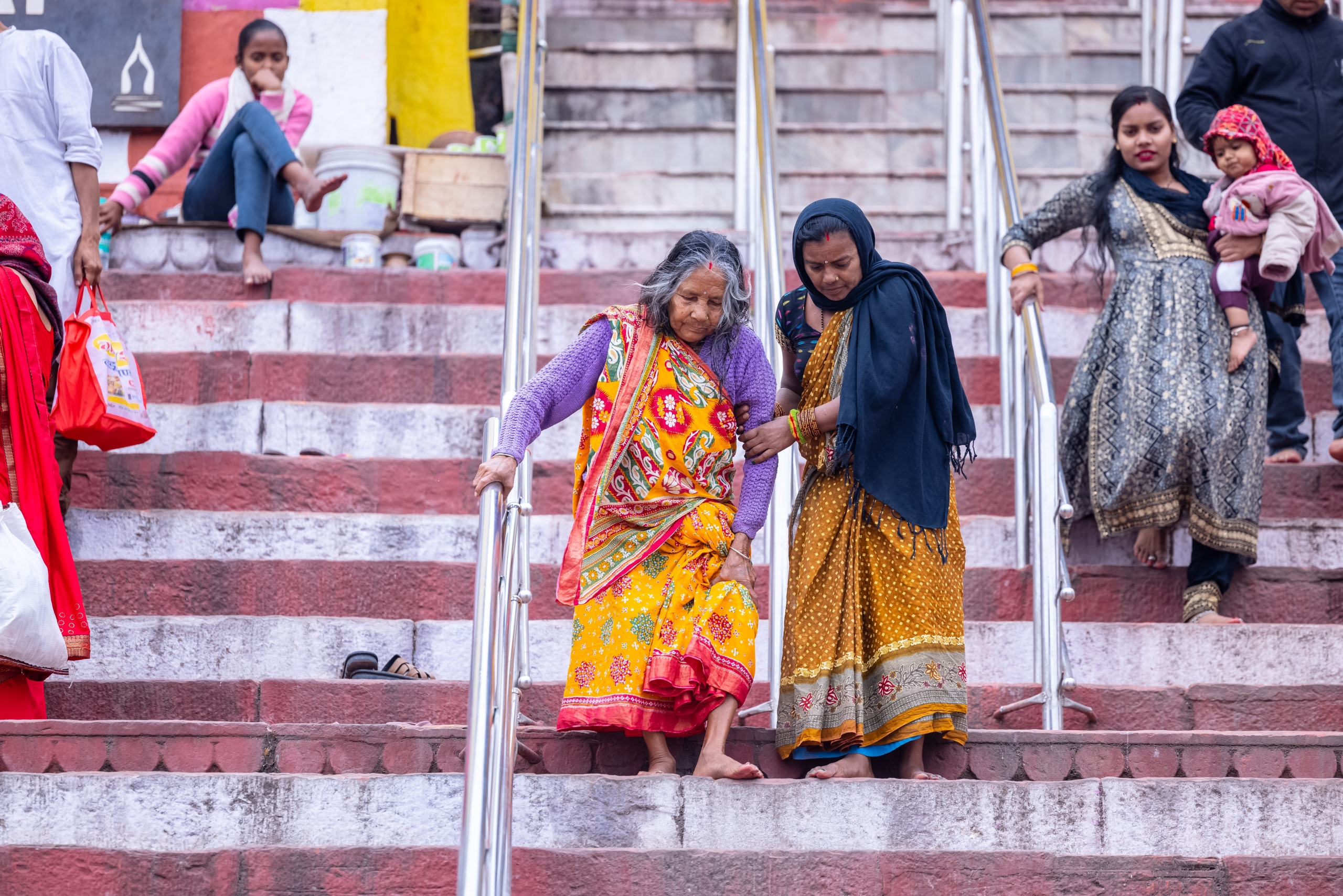
In July 2023, Gulab Bai was 94 years old and had spent 32 of them living in a residence for the elderly in Varanasi, in northern India. She had arrived from Jhansi accompanied by her husband, who died there some time later. She remained in the city, waiting for the end of her own life to arrive as well.
Her day began at four in the morning. Before breakfast she would go to a nearby temple to pray to Shiva, and then spend much of the day reading religious texts, among them the Sundarakanda, an episode of the Ramayana. Her son, a soldier, visited her regularly and made sure she wanted for nothing.
Gulab Bai had taken a decision that may be difficult to comprehend from within other cultural traditions: she did not want to die at home, surrounded by the places where much of her existence had unfolded, but in Varanasi, a city she considered especially favourable for attaining spiritual liberation.
Her story, recorded by the journalist Dewesh Pandey in 2023, is one of many that unfold at Mumukshu Bhawan, a residence where some people spend years — even decades — waiting for the moment of death.
The city receives numerous pilgrims every year who come to visit its temples, bathe ritually in the Ganges or take part in religious ceremonies. But there are also those who arrive seeking something different: the place where they wish their life to end.
Kashi, the City Where Dying Can Mean Liberation
Varanasi, also known as Benares or Kashi, lies in the state of Uttar Pradesh, on the banks of the Ganges. It is one of the most important religious centres of Hinduism, and a city whose history is deeply bound to Shiva, one of the principal deities of that tradition. Its religious importance is explained, in large measure, by beliefs concerning death and spiritual liberation.
According to numerous currents of Hinduism, living beings are subject to samsara, a continuous cycle of birth, death and rebirth, conditioned by karma — the consequences of actions performed during existence.
Liberation from that cycle is called moksha and constitutes one of the great spiritual objectives of Hinduism. To attain it means to cease being subject to successive rebirths, although the various religious and philosophical schools interpret differently what that liberation consists of and how it may be obtained.
Kashi occupies a special place within these beliefs. An ancient Sanskrit expression, Kāśyāṃ maraṇaṃ muktiḥ, sums up the religious conviction that dying in this city can lead to liberation.
In certain traditions connected with Shiva it is believed that the god grants decisive assistance to those who die there. According to one of the best-known interpretations, Shiva pronounces into the ear of the dying person the Taraka mantra, a sacred formula that eases the passage toward liberation.
This belief has made Varanasi a singular destination: the spiritual value of the journey lies not only in visiting a temple, fulfilling a vow or taking part in a ceremony, but in being physically present in the city when death arrives.
That does not mean all Hindu traditions hold that dying in Varanasi automatically ensures moksha. Doctrinal interpretations vary, and it is worth distinguishing death in Kashi from other practices connected with the city, such as the cremation of a body or the immersion of ashes in the Ganges.
What is beyond doubt is that these beliefs have shaped, over centuries, a religious geography in which territory, ritual and expectations about the destiny of the soul are closely bound together.
The Houses Where Pilgrims Await the End of Their Lives
Mumukshu Bhawan, the residence where Gulab Bai lived, was founded in 1920 near Assi Ghat, in the southern part of the historic city. The Sanskrit word mumukshu designates a person who aspires to attain spiritual liberation. The institution was created precisely to offer lodging to those who wished to settle in Kashi for the final stage of their lives.
The compound has rooms, gardens, temples and spaces for prayer. Some residents have been there for many years, while others arrived after retiring or when they began to sense that the end was approaching.
Daily life is far from being a silent wait for death. The residents read, converse, carry out their ordinary activities and take part in religious ceremonies. Devotional songs, known as bhajans and kirtans, form part of the communal activities.
The same 2023 report featured Draupadi Devi, a woman who had been living at Mumukshu Bhawan for seventeen years. Her husband had died there four years earlier, and she had decided to remain at the residence.
These stories show how a pilgrimage that might initially seem tied exclusively to the moment of death ends up becoming a new way of living. Some people arrive to spend their last days and remain for decades.
But Varanasi also has institutions designed for a far shorter stay. One of the best known is Kashi Labh Mukti Bhawan, founded in 1958 at the initiative of the Dalmia family. Unlike Mumukshu Bhawan, it is intended principally for people who are close to death and who wish to die in the sacred city.
Traditionally, the residence has permitted stays of around fifteen days, though the duration could depend on circumstances. Relatives accompany the dying person and take part in prayers, readings and religious ceremonies intended to help them face their final moments.
These institutions answer different needs. In some, residents have chosen to move to Varanasi while they can still organise a relatively autonomous life; in others, families arrive when death appears imminent.
There are also very diverse human circumstances behind each decision. Religious conviction may combine with loneliness, financial hardship, or the need to find a community in which to face old age.
What unites these people is the importance they attribute to the place where they expect to die. Their pilgrimage consists not only in reaching a sacred destination, but in remaining there until the end.
The Last Journey to the Ganges
Not all families arrive in Varanasi accompanying someone who wishes to spend their final days there. Many travel when a relative has already died, bringing the body for the funeral rites or the ashes to be placed in the waters of the Ganges.
The relationship between the river and death forms part of the city’s religious geography. Along its western bank stretch the ghats, great stone stairways giving access to the water, which for centuries have hosted ritual bathing, prayers, celebrations and funeral ceremonies.
Two of these places play a particularly important role: Manikarnika Ghat and Harishchandra Ghat. Manikarnika is one of the principal cremation sites in Hinduism. Its sacred character is bound to several legends involving Shiva, Parvati and Vishnu. One of them recounts that an earring of the goddess Parvati fell in that place, giving rise to its name.
Harishchandra Ghat is associated with another traditional story, that of King Harishchandra, famed for his fidelity to truth even when circumstances obliged him to work at a cremation ground.
In both places the last Hindu rites are performed, known as antyeshti, which may include the preparation of the body, its conveyance to the funeral pyre, the prayers and the cremation. Their form varies according to family, regional and religious traditions. Fire has a purifying significance and, after cremation, the remains may be placed in the Ganges, considered one of the most sacred rivers of Hinduism.
Behind these ceremonies there is also a complex human organisation. Members of the Dom community have traditionally performed essential functions in the cremations of Varanasi, particularly in handling the fire and the funeral pyres. Their work, indispensable to the continuity of these rites, has historically been carried out within a context of discrimination related to caste hierarchies.
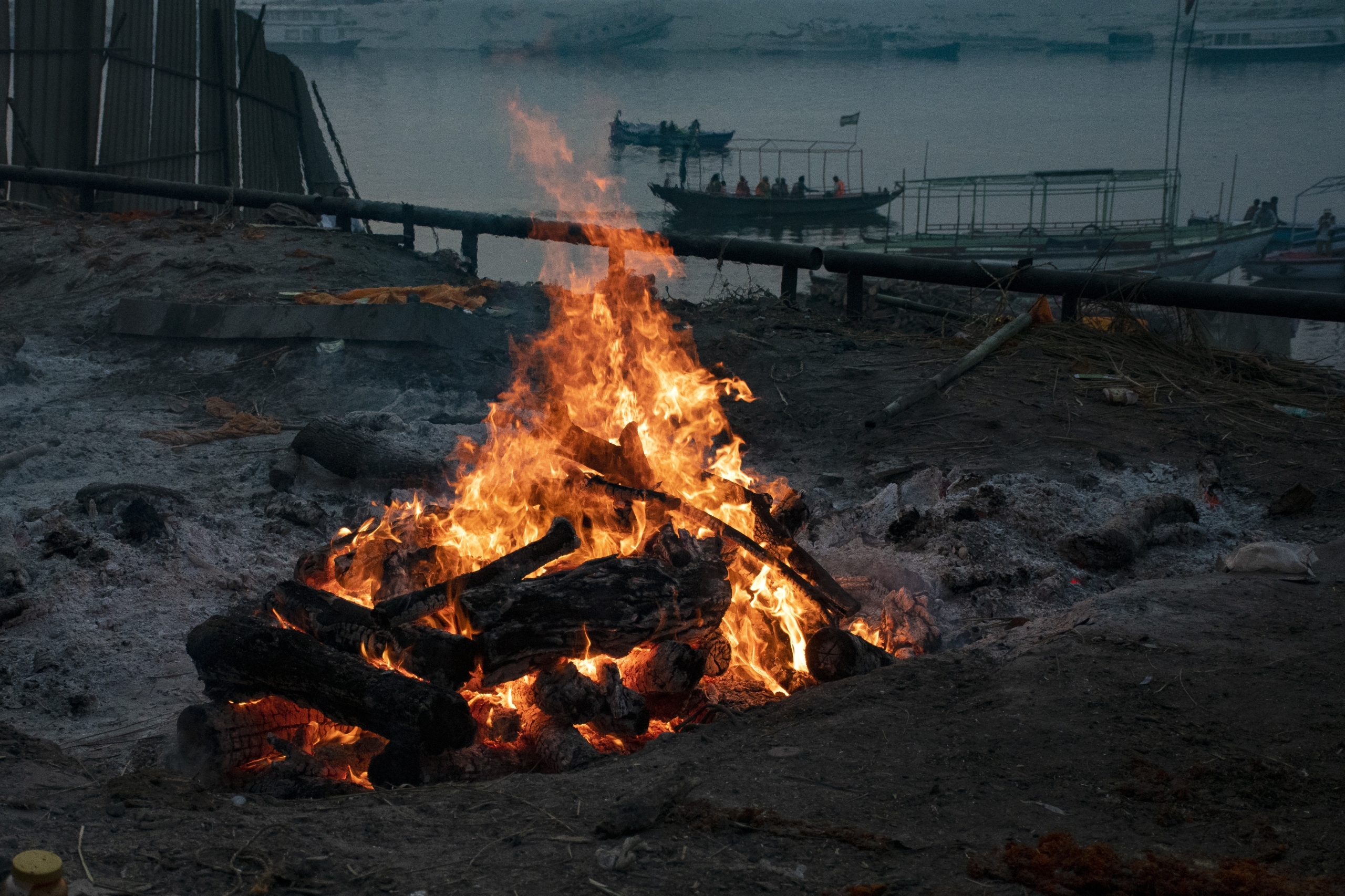
Nor do family obligations necessarily end with the cremation. In many Hindu traditions, descendants subsequently perform ceremonies such as shraddha and pinda daan, through which they honour their ancestors and fulfil their religious duties toward the dead.
All this makes Varanasi a place where the pilgrimage of the living and the last journey of the dead are constantly interwoven. Some families arrive seeking a spiritually favourable death for their relatives; others come to bid them farewell after they have died.
Visiting Varanasi, a City Where Life and Death Coexist
Although its relationship with death constitutes one of the best-known aspects of Varanasi, the city possesses an extraordinary religious and cultural heritage that extends far beyond its funerary spaces.
Among its principal places of pilgrimage is the temple of Kashi Vishwanath, dedicated to Shiva, whose sanctuary constitutes one of the most important devotional centres in Hinduism. There are also numerous religious itineraries that pass through temples, streets and sacred places connected with the history of Kashi.
For many pilgrims the day begins before dawn, when they go down to the ghats to bathe ritually in the Ganges or to say their prayers. At dusk, the Ganga Aarti ceremony brings together the faithful and visitors in places such as Dashashwamedh Ghat, where priests offer lights, incense and chants in honour of the river.
It is important to distinguish this celebration from the funeral rites: the Ganga Aarti is an act of religious veneration of the Ganges, and not a ceremony dedicated specifically to bidding farewell to the dead.
Those who visit the city can also discover its historic neighbourhoods, its craft traditions and its many religious spaces. Practical information about its principal monuments and places of interest is available on the official Varanasi district portal.
Visiting the cremation ghats requires particular consideration. Cremations are family and religious ceremonies, not spectacles organised for travellers. Observing them calls for discretion and respect, especially with regard to photographing the deceased and their relatives.
In the same way, the residences for people who wish to die in Kashi are not tourist attractions. Their cultural and anthropological interest does not alter their condition as private spaces where people face a particularly delicate stage of their lives.
For those who come moved by historical or religious curiosity, understanding these circumstances forms part of approaching a city where spiritual practices remain deeply integrated into everyday life.
Some of the people who come to Varanasi to die remain there for years. Others die shortly after their arrival, while some end up returning to their places of origin. There is no single outcome for those who undertake this pilgrimage.
Gulab Bai, the elderly woman who in 2023 had been living at Mumukshu Bhawan for more than three decades, had found in that residence a place in which to continue her daily life, accompanied by her reading, her prayers and her son’s visits. Her decision to remain in Kashi was bound to the hope of attaining spiritual liberation there.
In most pilgrimages, reaching the sacred destination precedes the return home. For those who travel to Varanasi with the desire to die there, that final stage takes on a different meaning. They have chosen a city where they hope their earthly existence will come to an end because, according to their beliefs, that ending may become the beginning of definitive liberation from the cycle of rebirths.
AI Transparency Notice
PilgriMaps uses artificial intelligence tools to assist in the research, drafting and translation of editorial content. All AI-assisted content is reviewed, edited and verified by our editorial team before publication. We contrast information against primary sources, specialist literature and on-the-ground knowledge to ensure accuracy, cultural sensitivity and editorial integrity.
AI is one tool among many in our workflow. The judgement, curation and responsibility for everything published on this platform remain entirely human.
Viator Media S.L. — in compliance with the EU Artificial Intelligence Act (Regulation EU 2024/1689).
This post is also available in: