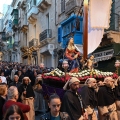
On the Japanese island of Shikoku, an ancient funerary tradition led families to walk several kilometres carrying, symbolically, the spirit of a loved one on their backs. Their destination was Mount Iyadani, held to be the dwelling place of the souls of the dead.
After the burial, one of the deceased’s relatives would return to the cemetery. There they would bend slightly forward, as though someone were about to climb onto their back, and announce that the moment had come to set out for Iyadani. According to an old belief of the Sanuki region of Japan, they had just symbolically gathered up the spirit of the dead person and were now to accompany it to a mountain several kilometres away.
The journey was made on foot, along the roads crossing the small settlements and fields of the region. Participants might carry objects connected with the deceased, such as a lock of hair or an item of clothing, and on arriving at their destination they would perform various ceremonies to bid farewell.
Then they would return home. But according to some versions of the tradition, they had to do so without looking back, because it was believed the spirit might follow them and return with them to the world of the living.
This singular funerary rite, known as Iyadani-mairi, was documented during the twentieth century, though its origins are older. Its details varied from place to place, but it answered a conviction shared by different communities of the region: the spirits of the dead were bound to a mountain, and the living were to accompany them symbolically as far as it.
Although the custom has changed profoundly, Iyadani remains a place of prayer for the dead. And the mountain forms part of a Buddhist pilgrimage that can still be walked today.
Iyadani, the Mountain Where the Spirits Dwell
The island of Shikoku lies south of Honshu, Japan’s main island, separated from it by the Seto Inland Sea. Its territory combines mountains, agricultural valleys, coastal settlements and numerous temples that form part of one of the country’s principal pilgrimage traditions.
In Kagawa Prefecture, near the city of Mitoyo, rises Mount Iyadani, an elevation of some 382 metres that occupies a singular place in the local religious imagination. According to the traditional beliefs of some communities in the region, the souls of the dead made their way to this mountain after death. It was not simply a place for remembering ancestors, but a territory considered bound to their spiritual existence.
The relationship between mountains and the dead appears across various Japanese traditions. In some rural communities, ancestors were imagined as spirits remaining in the mountains near the villages. These beliefs became progressively entwined with Buddhist teaching, local cults and practices of venerating the dead, giving rise to highly diverse regional traditions.
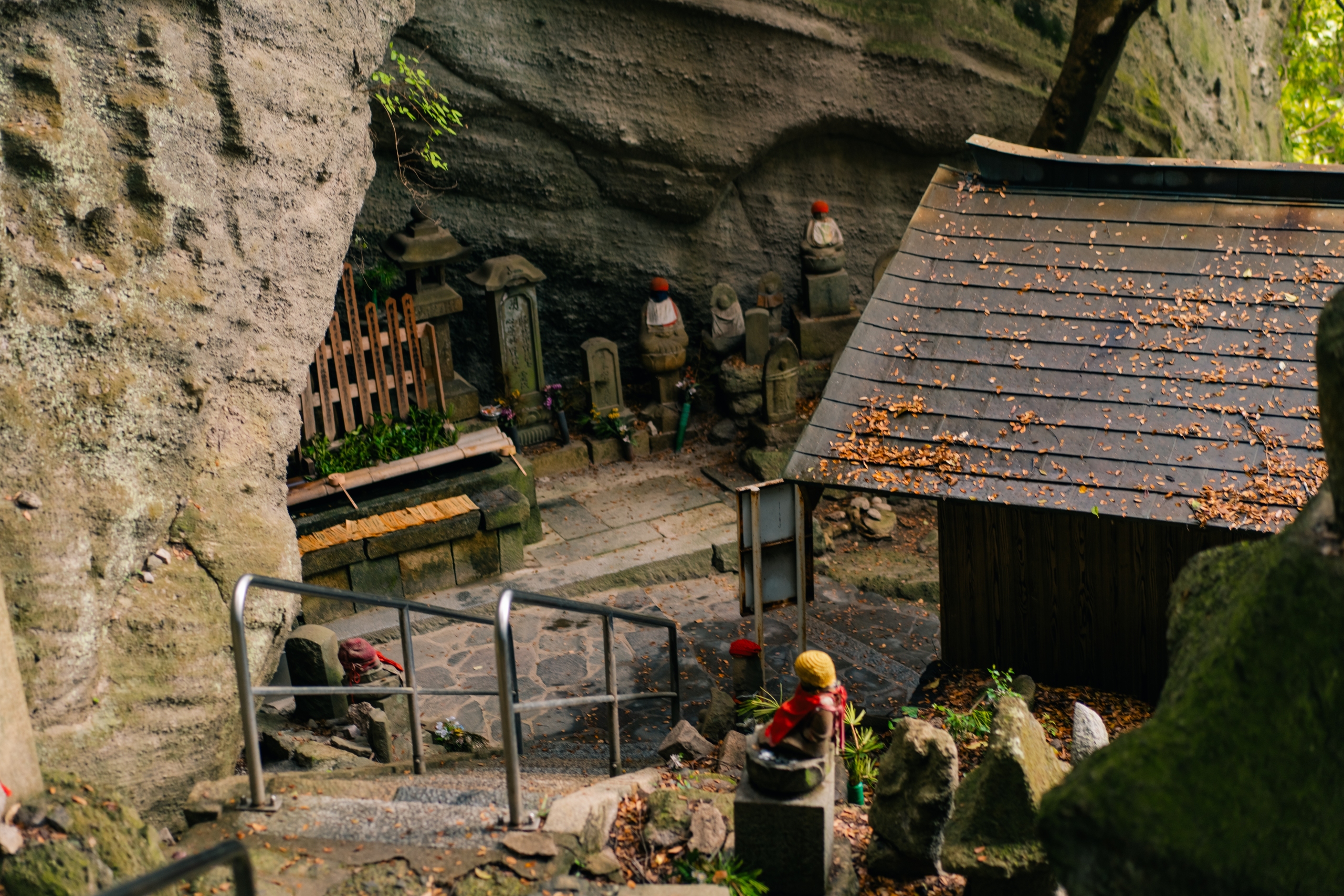
At Iyadani, that funerary dimension became associated with a Buddhist temple set among woods, rocks and caves. Iyadani-ji, whose full name is Kengozan Senjuin Iyadani-ji, is built into the rocky hillside of the mountain. To reach it, the visitor must climb a long series of stone steps leading up to the various religious spaces.
Among its most interesting features are the Buddhist images carved directly into the rock faces, known as magaibutsu, the cavities used as places of prayer, and the spaces dedicated to the memory of the dead.
For the communities that practised the Iyadani-mairi, climbing up there meant something more than visiting a temple: it meant accompanying the spirit of a relative to the place where it was believed to belong.
Iyadani-mairi: the Last Journey of the Dead
When a person died, their relatives might perform the Iyadani-mairi on the day after the burial, on the third or seventh day after the death, or at other moments in the funerary cycle, depending on the locality.
In one of the better-documented variants, the participants first went to the place of burial. There they announced to the deceased that they were going to carry them to Iyadani, and one of them performed the gesture of taking them onto their back.
The group then set out toward the mountain. Some families carried a lock of the dead person’s hair wrapped in paper, a provisional memorial tablet, or an item of clothing.
Once at Iyadani, these objects might be deposited in particular places within the precinct. Traditional accounts also describe ceremonies in which water was poured over small wooden tablets bearing the religious name of the deceased, following a Buddhist practice of prayer for the dead.
On the mountain, the place known as Omohakodani, the valley of the tombs, held particular importance. Among its cavities and rock faces the acts of farewell were performed.
But one of the most striking aspects of the ritual concerned the return. After completing the ceremonies, the participants shared a meal before beginning the descent, and avoided turning their gaze back toward the mountain.
According to local belief, these gestures marked the separation between the living and the dead, and were intended to prevent the spirit from returning with its relatives.
The custom reflected a conception of the world of the dead closely bound to the landscape. The spirit did not depart toward a hereafter entirely separate from familiar territory, but toward a mountain of the region itself, integrated into the religious geography of those communities.
A Tradition That Has Changed, but Has Not Entirely Disappeared
Over time, the Iyadani-mairi was transformed at the same pace as the funerary customs and ways of life of rural communities. In some localities, the journey to the mountain was replaced by ceremonies at nearby temples; in others, the rituals of accompanying the spirit were modified.
Even in the twenty-first century, the tradition of going to Iyadani to commend the dead is still recognised in the region, although it is not possible to establish how many families currently make the old journey, or whether they preserve gestures such as symbolically carrying the deceased on their back or returning without looking back.
What does continue is the temple’s relationship with the commemoration of the dead. Iyadani-ji maintains a religious practice involving water and wooden tablets, known as omizu matsuri. In it, the faithful wash small tablets called kyōgi, inscribed with religious formulas, in the water that runs down the rocks.
This practice is used both to make petitions and to perform acts of commemoration for the dead, and it preserves the symbolic importance water has historically held at the sanctuary. The place where it is carried out stands beside a cavity that local tradition associates with the world of the deities and the buddhas.
So although the old Iyadani-mairi no longer appears to be widely practised in its original form, the mountain continues to receive people who come to pray and to remember their dead.
Nanakashomairi: Seven Temples That Can Still Be Walked
Iyadani-ji forms part of the celebrated Buddhist pilgrimage of the 88 temples of Shikoku, known as the Shikoku Henro, bound to the figure of Kūkai, venerated as Kōbō Daishi.
This great itinerary crosses the island’s four prefectures over approximately 1,200 kilometres, though the distance depends on the variants chosen. The pilgrims, known as henro, visit the temples to pray and to honour Kōbō Daishi, whom they regard as their spiritual companion along the way.
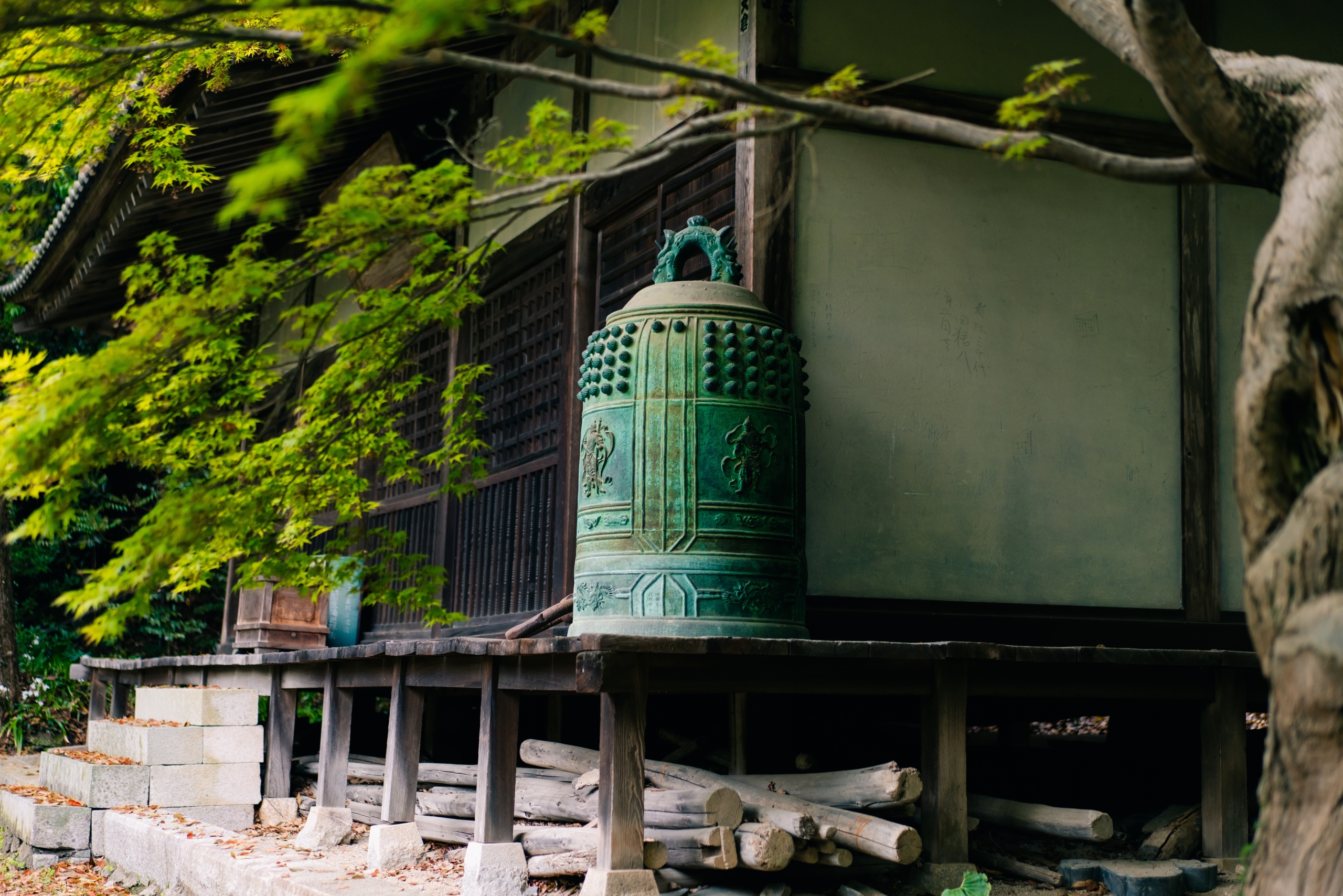
Iyadani-ji occupies position number 71 on the route and also forms part of a much shorter pilgrimage, the Nanakashomairi, which brings together seven temples close to one another.
The circuit begins at Iyadani-ji, in Mitoyo, and ends at Dōryū-ji, in Tadotsu, passing through five other temples in the Zentsūji region, among them the great sanctuary of Zentsū-ji, closely linked to Kūkai, who according to tradition was born in this part of Shikoku.
The route remained popular until the mid-twentieth century and subsequently declined. In 2011 its revitalisation was promoted by introducing images of the seven deities of good fortune, the Shichifukujin, into the temples along the way.
It can now be undertaken as a pilgrimage in its own right. The Kagawa Tourism Office suggests covering its temples in a single day by car or bicycle, while those who prefer to walk can spread the visit over two days.
To prepare for the pilgrimage, the Kagawa Tourism Office provides information on the seven temples, while Zentsū-ji temple explains the history of this circuit and its present-day devotional practices.
Those wishing to visit Iyadani-ji specifically can also consult its official website and Kagawa’s tourist information. The visit requires climbing numerous stone steps, so suitable footwear is advisable, as is allowing time to see the various spaces of the sanctuary.
A Road for Saying Goodbye
Today, the pilgrims who climb the steps of Iyadani-ji find a Buddhist temple surrounded by woods, rock faces and ancient sacred images. Some are completing the Shikoku pilgrimage, while others are walking the seven-temple circuit or have come to pray for their dead relatives.
The mountain continues to form part of a sacred geography, even though the practices of those who reach it have changed considerably over time.
For generations, there were families who walked those roads accompanying, symbolically, the spirit of a loved one. They climbed to the mountain, performed the ceremonies of farewell and then returned to their homes, convinced they had fulfilled a final obligation toward the person who had just died.
In some versions of the ritual, not looking back formed part of that farewell. The gesture expressed the separation between the world of the living and the destiny tradition assigned to the dead.
The roads of Iyadani thus preserve the memory of a particular form of pilgrimage: one in which the traveller set out not to find something they needed for themselves, but to accompany another to the place where, according to their beliefs, they were meant to remain.
AI Transparency Notice
PilgriMaps uses artificial intelligence tools to assist in the research, drafting and translation of editorial content. All AI-assisted content is reviewed, edited and verified by our editorial team before publication. We contrast information against primary sources, specialist literature and on-the-ground knowledge to ensure accuracy, cultural sensitivity and editorial integrity.
AI is one tool among many in our workflow. The judgement, curation and responsibility for everything published on this platform remain entirely human.
Viator Media S.L. — in compliance with the EU Artificial Intelligence Act (Regulation EU 2024/1689).
This post is also available in: