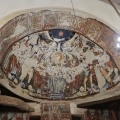
The pilgrim removes their shoes, leaves behind the blinding desert light and enters the Church of the Virgin at the monastery of Deir al-Surian. We are in Wadi el-Natrun, Egypt, the ancient Scetis of the first Christian monks. The eyes need a few moments to adjust to the dimness of the church, which reveals ancient frescoes and icons.
At the far end of the church, in its most sacred part, a great wooden structure marks a boundary. At its centre, six narrow hinged leaves form a door covered with figures, crosses, circles and strange geometries.
It is part of the iconostasis, the barrier that in Eastern Christian churches separates the space where the community gathers from the sanctuary containing the altar. It is not simply a decorative element. It marks a ritual limit between two spaces and regulates access and, at certain moments, the sight of the sanctuary as well. At Deir al-Surian, that boundary took an extraordinary form more than a thousand years ago: a monumental door of wood inlaid with ivory, approximately 2.80 metres high, known today as the Door of Prophecies.
An abuna, a Coptic monk, pauses before it. What he is about to tell immediately transforms those geometries into a narrative.
According to the tradition the monastery preserves, the door represents nothing less than the history of Christianity: its birth, its moments of splendour, the threats it has faced, its divisions and, finally, what is still to come. To understand it, you have to read it from top to bottom.
A History Hidden Among Crosses
It is a composition of six columns and seven rows, divided into panels. The first row is different from all the others. Here we find not only geometries but figures.
At the centre are Mary and Christ Emmanuel. On either side are arranged figures linked to two of the great centres of Eastern Christianity: Dioscorus and Mark point to Alexandria; Ignatius and Severus to Antioch. The choice does not appear accidental. The very arrangement of the figures speaks of the two worlds that met for centuries in this Egyptian monastery: the Coptic and the Syriac. The abuna explains it simply: they are two sister Churches, united by one faith. From there the figures disappear and the enigmas begin.
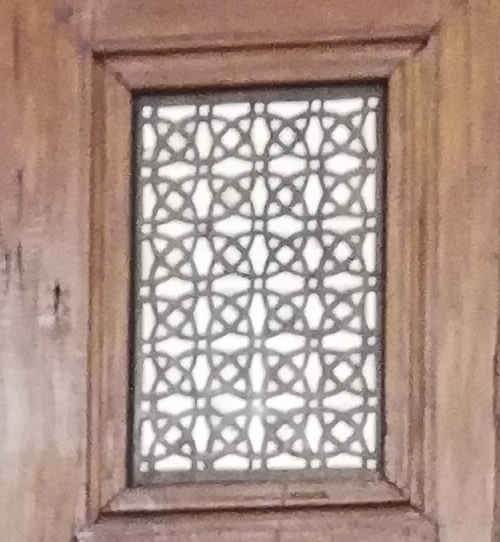
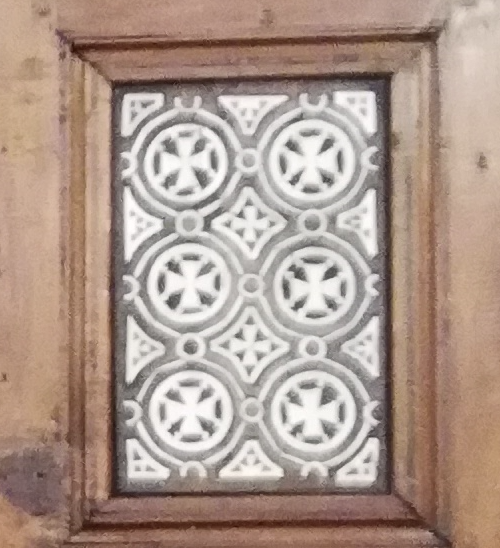
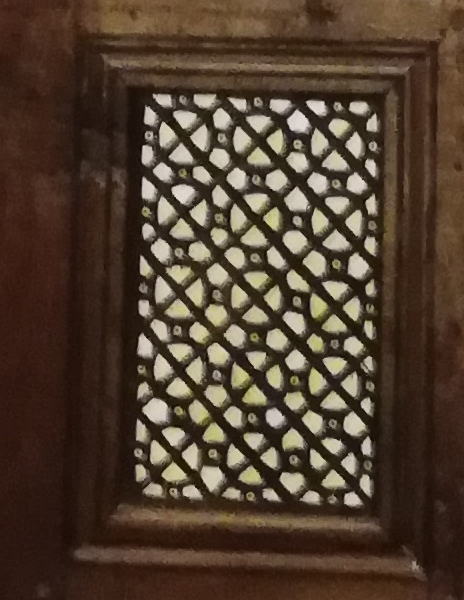
In the second row, large interlaced crosses evoke, in the traditional interpretation, the Christianity of the earliest times: a Church still united and a vigorous faith. In the third, six new combinations of crosses and circles appear, related in the account to the spread of Christianity across the six great episcopal sees of the ancient world and to the change that began in the time of the emperor Constantine, when persecution gave way to religious tolerance and subsequently to the Christianisation of the Empire.
In the fourth, the forms change again: a beautiful cross surrounded by what appear to be crescent moons. For the tradition now transmitted alongside the door, they represent the arrival of Islam in Egypt in the seventh century and the beginning of a new historical stage in which Muslims and Christians would share the same country.
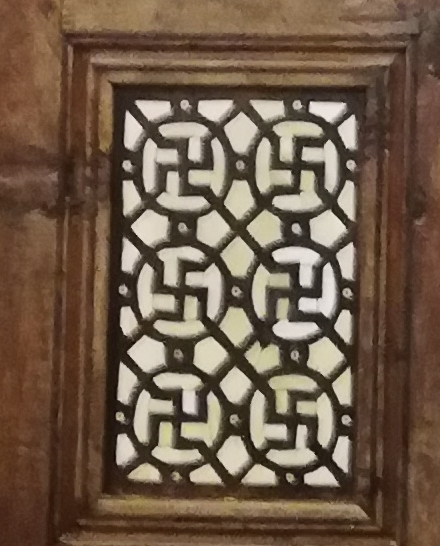
In the fifth panel appears one of the motifs that most startles the modern visitor: swastikas. No, this has nothing to do with Nazi Germany. This geometric motif has a history of millennia and appears in numerous pagan cultures of the East. What is genuinely singular is finding it here, integrated into a Christian decoration of the tenth century. In the monastery’s traditional explanation, these forms of deformed cross evoke heresies, doctrinal deviations and the forces that threaten the Church.
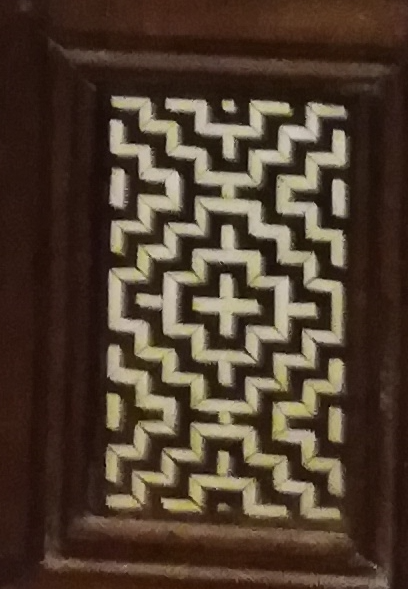
The sixth panel shows a composition without recognisable form, chaotic. The crosses multiply and lose the clarity of the earlier compositions. The abuna sees in them the later divisions of Christianity, the appearance of different Churches and denominations, and the weakening of an original unity.
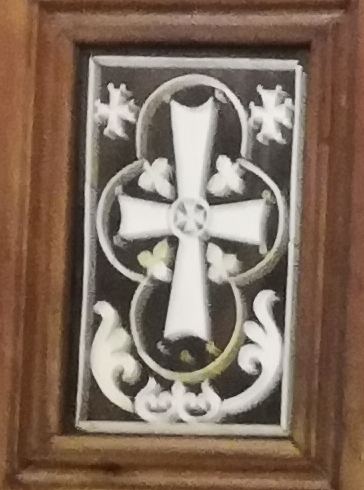
And in the seventh and final panel, a shining cross appears. Tradition relates it to the words of the Gospel of Matthew about the sign of the Son of Man that will appear in the sky. This would be the last scene: the return of Christ, the judgement and the end of history. Hence the name the door bears today.
A Prophecy Written a Thousand Years Ago?
If those designs were made in the tenth century, did their authors really intend to represent events that would occur many centuries later? Here the story becomes more interesting still.
The door is authentically medieval. Its antiquity is not seriously in doubt. But the prophetic interpretation is far harder to document. No tenth-century inscription, medieval manuscript or ancient liturgical commentary has so far been located that explains the seven registers as seven epochs of Christian history. Nor do we know when it began to be called the “Door of Prophecies.” That name is fully alive today and is used by the Coptic Church itself, but its present name does not prove that this was the intention of its craftsmen a thousand years ago.
Hence the importance of weighing the value of oral tradition: we are looking at another layer in the history of the object — an interpretative tradition transmitted and developed at some moment we have not yet identified. To approach what we do know of its origins, we have to return to the year 914.
A Monastery Connected to the World
Wadi el-Natrun may suggest isolation. Desert, silence, monastic communities far from the cities. Yet the monastery of Deir al-Surian reveals a far more cosmopolitan reality. Around the tenth century, Coptic and Syriac traditions coexisted there. Manuscripts circulated and different languages were used. Egypt was connected with Syria and Mesopotamia, and artistic influences reached even into circles connected with Abbasid Iraq.
In that world lived Moses of Nisibis, abbot of the monastery during the first half of the tenth century and a decisive figure in its cultural transformation. Under his direction significant works were carried out and a library was enriched that would end by becoming one of the great treasures of Deir al-Surian.
A Syriac inscription associated with those works provides something extraordinarily precise: a date, 15 May 914. That inscription is the principal basis for dating the sanctuary doors.
Woods That Had Travelled Thousands of Kilometres
The very material of the door tells another story. Each of its six vertical leaves measures approximately 2.80 metres by 47 centimetres and is divided into seven fields: 42 panels in all.
During its study and conservation it was discovered that some traditional descriptions needed revising. The panels, frequently presented as ebony, were identified as padauk, a wood of the genus Pterocarpus. Cedar or cypress was used for the main structure, and the decoration included ivory inlays, many of which have been lost.
Those materials turn the iconostasis into a kind of map. The woods were not local. Nor was the ivory. Their presence speaks of commercial and cultural routes connecting the Egyptian monastery with far distant territories.
We do not even know with certainty where the door was made. Some indications suggest it may have been produced outside the monastery and assembled there afterwards: the frame did not fit the opening perfectly and the space had to be filled in laterally; and during conservation work, carpenters’ marks appeared that seem related to assembly.
There are even small revealing accidents. The inscriptions combine Syriac, Coptic and Greek, and one Coptic letter was set upside down, as though whoever installed it did not know that alphabet well. All of this allows us to imagine a multicultural workshop, or one located outside Deir al-Surian, perhaps connected with the monastery’s extensive eastern contacts. But it does not allow us to identify with any certainty a city or a specific group of craftsmen.
And precisely there lies much of its fascination.
Two Doors in One
More than a thousand years later, the pilgrim still stands before the iconostasis. The figures still occupy the first row. Below them remain the crosses, the circles, the geometries and those symbols whose original meaning may have been lost. The abuna ends his explanation before the last cross.
We can now contemplate the door in two ways.
There is the historical door: the one we can date to 914, linked to Moses of Nisibis and born in a community where Coptic and Syriac cultures met. A work built with woods that came from far away, enriched with ivory and conceived to mark the threshold of the sanctuary.
And there is the narrated door: the one that later generations have contemplated as a representation of the whole of Christian history, from the apostles to the end of time.
That adds a final paradox to the Door of Prophecies. An iconostasis is meant to mark the boundary between what is visible and what remains hidden. And after more than a thousand years, this door continues to do exactly that. We can see its images, but what remains behind them is its mystery.
AI Transparency Notice
PilgriMaps uses artificial intelligence tools to assist in the research, drafting and translation of editorial content. All AI-assisted content is reviewed, edited and verified by our editorial team before publication. We contrast information against primary sources, specialist literature and on-the-ground knowledge to ensure accuracy, cultural sensitivity and editorial integrity.
AI is one tool among many in our workflow. The judgement, curation and responsibility for everything published on this platform remain entirely human.
Viator Media S.L. — in compliance with the EU Artificial Intelligence Act (Regulation EU 2024/1689).