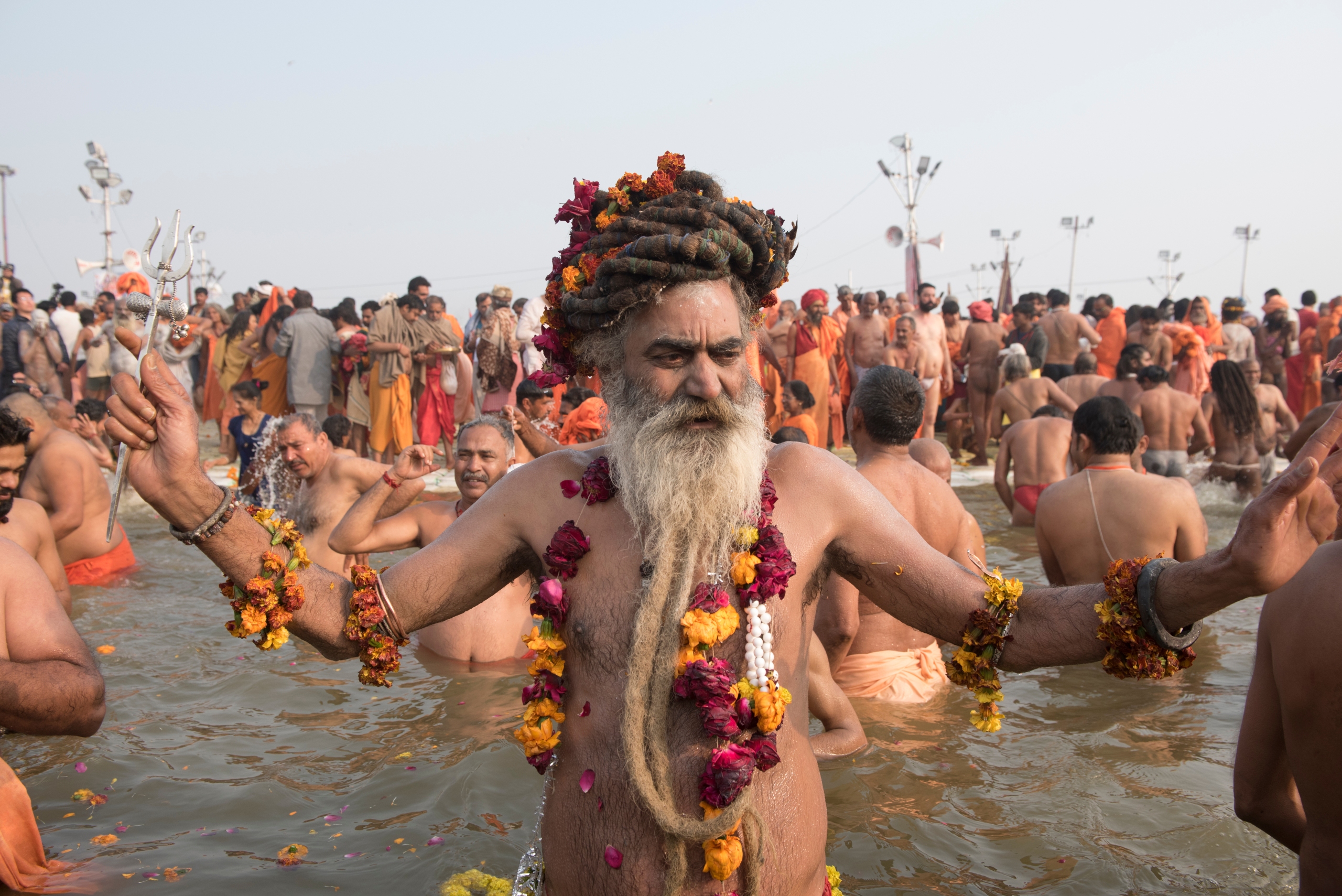
At the beginning of 2025, at the confluence of the Ganges, the Yamuna, and a mythical invisible river — the Sarasvati — the largest human gathering in the history of the species assembled. The Maha Kumbh Mela of Prayagraj, India, drew an estimated six hundred and sixty million people over forty-five days, all coming to immerse themselves in sacred waters at an astrological moment calculated by Brahmin priests. To give a sense of scale: it is as though the entire population of Europe, plus the United States, had bathed in the same river within a few weeks.
In the same year, nearly ten thousand kilometers away, 530,987 people reached Santiago de Compostela on foot, walking alone or nearly so for weeks along country paths. Two events both called “pilgrimage” — and yet entirely different in duration, rhythm, relationship to the body, to the crowd, to time. The planet is living through a genuine return of pilgrimage. But it would be a tourist’s mistake to assume that everyone goes on pilgrimage in the same way. Different grammars of sacred walking exist, and telling them apart is the way to understand whole cultures.
Walking versus arriving
The first great division is between pilgrimage as journey and pilgrimage as absolute destination. The European model — the Camino de Santiago, the Via Francigena, and many other routes — places its value in the passage: what counts is the kilometers, the accumulated effort, the slow transformation along the road. It is no coincidence that a certificate, the Compostela, is issued to those who can demonstrate they have walked at least the final hundred kilometers. Here, the sacred is a verb: it is enacted by walking.
The Muslim Hajj operates on a different logic. The approximately 1.8 million pilgrims of 2024 travel to Mecca to perform, in a specific place and on specific days, a ritual sequence codified over centuries: the tawaf, the seven circuits around the Kaaba, the running between the hills of Safa and Marwa, the standing on the plain of Arafat. The value lies not in the journey of approach but in the precise execution of the rite upon arrival.
The Indian Kumbh Mela is something else again. Everything turns on the act of immersion, performed by millions of bodies almost simultaneously at the moment judged most propitious.
There is even a difference in the direction of movement that reveals distinct cosmologies. Muslim pilgrims circle the Kaaba counterclockwise. Hindu and Buddhist devotees perform the pradakshina or kora keeping the sacred to their right, moving clockwise. The same action — circling a holy center on foot — and two opposite ways of understanding the relationship between the human and what exceeds it.
The threshold and its correction
For decades, anthropology had an elegant theory for explaining why pilgrimage, across such different cultures, produces such similar effects. Victor Turner formulated it in the 1970s. The pilgrim, he argued, enters a liminal state — a state of threshold: they leave behind their social role, their ordinary clothing, their hierarchies, and for the duration of the journey become equal to all others. From this shared nakedness arises communitas — a horizontal, intense, and temporary bond between strangers whom ordinary life would keep apart. Anyone who has slept in a Camino hostel, or seen photographs of millions of Indians bathing side by side with no apparent distinction of caste, will recognize that feeling.
The theory, however, has been revised by subsequent anthropologists. Studying major sanctuaries, John Eade and Michael Sallnow showed that pilgrimage is also — and often primarily — an arena of competing meanings: the faithful and the priest want different things, the tourist and the devout coexist uneasily, the state and the church contest the meaning of the place (Contesting the Sacred, 1991). Not only brotherhood, then, but also tension and negotiation. What is interesting is that both truths hold simultaneously: pilgrimage unites and divides in the same moment, and it is perhaps this ambiguity that keeps it so alive.
The pilgrim who no longer believes — and walks anyway
The most revealing new development, and the most telling about our era, concerns who today’s pilgrims actually are. In Japan, on the ancient Kumano Kodo, the tourist office itself acknowledges that the great majority of those who walk those paths are not pilgrims in any formal religious sense: they come to enter a forest that has been alive for a thousand years. On the Camino de Santiago, the proportion of those declaring purely or partially non-religious motivations grows year by year. The Via Francigena saw arrival certificates in Rome exceed twelve thousand in 2025, while it is estimated that up to one hundred thousand people walked some portion of the route without requesting any documentation at all.
A category is emerging that would once have seemed contradictory: the secular pilgrim. They walk for the same deep reasons as always — to seek meaning, to process grief, to mark a life transition — but without a doctrine to tell them where they are going. The rite survives the faith that generated it, exactly as happens with the most living traditions. The vessel holds even when the contents change.
One question remains for anyone who plans destinations, narrates territories, or seeks their own road. If six hundred and sixty million people immerse themselves in a river and half a million walk for weeks toward the same cathedral, and all of them call what they are doing “pilgrimage,” perhaps the word indicates neither a place nor a god, but an ancient human need to put the body in motion toward something larger than itself. The question, then, is not where we are going. It is why, in an age that has everything available at the touch of a screen, we still feel the need to go there on foot.
Sources: Maha Kumbh Mela 2025 attendance estimates (Prayagraj); Hajj 2024 data (Saudi authorities); pilgrim statistics, Oficina de Acogida al Peregrino (Santiago) and Testimonium della Via Francigena, 2024–2025; V. Turner, The Ritual Process (1969) and Image and Pilgrimage in Christian Culture (with E. Turner, 1978); J. Eade and M. Sallnow, eds., Contesting the Sacred: The Anthropology of Christian Pilgrimage, 1991; Kumano Kodo tourism office data and framing.
AI Transparency Notice
PilgriMaps uses artificial intelligence tools to assist in the research, drafting and translation of editorial content. All AI-assisted content is reviewed, edited and verified by our editorial team before publication. We contrast information against primary sources, specialist literature and on-the-ground knowledge to ensure accuracy, cultural sensitivity and editorial integrity.
AI is one tool among many in our workflow. The judgement, curation and responsibility for everything published on this platform remain entirely human.
Viator Media S.L. — in compliance with the EU Artificial Intelligence Act (Regulation EU 2024/1689).
This post is also available in: