At nine in the evening, in Ħal Qormi or Ħaż-Żebbuġ, the air smells of burnt sulfur and toasted almonds. The fireworks have just stopped lighting up the bell tower, the band is still playing in the square, and under the wooden stalls someone is slicing a white, elastic mass, still warm at the center. This is qubbajt, Maltese nougat, marking the moment when the village patronal feast — one of the nearly ninety that light up the villages of Malta and Gozo between May and October — has truly begun.
The folklorist Ġużè Cassar Pullicino wrote it down with the dryness of someone who has no need to persuade anyone: “Festa bla qubbajt mhix festa,” a feast without nougat is not a feast. The phrase has become a small piece of popular canon, still repeated today by those who organize the archipelago’s patronal celebrations.
Understanding a religious feast, or a pilgrimage that shares its processional structure, often means beginning with what people eat while living it. In the case of qubbajt, that food carries seven centuries of Mediterranean routes. The name comes from the Arabic qubbayt, the same linguistic root from which the Sicilian cubbaita descends, a sweet made with almonds and honey that is still prepared at Christmas on the neighboring island.
Food historians place this nougat within the Arab culinary tradition that spread through medieval Spain and Sicily, from where Arab rule over Malta and the island’s close ties with Sicily brought it into the local cuisine. The same root produced Spanish turrón, Catalan torró, Italian torrone, and Greek pasteli: a confectionery family that follows almost exactly the routes of Arab-Norman trade.
In Malta, the first documented trace dates back to the rule of the Knights of St. John: records from the period mention a cobaytaro, a nougat seller, active at least from 1580. Two centuries later, the Maltese philosopher and linguist Mikiel Anton Vassalli described a variant made with sesame seeds, almonds, honey, and sugar, cooked until brittle and known as qubbajt tal-penit, a recipe that still survives alongside the soft version.
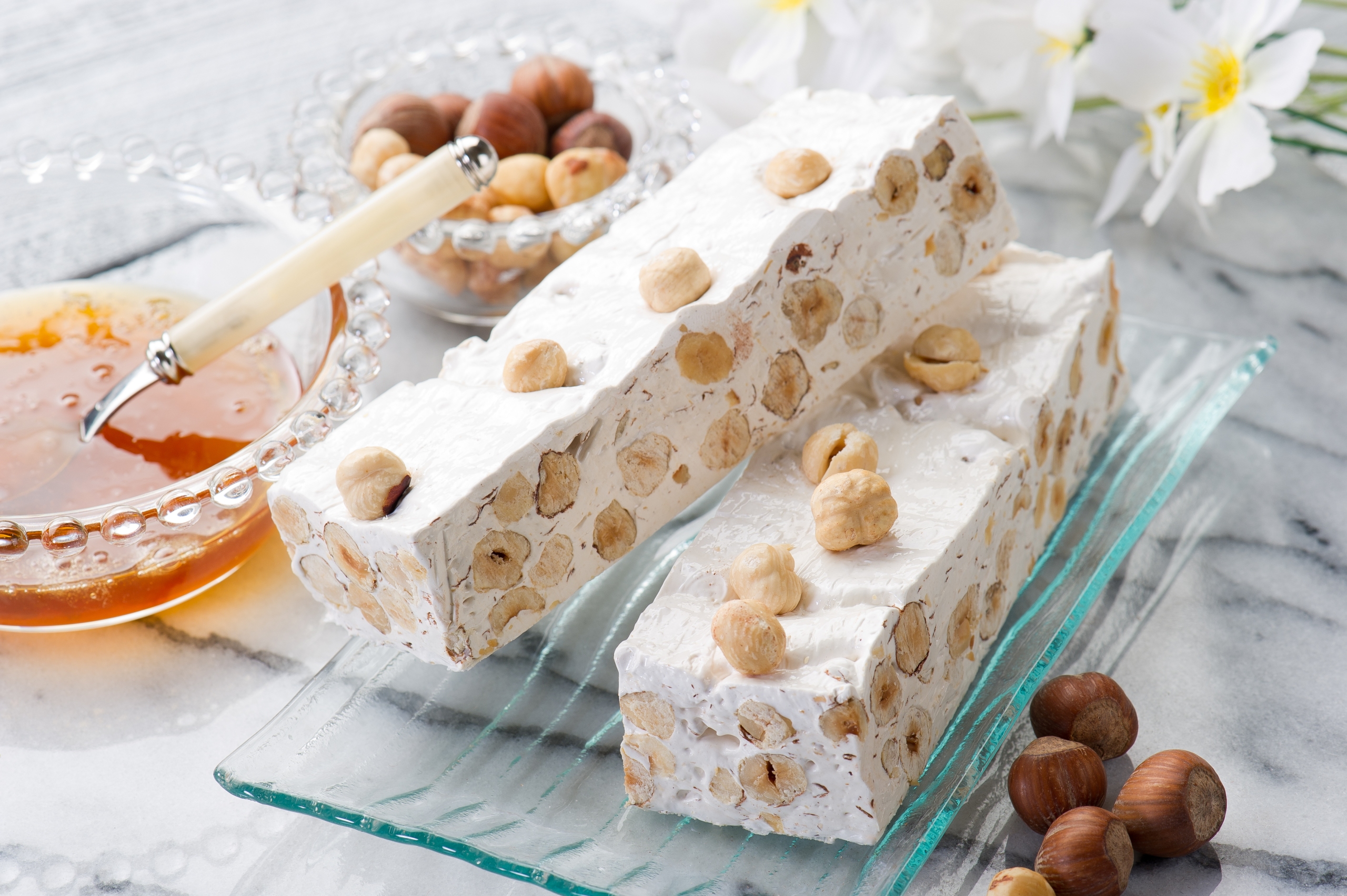
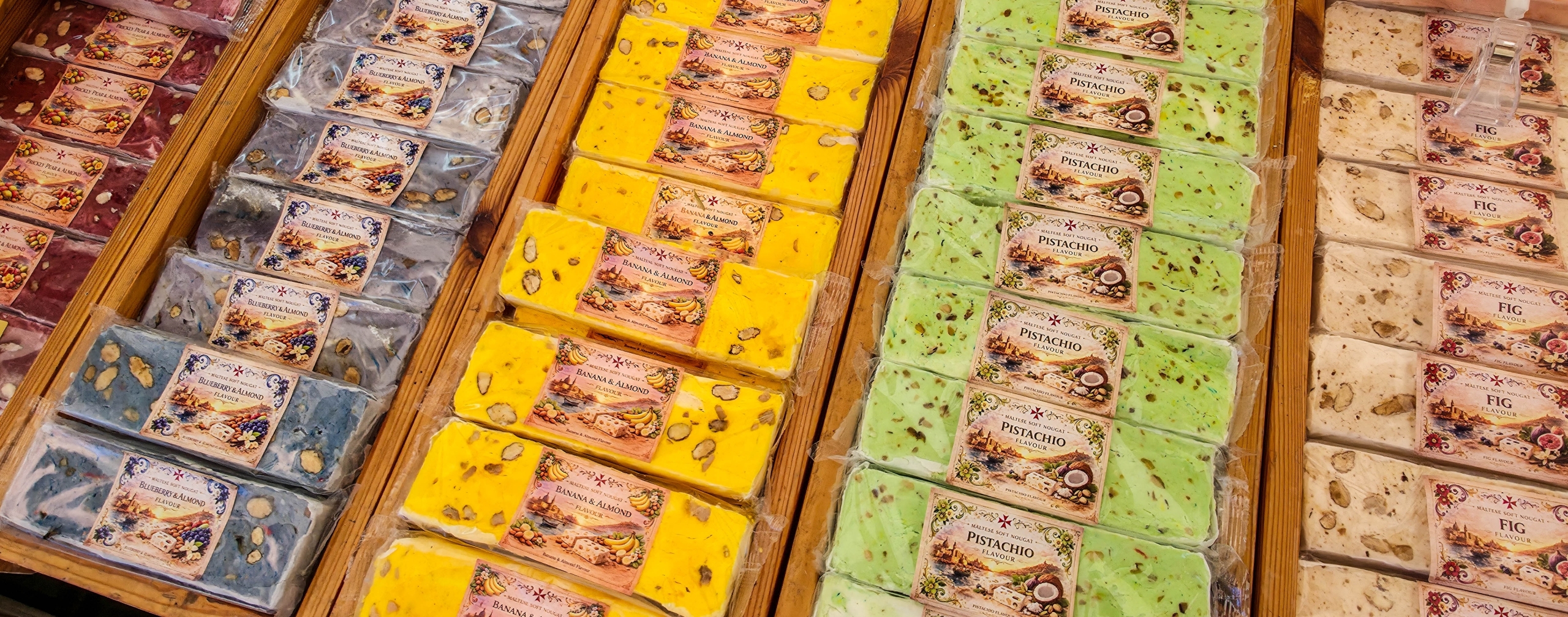
Under the stalls, in fact, two textures coexist. The dark nougat, made with almonds, hazelnuts, cashews, and sesame seeds bound with caramel, remains closest to the historic recipe and is still the preferred version at the feasts of Mellieħa and Gozo. The white nougat, made by whipping egg white with sugar syrup and honey, is now the most widespread on the main island. Finally, there is a small version, without nuts, wrapped in shiny colored paper, which the Maltese call peniti: children’s nougat, sold piece by piece in front of the church during the procession.
In Rabat, on the island of Gozo, the Caruana family has been making it for more than thirty years. Robert took over his father’s workshop thirty-three years ago, and still today he spreads the hot mixture on a marble surface and cuts it by hand into regular bars. In an age of industrial production, that gesture remains one of the few still tied almost entirely to the manual work of a handful of families scattered across the two islands.
In December 2023, UNESCO inscribed the Maltese festa, il-Festa Maltija, on the Representative List of the Intangible Cultural Heritage of Humanity: Malta’s third entry after ftira bread in 2020 and għana singing in 2021. The nomination file, promoted by the Malta Band Clubs Association with the support of the Curia, describes the festa as a “community event of religious origin” transmitted from generation to generation through band clubs and families. Qubbajt remains outside the text of the nomination, but inside every ethnographic description of the festa, because religious celebrations are also remembered through taste, and the flavor of a sweet tied to a precise place and date often becomes a long-lasting mnemonic anchor.
The language changes from one end of the Mediterranean to the other, the name changes, but the architecture remains: almonds, honey or sugar, and a devotion that melts in the mouth.
The recipe
This is the historic version of hard qubbajt, the one closest to Maltese family recipes, made with toasted almonds or hazelnuts.
Ingredients
For a medium baking tray:
* 800 g sugar
* 300 g toasted almonds or hazelnuts; sesame seeds may also be used
* 1 teaspoon freshly ground cinnamon
* 250 ml water
* One sheet of wafer paper or rice paper for lining the bottom of the tray
* Neutral oil for greasing the work surfaceMethod
1. Grease a shallow tray with a thin layer of oil, line it with parchment paper, and then with a sheet of wafer paper.
2. Dissolve the sugar in the water over low heat in a heavy saucepan, moving the pan without stirring, until it reaches 154 °C.
3. Lightly grease a marble surface with a thin layer of oil and water, spread the toasted almonds over it, and sprinkle with cinnamon.
4. Pour the boiling syrup over the almonds and work the mixture with two spatulas, folding it over itself.
5. When it begins to harden, transfer it to the tray lined with wafer paper, press it down well, and let it cool completely before cutting it into bars.
Those who prefer the soft white version, now the most common at festa stalls, replace part of the sugar with honey, incorporate whipped egg white into the hot syrup before adding the almonds, and obtain a lighter, more elastic nougat, which is wrapped while still warm in a second sheet of wafer paper.
All that remains is to taste both versions and decide which one to take home as a gift for loved ones.
Sources
* GuideMeMalta.com, “A sweet tradition: festa nougat”
* KM Malta Airlines, “Sweet traditions”
* Oh My Malta, “Qubbajt: Traditional Maltese Nougat”
* It-Tokk Gozo, “Traditional nougat and the Maltese feasts”
* Wikipedia, “Nougat”
* Wikipedia, “Turrón”
* UNESCO Intangible Cultural Heritage, Decision 18.COM 8.b.43, Maltese Village Festa
* The Malta Independent, “The Maltese Festa officially recognised as Intangible Cultural Heritage of Humanity by UNESCO”
* Vassallo History, “Maltese Traditional Recipes,” historic qubbajt recipe
AI Transparency Notice
PilgriMaps uses artificial intelligence tools to assist in the research, drafting and translation of editorial content. All AI-assisted content is reviewed, edited and verified by our editorial team before publication. We contrast information against primary sources, specialist literature and on-the-ground knowledge to ensure accuracy, cultural sensitivity and editorial integrity.
AI is one tool among many in our workflow. The judgement, curation and responsibility for everything published on this platform remain entirely human.
Viator Media S.L. — in compliance with the EU Artificial Intelligence Act (Regulation EU 2024/1689).
This post is also available in: