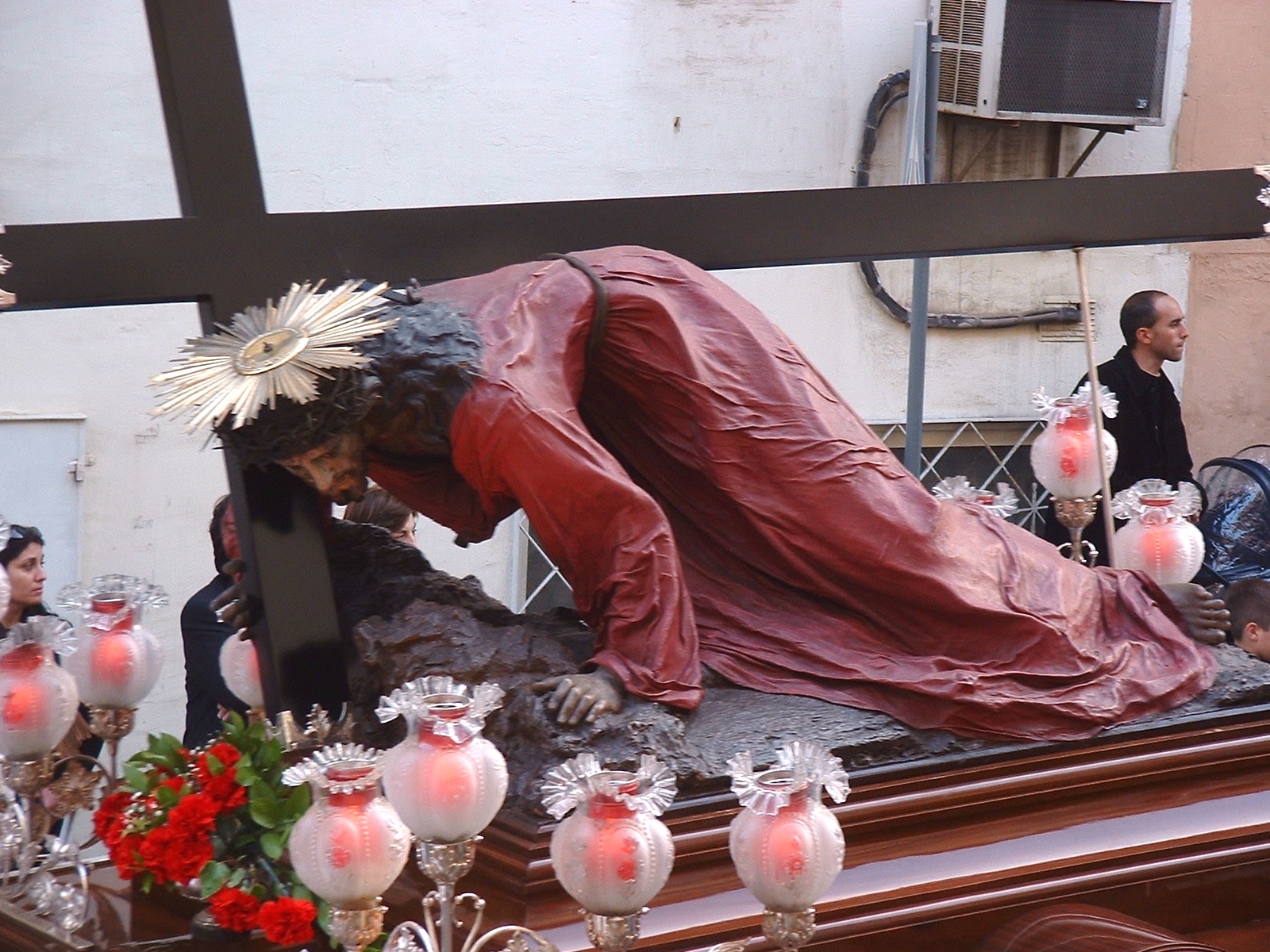
In one of the smallest towns in Malta, half a square mile of limestone jutting into the Grand Harbour, there is a side room off a basilica where a man is falling.
He has not fallen yet. He is on one knee, the cross still across his shoulder, caught in the instant before the ground takes him. And he is looking up — not at the cross, not at the road ahead, but out, at whoever happens to be standing there.
“His gaze is so profound that you are almost afraid to look at Him,” one devotee told TVM News during the statue’s restoration. She is not the first person to say something of the kind. For nearly three centuries, the people of these islands have been coming to Senglea to stand in front of this face, and a great many of them have gone away convinced that something looked back.
This is Ir-Redentur ta’ l-Isla, the Redeemer of Senglea. It is, by a wide margin, the most venerated effigy in Malta, and one of the most remarkable pilgrimage destinations in the Mediterranean — which is a strange thing to say about a life-sized wooden statue in a town you can walk across in fifteen minutes.
A statue nobody claims
The documented facts are few, and the gap where the facts should be is part of the story. The statue was commissioned by the Confraternity of the Holy Crucifix in 1742, as one figure in a set of Passion statues for the Good Friday procession. Seven statues, of which this was to be one among several. No records have been found about its origins, and its maker is unknown.
Think about what that means. The most beloved sacred object in the country, carried through the streets by men who consider it the honour of their lives, prayed before daily for two hundred and eighty years — and nobody knows who carved it. Somebody sat in a workshop in the 1740s and made this face, and their name is gone.
Whoever they were, they did something the commission did not require. A Passion set needs a figure of Christ carrying the cross. What they produced instead was a man looking directly out of the scene at the person watching it. That is not a compositional choice for a processional statue, which is meant to be seen in motion from a distance. It is a choice for a room.
And within a very short time, the room is what it got. The statue outgrew the set almost immediately. Its forgotten history has since been reconstructed in a scholarly volume, Ir-Redentur: History, Art and Cult of the Miraculous Effigy of Christ the Redeemer at Senglea, published by Midsea Books with the Chapter of the Basilica.
The Vow
The decisive moment came in 1813, and it came out of catastrophe. Plague swept Malta that year and killed thousands. In Senglea, the clergy and the people made a solemn vow: if the town were spared, a procession of devotion would be held every June, on the third Sunday after Pentecost, in perpetuity. Senglea was spared.
The procession has been kept ever since, more than two centuries of it, and the Maltese call it the Feast of Vows. Halfway down Victory Street there is a statue of the Madonna — il-Madonna tan-Nofs, the Madonna halfway along — raised in thanksgiving for the same deliverance. The town wrote its gratitude into its own street plan.
Devotion had already been growing before that. Within sixty years of the statue’s making, Pope Pius VII had granted permission for an annual feast in its honour after the Easter season. But 1813 turned a local cult into a national one. From that point the Redeemer belonged not to Senglea but to Malta, and the ex-voto offerings — the silver hearts, the crutches, the photographs, the written thanks of people who believe they were healed — began to accumulate in numbers that have never stopped growing.
The Bomb
Then came the second catastrophe, and it very nearly took everything. The basilica was consecrated in 1743, granted the title of basilica by Benedict XV in 1921, and destroyed in an air raid in January 1941. Senglea, sitting on the Grand Harbour beside the dockyards, was among the most heavily bombed places on earth during those years.
Joseph Zarb, who was a boy then and eighty-nine when he told the story to TVM News, remembered the fear that gripped the city when a bomb fell on the basilica while the statues of the Redeemer and Our Lady were inside. When the basilica was destroyed, everyone asked the same question: what had happened to the Redeemer?
They got him out. “But we managed to save them,” Zarb said. “The devotion grew even stronger during the war, especially here in Senglea.” That is the detail that explains Senglea. A town reduced largely to rubble, its basilica gone, and what the survivors wanted to know first was whether the statue had come through. It had. The church was rebuilt and reopened in 1956, and the Redeemer went back into his oratory.
The rhythm of the year
For most of the year the statue stays where it belongs: the Oratory of the Confraternity of the Crucifix, annexed to the basilica. And people come — every day of the week, and particularly on Fridays, from all parts of Malta and Gozo, to pray and give thanks before it.
That daily, unspectacular traffic is the real heart of it. Not the great occasions — the woman who comes in on a Friday morning on her way somewhere else, sits for ten minutes, and leaves.
Three times a year the statue comes out. During Lent, when it is brought into the church to join the six other Passion statues, and for the national pilgrimage that draws enormous crowds walking behind it through the streets. Fr Robin Camilleri told TVM that the parish keeps the church open from half past six in the morning until half past eight at night, so that people can come in the quieter hours of the afternoon and evening.
On Good Friday, in the procession it was originally made for. And in June, on the Sunday following the solemnity of the Sacred Heart — the third Sunday after Pentecost — for the Feast of Vows, keeping the promise made in 1813. It has also, on occasion, travelled. In May 2000 it went to Qala in Gozo, and people who were there still talk about it.
Senglea itself
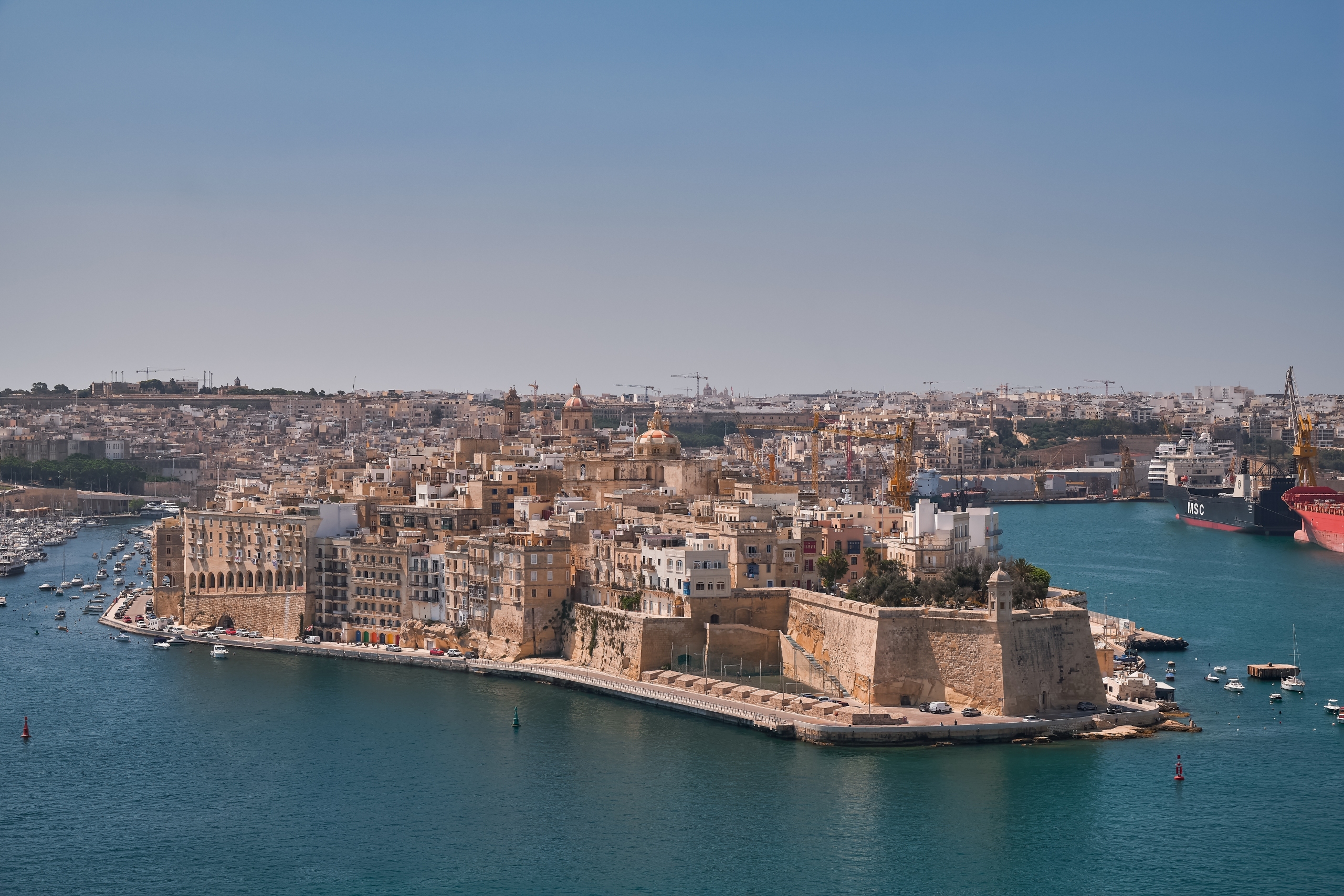
The setting deserves its own paragraph, because it is not incidental. Senglea — L-Isla in Maltese, and Città Invicta, the Unconquered City — is the smallest locality in Malta, just over half a square mile. It is one of the Three Cities on the far side of the Grand Harbour from Valletta, and it held out through the Great Siege of 1565 alongside Birgu, which is how it earned its title.
The basilica is dedicated to the Nativity of the Virgin, Marija Bambina, whose feast falls on 8 September — the same date that carries Malta’s memory of 1565, of 1800, and of 1943. Senglea therefore has two patrons, the Child Mary and the Redeemer, and a calendar in which deliverance is the recurring theme: from the Turks, from the plague, from the bombing.
You enter through the Knights’ gate. You walk down the main street past street-corner niches and old houses that survived the war, past the Madonna halfway along, to the basilica. Beyond it the town narrows to a point and the harbour opens out, with Valletta’s bastions directly opposite.
The Camino Maltés ends its Maltese section at Fort St Angelo in Birgu, next door. Anyone walking it is already within a few minutes of the oratory.
Visiting
The basilica stands at the centre of Senglea, reachable on foot from Birgu or by the traditional dgħajsa ferry across the Grand Harbour from Valletta — which is the way to arrive if you have any choice in the matter.
The oratory is generally accessible when the church is open.
Fridays carry the strongest devotional traffic, and on the Lenten pilgrimage day the church opens from 6.30am to 8.30pm.
This is an active shrine, not a monument. Dress accordingly, keep quiet, and be careful about photographing people at prayer.
What it is really for
Malta has grander churches. St John’s in Valletta has Caravaggio and a floor of inlaid marble tombstones. Mosta has the dome. Ta’ Pinu has the basilica on the Gozitan hillside and the Pilgrim’s Way. Senglea has a room, and a face in it.
There is a particular logic to what the unknown carver made. He did not give Malta a triumphant Christ, or a dead one. He gave them a man at the moment of collapse, who is still looking at you, and who has not let go of the thing he is carrying.
An archipelago that has been besieged, starved, plagued and bombed understood that figure immediately, and has not stopped coming to see him since. Whatever else is happening in the Mediterranean, in the oratory at Senglea somebody is always kneeling in front of a man who is falling and has not fallen yet.
That is what the ex-votos are for. They are a record of everyone who came in with something too heavy and found it bearable enough to walk back out.
AI Transparency Notice
PilgriMaps uses artificial intelligence tools to assist in the research, drafting and translation of editorial content. All AI-assisted content is reviewed, edited and verified by our editorial team before publication. We contrast information against primary sources, specialist literature and on-the-ground knowledge to ensure accuracy, cultural sensitivity and editorial integrity.
AI is one tool among many in our workflow. The judgement, curation and responsibility for everything published on this platform remain entirely human.
Viator Media S.L. — in compliance with the EU Artificial Intelligence Act (Regulation EU 2024/1689).
This post is also available in: