The wooden churches of Chiloé are UNESCO World Heritage. They are also not the only jurisdiction on the archipelago.
Walk into the forest on any of the islands and you enter territory belonging to somebody else. Cross the channels at night and you may see lights and hear music from a ship that should not be there. And for roughly a century and a half, if you had a dispute with a neighbour in Chiloé, you had a choice of two legal systems — the Chilean one in Ancud, and another one, older and considerably more frightening, that met in a cave.
This is not folklore in the decorative sense. Memoria Chilena, the Chilean national library’s digital archive, describes a world of water and forest divinities coexisting without difficulty alongside Catholic devotion; magical formulae halfway between the medieval imagination and the Mapuche-Huilliche world; and sorcerers and shamans whose authority came to exceed that of the Chilean state itself.
That last clause is not a metaphor. There was a trial.
Where It Comes From
Chilote mythology is a fusion, and you can name the ingredients fairly precisely. The substrate is indigenous. When the Spanish arrived, Chiloé was inhabited by Chonos, Cuncos and Huilliches, each with their own religious traditions — and in the Huilliche case, connected to the broader Mapuche world of the southern mainland.
The overlay is Spanish, and it arrives with the conquest of Chiloé beginning in 1567: not the theology of the Council of Trent but the working supernatural beliefs of sixteenth-century Iberian peasants and sailors — witches who fly, pacts with the Devil, ships that appear in fog.
And then the third ingredient, which is the decisive one: isolation. Chiloé was the far edge of the Spanish empire, reachable only by sea, in a climate that closes the channels for months. It was the last royalist stronghold in South America, holding out until 1826, years after the rest of the continent had gone. Whatever arrived there stayed there and fermented.
There is a fourth factor, and readers of our piece on the wooden churches will recognise it. Under the Jesuit misión circular, a priest reached most communities once a year. The rest of the time, Catholicism was run by the fiscales, lay leaders holding the keys. That arrangement kept the faith alive. It also left an enormous amount of supernatural territory unsupervised.
Into that space came a full second population.
The Serpents and the Sea
The origin story is Huilliche and explains the geography. Two serpents fought at the beginning of the world: Caicai Vilú, the serpent of the waters, and Tentén Vilú, the serpent of the earth. Caicai raised the sea to drown the land; Tentén raised the land to save what lived on it. The struggle went on until both exhausted themselves.
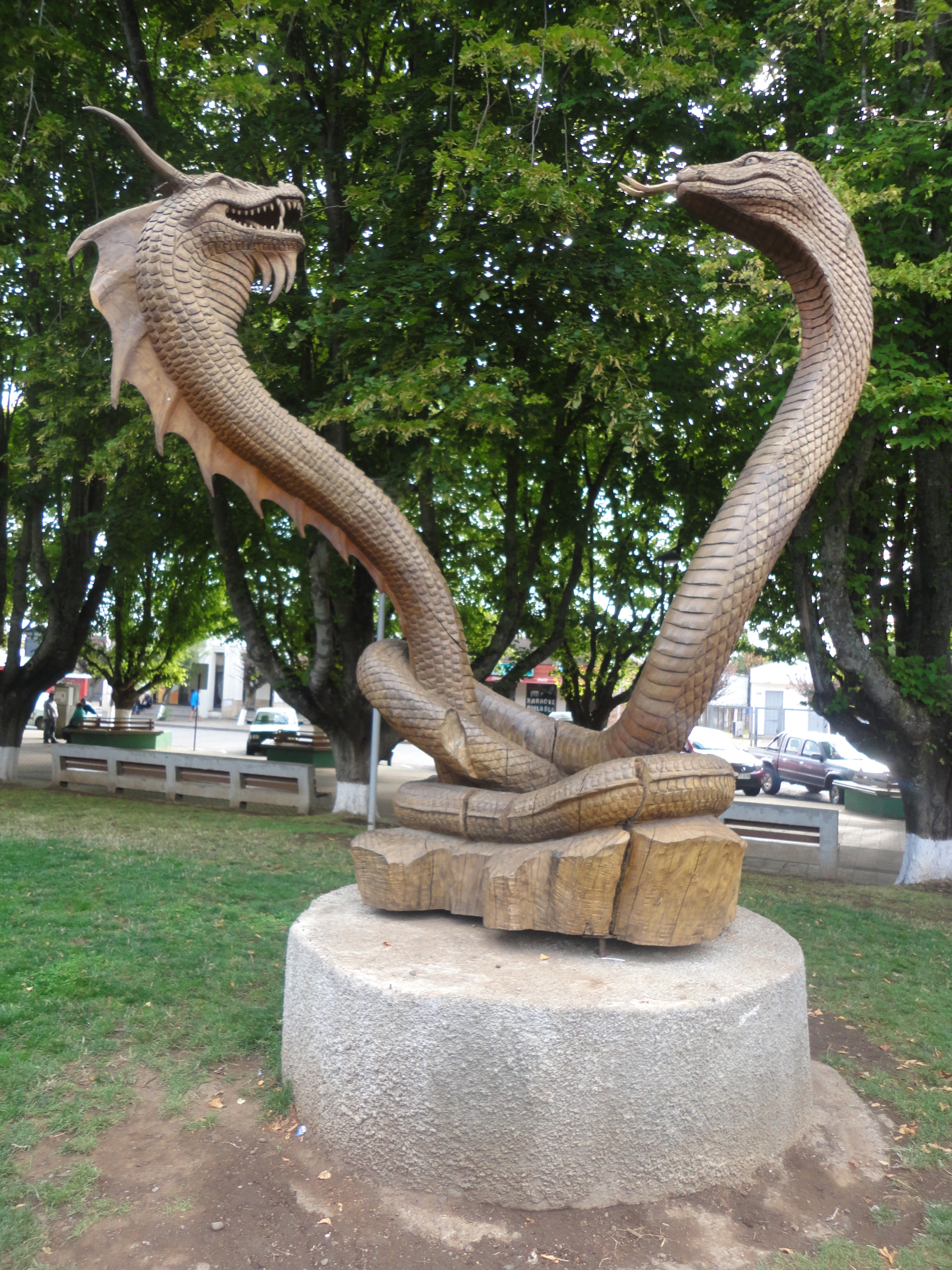
What was left when the water settled is Chiloé — an archipelago of drowned mountains, the peaks that Tentén managed to lift above the flood. The myth is a geological account, and a fairly good one.
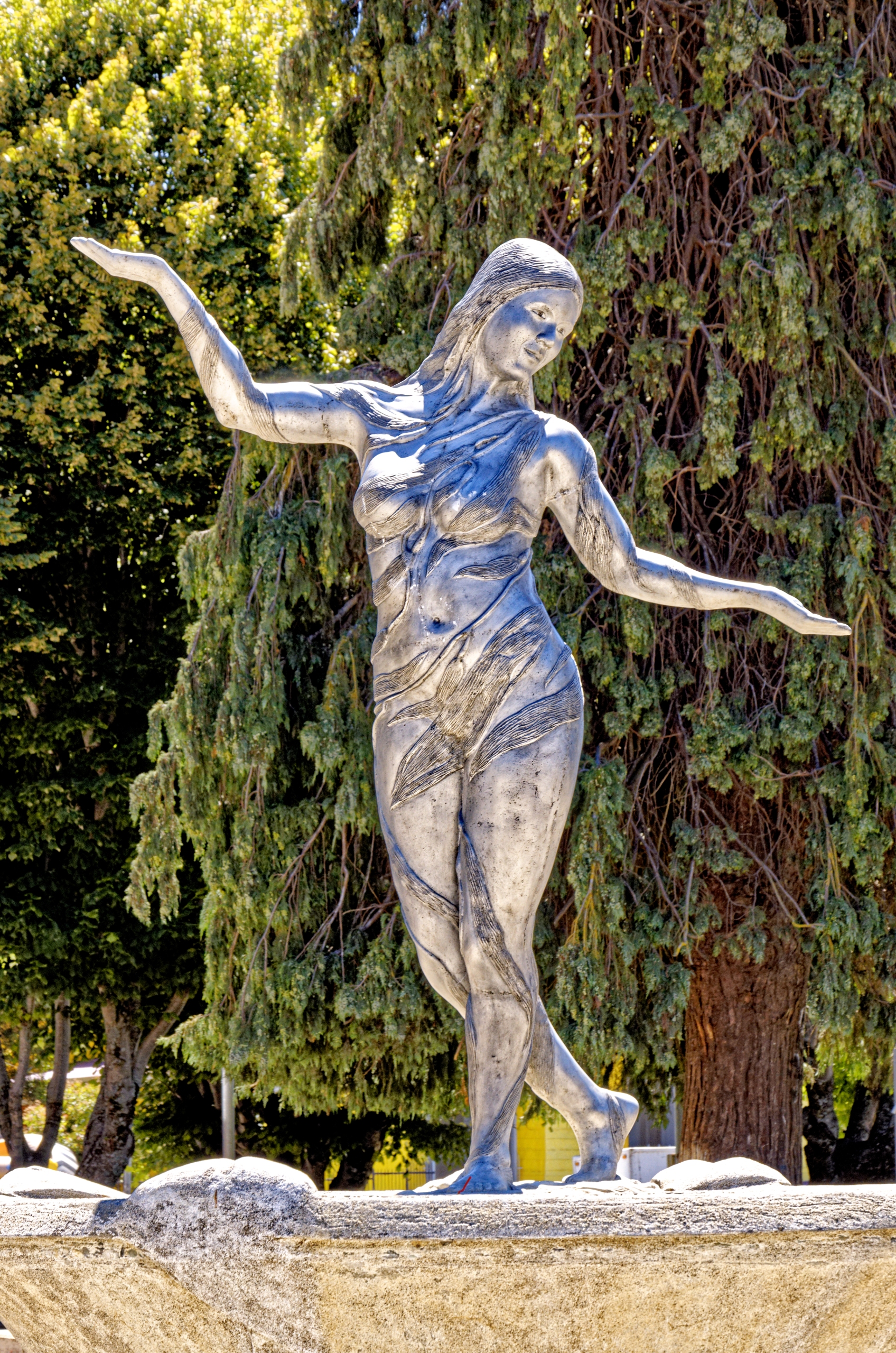
The sea it produced is ruled by the Millalobo, king of the waters, with his wife Huenchula and their three children: the Pincoy, the Sirena chilota, and the Pincoya, who appears as a beautiful young woman with long fair hair and who dances on the shore. The direction she faces determines the catch. Toward the sea means abundance; toward the land means the fishing will fail.
You can see exactly what that myth is for. It gives a community entirely dependent on unpredictable fish stocks a way of talking about scarcity that is neither anyone’s fault nor entirely random.
And then there is El Caleuche — the ghost ship, the Buque de Arte, which passes through the channels carrying music and light, visible on foggy days, announced by the sound of chains and celebration. Its crew are drowned sailors. It is the reason a drowning in Chiloé is not necessarily a death: the Millalobo’s ship may have taken them. Sorcerers can board it without becoming slaves, and they are ferried out to it on the Caballo Marino Chilote, the Chilote sea horse.
The Forest
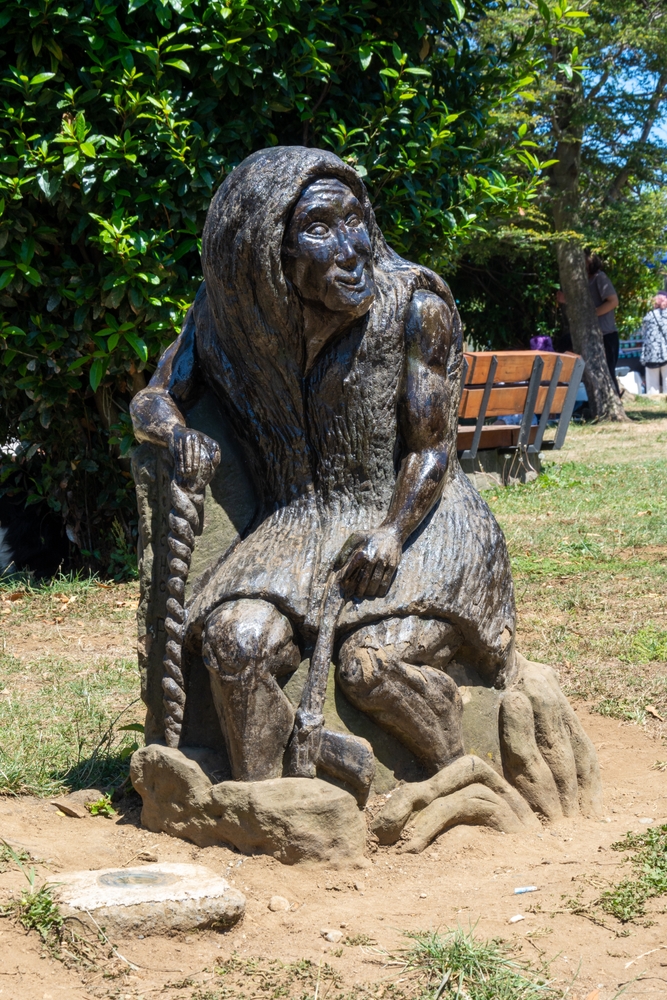
The sea produces beauty. The forest produces something else. El Trauco is a short, powerful, deformed being of the deep woods who arouses desire in women and is aggressive toward men. He carries a stone hatchet, is said to be able to twist a man’s spine with a look, and enchants young women who sleep alone.
It has to be said plainly what this myth was used for. In a small, Catholic, intensely observed island society, the Trauco was the explanation offered when an unmarried woman became pregnant, and it removed her from blame entirely — which is, in one sense, merciful. In another sense, and anthropologists have been direct about this, it provided a supernatural name for assaults that had entirely human perpetrators, frequently within the household. The Trauco is the most famous figure in Chilote mythology and the least charming once you look at it steadily.
His wife is La Fiura, who does the reverse: hideous, foul-breathed, she seduces men and leaves them deformed or insane. Around them move the rest — the Camahueto, a horned creature that tears its way to the sea; the Basilisco chilote, hatched from a hen’s egg, which drains the breath of sleeping people; the Peuchén; the Chonchón, a head that detaches and flies; La Voladora, the witch’s messenger who vomits her intestines to take flight. And the Tempilcahue, the ferryman who carries souls to the other world.
The Cave, and the Book
Which brings us to the sorcerers, and to the part of this that is documented history.
The origin story is itself a fusion. In 1786 the Basque navigator José de Moraleda y Montero visited Chiloé and, by legend, was defeated in a contest of powers by the Huilliche machi Chillpila. She sank his ship; he handed over a European book of magic, the Libro de Arte.
In a single story: Spanish learning surrendering to indigenous power, and the sorcery of Chiloé born from the transaction.
What the brujos became is stranger than the legend. They organised. Grouped into a secret society called La Recta Provincia, popularly known as La Mayoría, they maintained a complex organisation — with a jurisdiction extending across the archipelago, headed by a King who with his subordinates formed a governing council.
La Recta Provincia: the Righteous Province. A shadow government with a name that claimed legitimacy.
Its seat was the cave at Quicaví. According to tradition the entrance lay in a ravine and was guarded by a deformed being, the Invunche. There were kept the Book, the Levisterio or Revisorio — an instrument for examinations — and the Chayanco, used to keep watch over every member of the community of sorcerers.
The Invunche deserves its own note, because it is the most disturbing figure in the whole system. The name comes from Mapudungun ifünche, “deformed person.” Tradition holds it was made by taking a firstborn child and breaking and twisting the body over years until it could no longer speak, only produce guttural sounds, and could do nothing but guard the cave.
Whatever else the Chilote imagination was doing, it was not being whimsical.
The Trial
In 1880, the Intendant of Chiloé ordered a prosecution, and the Juzgado de Ancud conducted the proceso a los brujos de Chiloé, in which dozens of people were brought to trial and declared themselves members of a secret society called La Recta Provincia, which worked on commission to harm or heal and administered justice.
Roughly eighty members were tried across 1880 and 1881 on charges including illegal administration of justice and murder, and many were convicted. Read the charge sheet again. Illegal administration of justice. The Chilean state was not prosecuting superstition. It was prosecuting a rival court.
Contemporary historians read it accordingly. The trial is now understood as a collision of two worldviews, and possibly as a form of Huilliche resistance to colonial authority — an attempt not only to eradicate practices considered heretical or illicit, but a response to the autonomy and organisation of a group that escaped the control of both State and Church. The trial partially dismantled La Recta Provincia. Partially. The word is doing work.
Living With It
None of this is presented in Chiloé as a museum exhibit, and visitors should calibrate accordingly. You will be told about the Trauco by people who are half joking. The half that is not joking is the interesting part. The mythology remains a functioning explanatory language in the archipelago, coexisting with Mass on Sunday in exactly the way Memoria Chilena describes — water and forest divinities living without difficulty alongside Catholic devotion.
For a traveller, the practical advice is the same as for the churches. Quicaví is on the eastern coast of the Isla Grande, north of Dalcahue, and is a working village rather than an attraction. The Museo Regional in Castro and the excellent municipal museums across the archipelago treat this material seriously. And the best source remains the oral one, which requires time, some Spanish, and the good sense not to arrive treating any of it as quaint.
Chiloé produced sixteen wooden churches that UNESCO recognises as a unique fusion of European and indigenous traditions. It produced a mythology by exactly the same process, out of exactly the same ingredients, in exactly the same centuries. One of them got a World Heritage listing. The other got a criminal trial.
AI Transparency Notice
PilgriMaps uses artificial intelligence tools to assist in the research, drafting and translation of editorial content. All AI-assisted content is reviewed, edited and verified by our editorial team before publication. We contrast information against primary sources, specialist literature and on-the-ground knowledge to ensure accuracy, cultural sensitivity and editorial integrity.
AI is one tool among many in our workflow. The judgement, curation and responsibility for everything published on this platform remain entirely human.
Viator Media S.L. — in compliance with the EU Artificial Intelligence Act (Regulation EU 2024/1689).
This post is also available in: