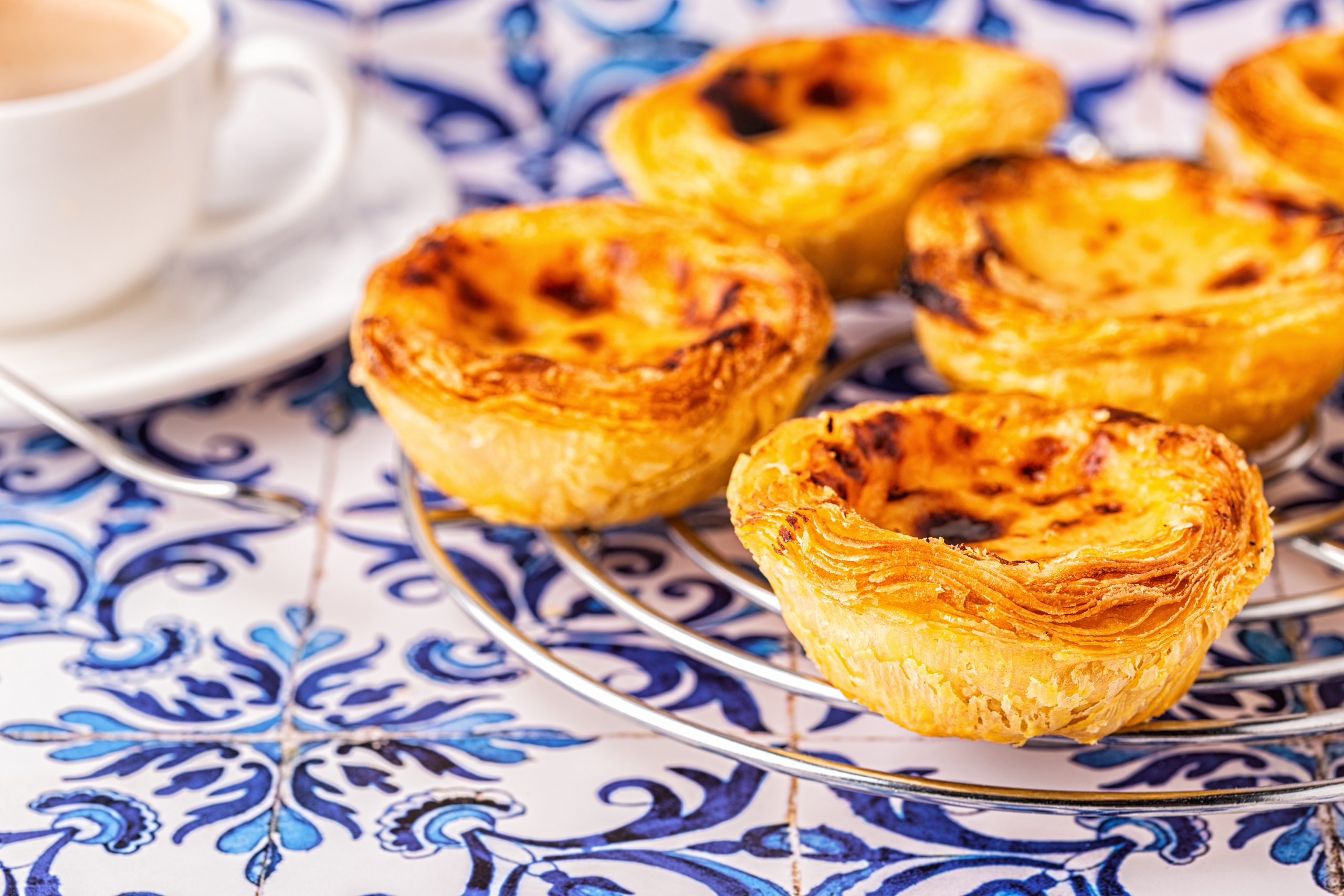
From the kitchens of a Lisbon monastery to the pastry shops of half the world, the pastel de nata has become one of the most recognisable symbols of Portuguese gastronomy. Its history combines religious traditions, political revolutions, secret recipes and encounters between cultures. A surprising story for a sweet that fits in the palm of your hand.
Its apparent simplicity is deceptive. Beneath a thin layer of crisp puff pastry hides a custard usually made with eggs, sugar and milk or cream, sometimes flavoured with lemon and cinnamon. Baking at very high temperatures crisps the pastry and leaves the custard with its characteristic scorched spots.
In Lisbon it is usually taken with coffee, still warm, straight from the oven. But today it can also be found in the windows of pastry shops in London, Hong Kong or New York. Its international popularity is relatively recent, though its history reaches deep into the Portuguese baking tradition.
To uncover it you have to travel to Belém, beside the Tagus, where a monumental monastery holds part of the memory of Portuguese maritime expansion. There begins a story in which conventual confectionery, the political upheavals of the nineteenth century and a recipe that remains secret are all interwoven.
A Sweet Born in the Shadow of a Monastery
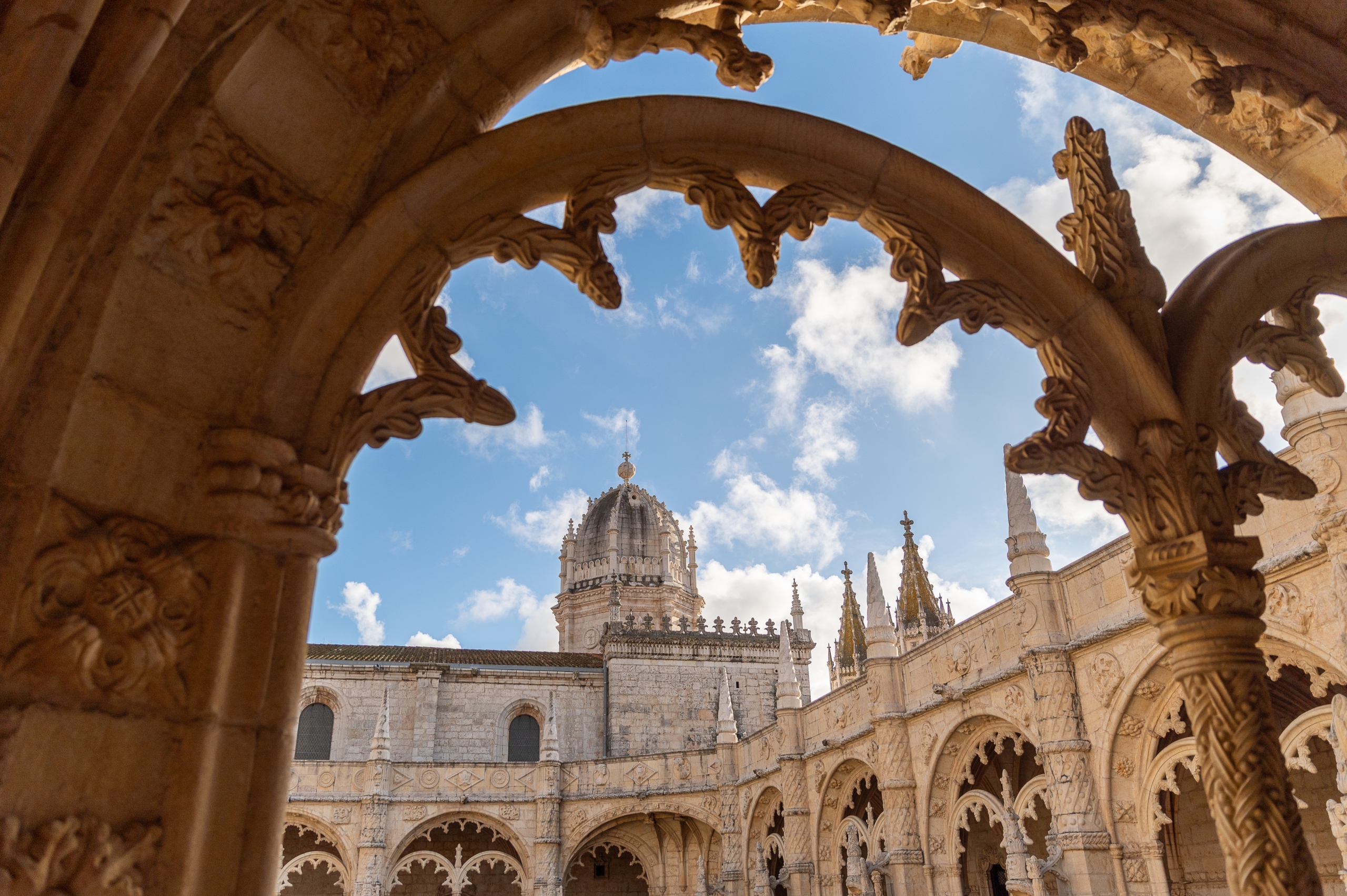
The origin of the tradition that gave rise to the celebrated Pastéis de Belém is connected to the monastery of Santa Maria de Belém, better known as the Jerónimos Monastery, one of Portugal’s most emblematic monuments.
The Order of St Jerome emerged in the Iberian Peninsula in the fourteenth century as a contemplative Catholic religious community, inspired by the figure of St Jerome, scholar and translator of the Bible. At the beginning of the sixteenth century, the Hieronymites were established at Belém by the will of the Portuguese monarchy. Their monastery, closely bound to the age of the great navigations, became a symbol of the kingdom’s power and prosperity.
In Portugal, religious communities developed over the centuries an important baking tradition, known as doçaria conventual, characterised by the abundant use of eggs, sugar and almonds. The Portuguese trading networks, which facilitated the circulation of sugar, helped to enrich that culture of sweets.
A widely repeated explanation holds that egg whites were used to starch certain religious garments and that the leftover yolks were put to use in making desserts. Although the practice is plausible in the context of conventual confectionery, there is insufficient documentary evidence to confirm that this is precisely how the Belém recipe came about.
In fact, nobody knows for certain who invented those pastries or when they were first made. Their creation is usually placed in the eighteenth century or the first decades of the nineteenth, but no original recipe survives to confirm it.
The Revolution That Changed a Recipe’s Destiny
The decisive event in transforming that conventual tradition into a commercial business was not gastronomic but political.
During the first half of the nineteenth century, Portugal experienced profound upheavals between defenders of absolutism and supporters of liberalism. On 30 May 1834, following the liberal victory, a decree abolished the male religious orders and ordered that their property pass to the State.
The Hieronymites had to abandon their monastery at Belém. The religious life that had marked that place for more than three centuries came to an end, but the baking tradition associated with its kitchens found a way to survive.
According to the official history of the Fábrica dos Pastéis de Belém — the establishment that still makes and sells these pastries in Lisbon today — production began in 1837 in premises adjoining an old sugar refinery, very close to the Jerónimos Monastery. They were made using a recipe which, according to the tradition preserved by the company itself, came from the monks.
The formula remains a jealously guarded secret. The bakery maintains that only its master pastry chefs know the original preparation, and that an essential part of the process takes place in a space known as the Oficina do Segredo, the “workshop of the secret.”
It is not possible to verify how far the present recipe matches exactly what the monks may have made two centuries ago. But that claimed continuity, combined with the mystery, has helped build the establishment’s identity and prestige.
Pastéis de Nata and Pastéis de Belém: an Important Distinction
Although they are often used as though interchangeable, the terms pastéis de nata and Pastéis de Belém do not mean quite the same thing.
Pastel de nata is the generic name for a speciality of Portuguese baking: a small puff pastry tartlet filled with egg custard. It is made in countless pastry shops and cafés across Portugal, each with its own recipe and its own differences in ingredients, proportions or baking.
Pastéis de Belém, by contrast, is a trademark identifying the pastries made by one specific company: the historic Fábrica dos Pastéis de Belém, on Rua de Belém in Lisbon. The establishment, also known as the Antiga Confeitaria de Belém, is distinguished by its reserved recipe and by a tradition of manufacture dating back to 1837.
These are not, therefore, two sweets with independent origins. The Pastéis de Belém belong to the same gastronomic family as the pastéis de nata, but they have a specific commercial identity. The Lisbon bakery’s secret recipe should not be confused with the many formulas used by other Portuguese pastry chefs.
This distinction is fundamental to understanding their international expansion: it was the pastel de nata as a gastronomic speciality, and not the Pastéis de Belém brand, that set off on a journey around the world.
From Lisbon to Macao: an Unexpected Reinvention
The present-day presence of the pastel de nata in territories historically linked to Portugal — Brazil, Mozambique, Goa, Macao — invites us to imagine a recipe that travelled intact for centuries. Its international diffusion, however, was far more complex.
The case of Macao is especially revealing. This city on the Chinese coast, administered by Portugal until 1999, became at the end of the twentieth century the setting for a new chapter in the pastry’s history.
Its protagonist was Andrew Stow, a Briton who had encountered pastéis de nata during his travels in Portugal. Fascinated by the sweet, he decided to make his own version without knowing the Pastéis de Belém recipe. To do so he combined elements of the Portuguese pastry with influences from the traditional British custard tart — small tartlets filled with egg custard.
In September 1989 he opened Lord Stow’s Bakery in Coloane, Macao. His reinterpretation, developed over that period, gave rise to a speciality that soon acquired a character of its own: the Portuguese egg tart.
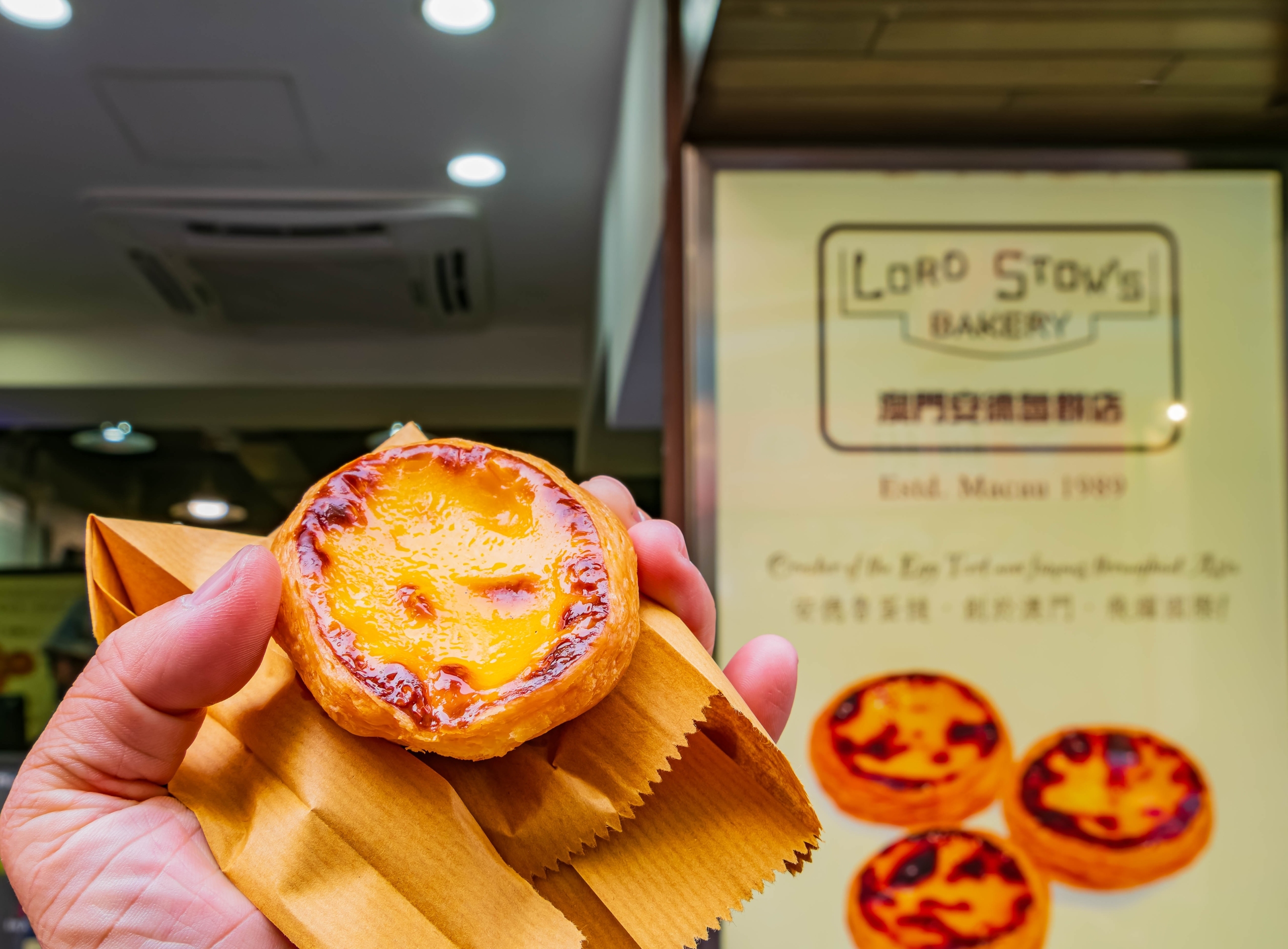
From 1997 onwards, expansion through franchises helped popularise it in various Asian markets. Hong Kong and other cities in East Asia took these tartlets into their everyday eating habits.
The striking thing is that one of the most influential versions of the Portuguese pastry was born of a British reinterpretation in a Chinese city of Portuguese tradition. Far from being a recipe preserved intact since colonial times, the Portuguese egg tart of Macao is the result of a meeting between cultures at the end of the twentieth century.
A Gastronomic Ambassador for Portugal
While the pastry was conquering Asia, in Europe it advanced along a different road. The growth of Portuguese tourism, the popularity of Lisbon as an international destination and the expansion of specialist cafés all helped to turn the pastel de nata into an increasingly familiar product outside its country of origin.
In the United Kingdom, for example, it moved from being a speciality tied to Portuguese communities and certain establishments to being sold in retail chains and supermarkets.
In Lisbon, businesses dedicated specifically to this sweet proliferated. Brands such as Manteigaria, Fábrica da Nata and Castro helped turn its making and tasting into a gastronomic experience for residents and visitors alike.
Internationalisation has also encouraged new interpretations. Today the traditional versions coexist with others incorporating chocolate, pistachio, fruit and custards of different flavours. Some pastry shops explore combinations aimed at an international public, while others hold to the classic preparation.
The pastel de nata has thus become something of an ambassador for Portuguese gastronomy, even if its enormous international popularity contrasts with the relative obscurity of other specialities from the country’s rich baking tradition.
One Secret in Belém, Thousands of Versions Worldwide
Since 1837, the Pastéis de Belém have built their prestige around a historic establishment and a reserved recipe. Meanwhile the pastel de nata, as a speciality shared by countless bakers, has travelled far beyond Portugal and become an internationally recognised sweet.
Its trajectory reflects the country’s political and social transformations, the development of tourism and the unexpected encounters between cultures. But it also demonstrates that gastronomic traditions do not necessarily stand still: they travel, they adapt, and they acquire new meanings.
We may never know who made the first pastel de nata, or what exactly the recipe was. What we do know is that while a bakery in Belém goes on guarding its secret, pastry chefs all over the world continue reinventing that small sweet of pastry and custard which was born of a Portuguese tradition and ended up winning over palates far from the Tagus.
AI Transparency Notice
PilgriMaps uses artificial intelligence tools to assist in the research, drafting and translation of editorial content. All AI-assisted content is reviewed, edited and verified by our editorial team before publication. We contrast information against primary sources, specialist literature and on-the-ground knowledge to ensure accuracy, cultural sensitivity and editorial integrity.
AI is one tool among many in our workflow. The judgement, curation and responsibility for everything published on this platform remain entirely human.
Viator Media S.L. — in compliance with the EU Artificial Intelligence Act (Regulation EU 2024/1689).
This post is also available in: