


In August, the mountain seems to move. Thousands of people climb toward the monastery of the Virgin at Dronka, on the outskirts of Assiut, filling a landscape that for much of the year is dominated by the silence of rock and desert. There are roads, car parks, buildings for pilgrims, churches, accommodation and vast open esplanades. But in the middle of that whole monumental complex there is one place toward which attention finally converges: a cave.
According to the Coptic tradition of Assiut, Mary, Joseph and Jesus came here during the flight into Egypt. After the stay at Al-Muharraq and the vision in which Joseph is said to have received the announcement that he could return to his own land, the family would have continued still further south, as far as the region of Assiut, before finally beginning the journey home.
This extension of the itinerary as far as Dronka forms part of local ecclesiastical tradition and is not documented with the same antiquity as other stages of the route. But it is precisely that memory which has turned the mountain into one of the great contemporary centres of Marian pilgrimage in Upper Egypt.
The image is a powerful one: a tradition born around the memory of a family seeking refuge has ended by creating a place capable of receiving multitudes.
A pilgrimage city above the Nile Valley
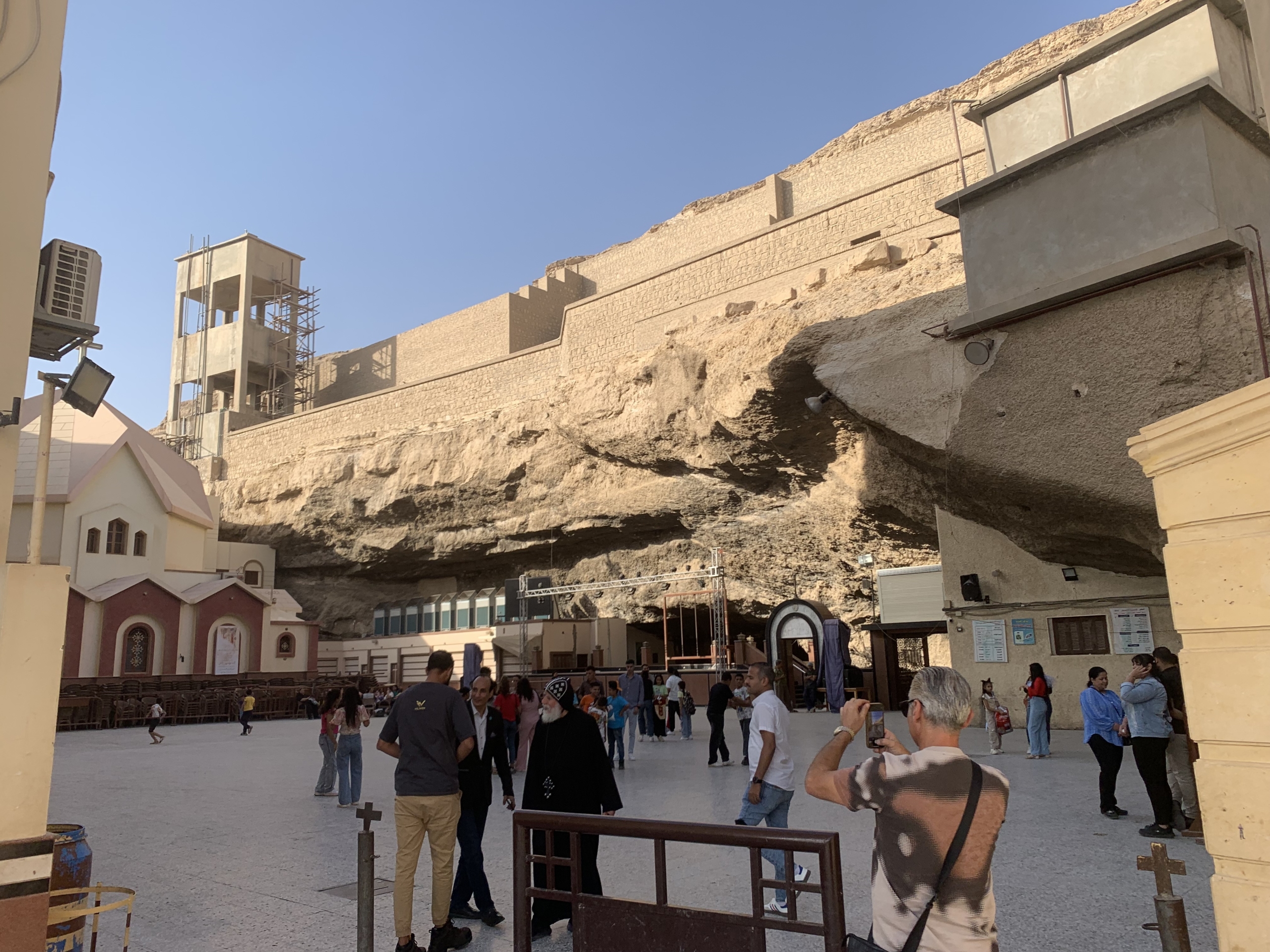
Dronka — also written Durunka, Drunka or Dayr Durunka — lies some eight to ten kilometres south-southwest of Assiut, on the western mountain that borders the Nile valley.
The geography is part of the experience. Below lie the city, the villages and the intensely cultivated strip that accompanies the river. Then, almost abruptly, the dry mountain begins. In its walls open caves and ancient tombs cut into the rock. There, terraced along the escarpment, stands the present sanctuary of the Virgin.
To call it simply a “monastery” can mislead. Dronka functions today as a genuine pilgrimage city: it brings together churches, accommodation buildings, retreat spaces, large squares, visitor services, road access and structures designed to receive large groups.
Much of this transformation took place during the 20th century. In 1955 a new church of the Virgin was built and the access road considerably improved. Since then the complex has continued to grow until reaching its present scale.
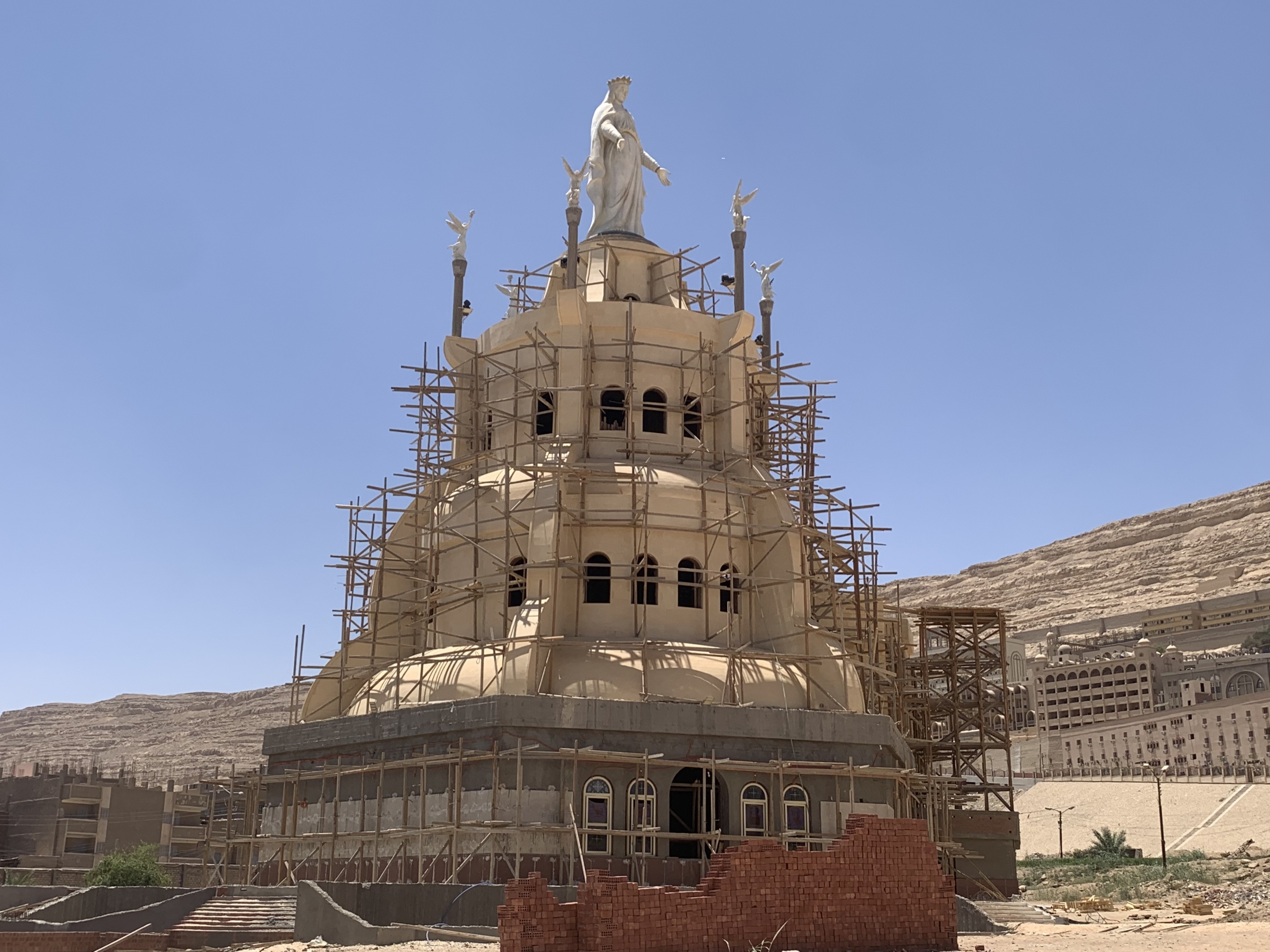
The expansion continues even now. On 3 October 2025, the Coptic Pope Tawadros II celebrated the consecration of the altars and icons of the renovated cave church. And in August 2026 the great annual cycle of pilgrimages was still drawing enormous numbers of the faithful.
The traveller who arrives in search of the memory of a fugitive family from the first century finds, therefore, a fully contemporary religious infrastructure.
Everything leads to a cave
The scale of the sanctuary can be deceptive, because the symbolic heart of Dronka remains a small space.
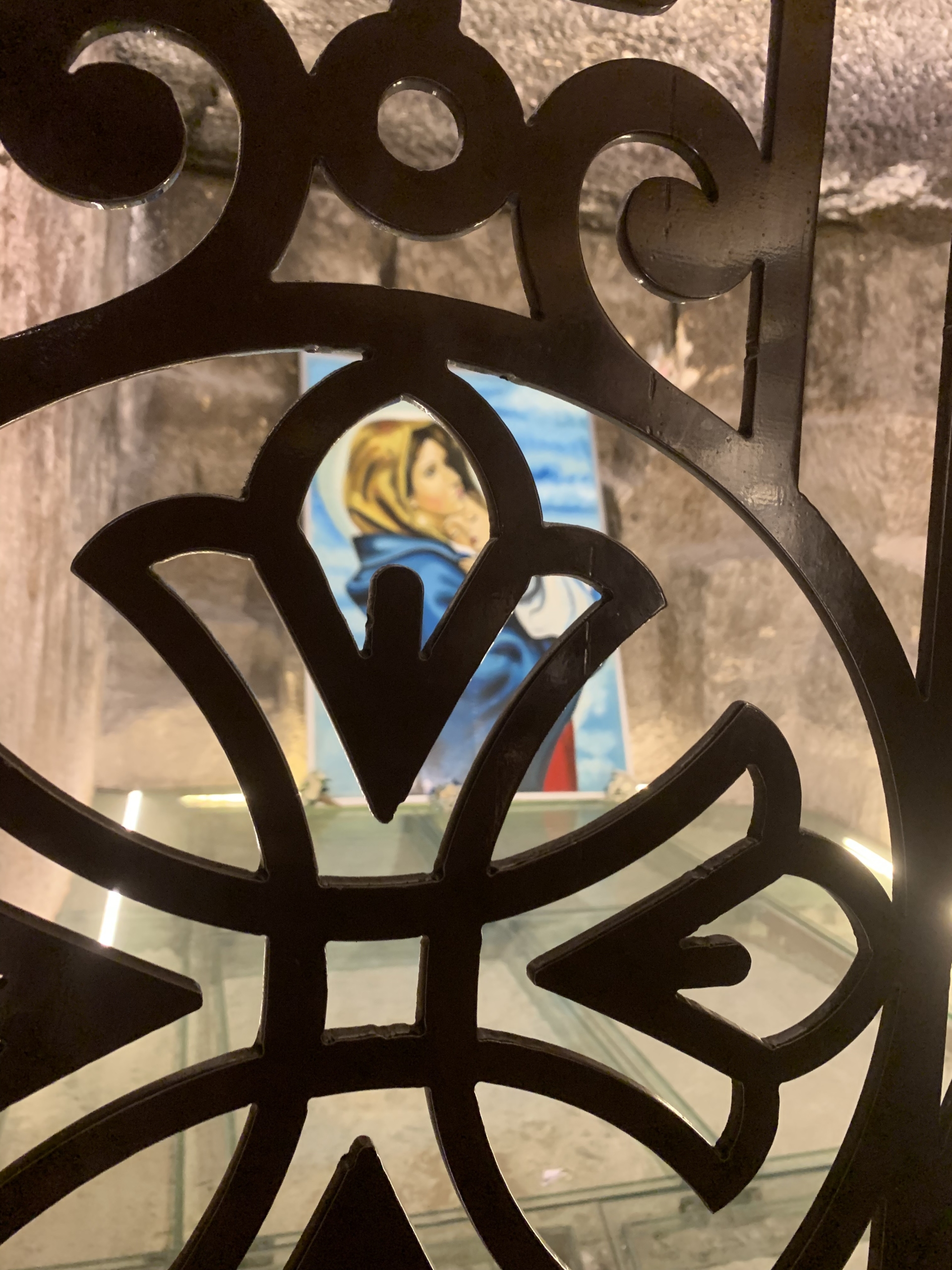
Local tradition identifies one of the mountain’s caves as the place where the Holy Family is said to have rested during their passage through Assiut. Today it is not a bare cavity nor an archaeological enclave preserved as it might have existed in Roman times. It is integrated into a rock-cut church and forms part of a living space of worship, transformed over generations.
That helps to understand the pilgrims’ relationship with the place. The cave functions as a kind of geographical relic: what is venerated is not simply an image, an object or a memory associated with Mary and Jesus, but a space the community considers marked by their presence. Mountain, rock and cavity thus become part of the religious narrative.
And that relationship with caves has, moreover, a far older history than might appear.
Before Christianity
The history of Dronka does not begin with the Holy Family. Long before Christianity existed, the western mountain of Assiut was already a great funerary landscape. During pharaonic Egypt, tombs, chapels and inscriptions were carved here that still allow some of their religious uses to be reconstructed.
One of the most interesting examples is the tomb-chapel of Amenhotep, (not to be confused with the pharaoh of the same name) a senior official of the Nineteenth Dynasty who was a royal scribe, a lector priest, and connected with the cult of the goddess Sekhmet and with medical functions.
The tomb contained reliefs and hieroglyphic inscriptions, fragments of which are now preserved in museums. But there is a still more suggestive detail: in later periods, visitors left graffiti in the tomb and came there seeking healing associated with the ka — the vital force — of the physician Amenhotep.
When the tombs became hermitages
With the spread of Christianity in Egypt, the rock landscape acquired new uses. Some ancient tombs were reused by Christians as dwellings or hermitages. The caves offered isolation and protection, two elements particularly suited to the ascetic forms that proliferated in Egypt during late antiquity.
Archaeological studies have documented pharaonic tombs transformed into Christian spaces, churches cut into the rock and ancient settlements connected with monastic communities. Recent research analyses Dronka alongside other sites on the western mountain of Assiut — such as Rifa and al-Ganadla — precisely as part of this Coptic rock-cut landscape.
In other words, although the specific presence of the Holy Family cannot be demonstrated archaeologically, the Christian antiquity of the mountain is well documented. And its identification as the last great stage of the journey acquired particular institutional force during the 20th century, especially from the 1950s under Bishop Anba Mikhail.
When Dronka fills
Around the Fast of the Virgin, approximately between 7 and 21 or 22 August, the complex changes scale completely. Pilgrims arrive from different parts of Egypt. Liturgies, prayers, chants and mass gatherings are held. The accommodation fills and the mountain is transformed into an enormous religious and social space.
One of the central moments is the procession of the Virgin. The icons leave the cave church accompanied by priests and deacons, amid hymns and incense, cross the sanctuary and finally return to the place from which they set out.
The gesture contains much of the meaning of Dronka. The tradition is not preserved merely by telling a story. It is enacted with the body: walking, carrying images, singing, lighting candles and entering the cave once again.
Nor do the festivals of Dronka unfold exclusively within the strict boundaries of the Coptic community. Egyptian Christian mulids have traditionally been religious and social events at the same time, and there are accounts of Muslims attending these spaces accompanying Christian friends, taking part in the popular celebrations or seeking blessings. During the pilgrimage, the boundaries between Christian devotion, popular festival, communal gathering and cultural heritage become less rigid.
This dimension was recognised internationally in 2022, when UNESCO inscribed the “Festivals related to the Journey of the Holy Family in Egypt” on the Representative List of the Intangible Cultural Heritage of Humanity.
How to visit Dronka
For an international traveller, the most practical option is to use Assiut as a base. The city lies some 375 kilometres south of Cairo and is connected to the capital by rail. From the centre of Assiut, the sanctuary is about 8–10 kilometres away and the final stretch can be covered by taxi or car with driver.
It is worth setting aside at least half a day for Dronka. A visit of two or three hours allows you to see the principal spaces, but the interest of the place also lies in stopping, contemplating the valley from the mountain and observing how a living Coptic sanctuary works.
The choice of date changes the experience completely. August allows you to attend the great Marian pilgrimage, but it means crowds, access controls and very high temperatures. Anyone seeking to understand the architecture and history in greater calm will find far more comfortable conditions in autumn, winter or early spring.
The monastery has accommodation intended for retreats, families and days of spiritual reflection, though it should not be understood as a conventional hotel. For a visitor not taking part in a religious retreat, it is usually simpler to stay in Assiut.
And there is one final consideration that changes the way you visit: Dronka is not a monument turned into a museum. It remains a sanctuary. Discretion in dress, respect for the celebrations and care in photographing pilgrims — especially inside the cave church — are part of the experience.
From refuge to meeting place
Dronka transcends the memory of centuries. Archaeology tells us of a pharaonic mountain. The tombs and hermitages show how that landscape was reused by Christian communities. Oral tradition links this place to the Holy Family. And contemporary documentation explains how, during the 20th century, Dronka came to be one of the great Marian sanctuaries of the country.
According to tradition, a persecuted family came to this mountain seeking refuge before undertaking the return journey. Two thousand years later, the cave is still there — but around it a meeting place has grown.
This content comes to you in collaboration with the Egyptian Tourism Authority
AI Transparency Notice
PilgriMaps uses artificial intelligence tools to assist in the research, drafting and translation of editorial content. All AI-assisted content is reviewed, edited and verified by our editorial team before publication. We contrast information against primary sources, specialist literature and on-the-ground knowledge to ensure accuracy, cultural sensitivity and editorial integrity.
AI is one tool among many in our workflow. The judgement, curation and responsibility for everything published on this platform remain entirely human.
Viator Media S.L. — in compliance with the EU Artificial Intelligence Act (Regulation EU 2024/1689).
This post is also available in:
![Por Palma el Joven - [1], Dominio público](https://media.pilgrimaps.com/wp-content/uploads/2026/01/Conversion_de_San_Pablo_de_Palma_el_Joven_Museo_del_Prado-120x120.jpg)
