Our route begins at Euni, among the wooded hills of Yongin, south of Seoul. From here, a trail of just over ten kilometres crosses three mountain passes before reaching Mirinae, one of the great Catholic pilgrimage sites of South Korea. It follows no ancient medieval road and leads to no great cathedral. Its protagonist is a young priest who died at barely twenty-five: St Andrew Kim Taegon, the first Korean Catholic priest.
The city of Yongin currently promotes this itinerary as the Youth Kim Daegeon Trail. It runs 10.3 kilometres between the shrines of Euni and Mirinae — around four hours of walking along forest paths and rural tracks, crossing the passes of Shindeok, Mangdeok and Aedeok.
It can be walked today, and ahead of World Youth Day in Seoul in 2027, the municipality has renewed part of its signage and facilities. But to understand what it means to walk through these mountains, you first have to travel somewhere else in Korea.
Before the trail: Solmoe
Some 100 kilometres south of Seoul lies Solmoe, one of the best-known Catholic shrines in the country. Andrew Kim was born here in 1821. The name is usually translated as “pine hill,” and the trees still form part of the shrine’s landscape today. There is a reconstruction of his birthplace, spaces for prayer and a memorial dedicated to the saint. In 2014, Pope Francis visited the site during his journey to Korea.
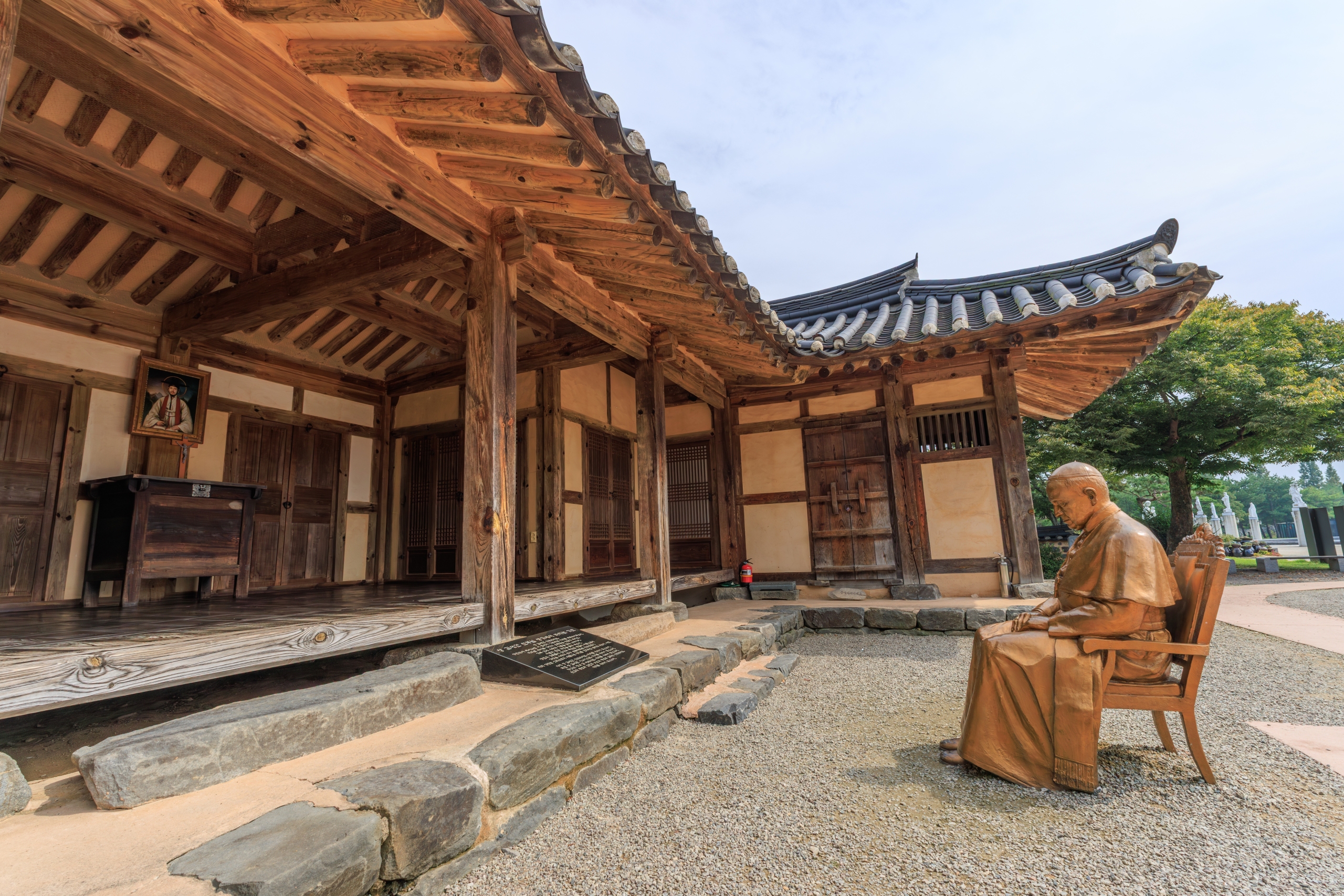
Solmoe helps to grasp something essential: Andrew Kim was not an isolated convert. He was born into a family that had been bound for several generations to a persecuted Catholic community. His father, Ignatius Kim Je-jun, was executed in 1839; other members of the family also suffered in the persecutions.
The story of those Catholics is particularly singular because Korean Christianity did not begin with the arrival of a foreign mission. It began, to a large extent, with books.
A Church born among readers
During the eighteenth century, some Korean intellectuals had begun to study Western texts arriving from China. Among them circulated Christian works written or translated by the Jesuits established there.
One of those scholars, Yi Seung-hun, travelled to Beijing and was baptised in 1784. On returning to Korea he passed the new faith on to others. The first communities grew for years practically without priests. Lay people studied, taught, baptised and gathered to pray.
But the new religion posed difficulties within the society of the Joseon dynasty, profoundly shaped by neo-Confucianism. The conflict over rites dedicated to ancestors was especially serious; to this were added suspicions toward a religion associated with foreigners, and the tensions that could arise from a religious community in which people of different social rank recognised one another as equals before God.
The persecutions began. There were major waves of repression in 1801, 1839, 1846 and 1866. Priests, catechists and lay people were imprisoned and executed. A large part of Korea’s present-day Catholic pilgrimage sites emerged from that geography: villages where Christians hid, prisons, places of martyrdom, and mountains in which entire communities tried to disappear from the sight of the authorities. That was the world in which Andrew Kim grew up.
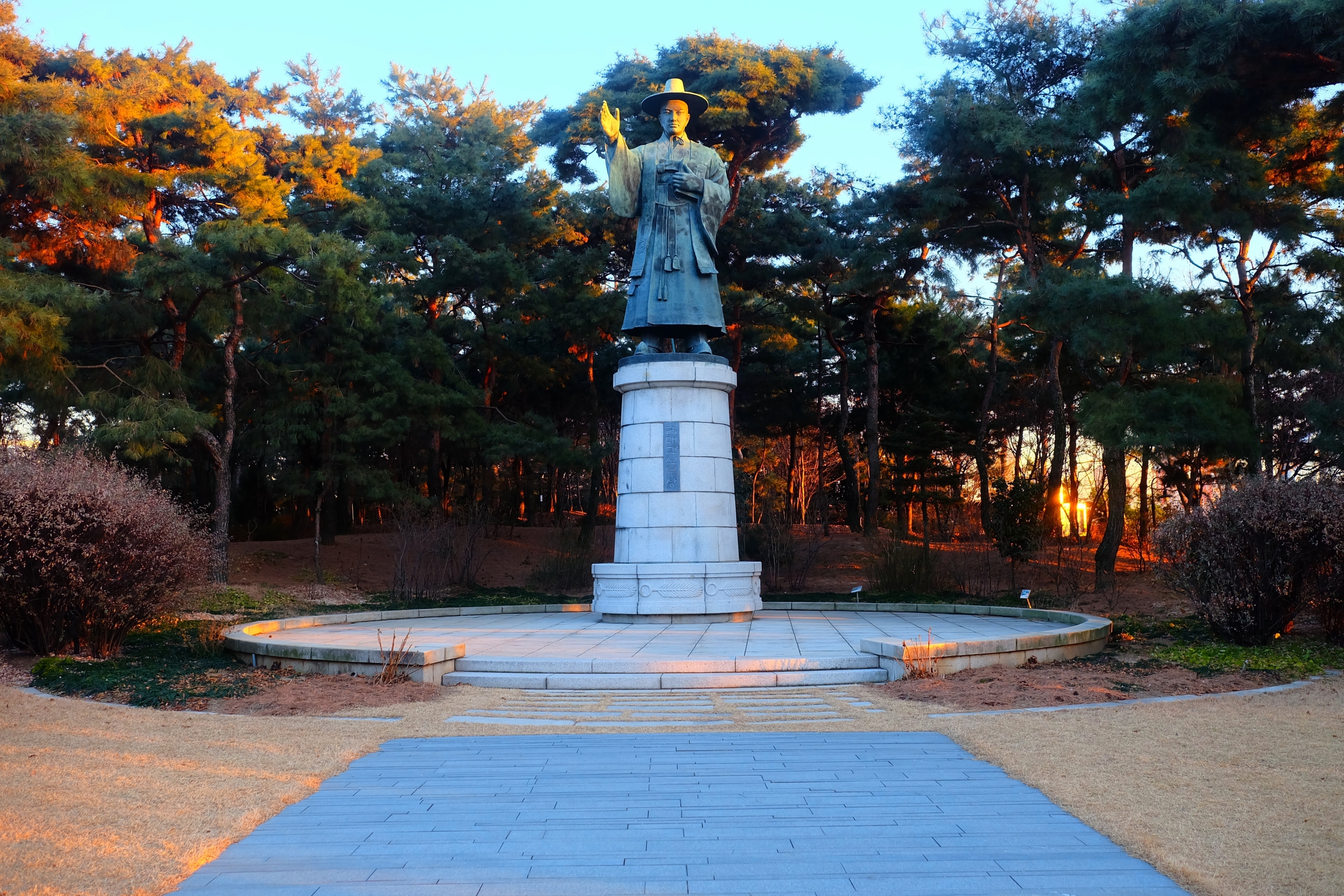
At around fifteen he was chosen as a candidate for the priesthood. There was no safe place in Korea at that time where he could be trained, so in 1836 he left the country clandestinely. His formation took him to Macau and other territories in China. Almost a decade later, in 1845, he was ordained a priest in Shanghai. He was the first Korean to reach the priesthood.
But returning to his country remained dangerous. Kim came back clandestinely and began to serve small Catholic communities scattered across the territory. One of the places associated with those few months of ministry is Euni. And here our route truly begins.
Euni: Where a Biography Becomes a Trail
The name Euni is usually interpreted as “hidden village.” It is fitting. In this area surrounded by mountains, Catholic communities found refuge during the persecutions. Today there is a shrine there linked especially to Andrew Kim and equipped to receive visitors.
One of its more curious elements is a reconstruction of the Kim Ga Hang church in Shanghai, associated with his priestly ordination. But Euni matters above all because it remembers Andrew Kim the priest, not only the martyr. His ministry lasted a very short time. He celebrated the sacraments, visited clandestine communities and moved through a territory in which a priest had to take care not to draw attention.
The Youth Kim Daegeon Trail now departs from the shrine. Up to Euni we have been following a story. Now we can walk it.
Ten kilometres and three passes
The route to Mirinae covers 10.3 kilometres and usually takes about four hours. It should not be imagined as a carefully paved urban walk. It combines forest paths, rural tracks, small villages and some sections close to roads.
The trail has been recognised among Korea’s notable forest paths and, with 2027 approaching, Yongin has renewed its orientation and signage. Its greatest appeal does not lie in a succession of monuments.
To understand it, you have to picture these mountains almost two centuries ago. The small Christian communities needed discreet places to settle and paths along which to communicate. Priests moved between villages. Letters, news and books circulated. Finding a route that was lightly watched could be a decisive matter.
Andrew Kim moved within this world. And the roads would eventually also be the cause of his arrest. One of the tasks entrusted to Kim was to locate places through which foreign missionaries could safely enter Korea. He needed to study land and sea routes, make contact with vessels and find ways of evading surveillance.
In 1846 he was detained while carrying out one of these missions on the western coast. He had been ordained barely a year earlier. He was taken to Seoul, interrogated and sentenced to death.
Mirinae: the End of the Trail
After crossing Aedeok, Mirinae appears. Today it is a large pilgrimage centre, with churches, chapels, a Way of the Cross and various spaces dedicated to Christian memory. It is prepared to receive groups and already features in international pilgrimages organised for WYD 2027.
But long before it became a shrine it was a hiding place. Mirinae means “Milky Way” — an interesting connection with Compostela, incidentally. According to local tradition, the name recalls the small lights that could be seen at night scattered among the mountains, coming from the homes of Catholic families hidden in the valley.
Andrew Kim was executed on 16 September 1846 at Saenamteo, beside the Han river in Seoul. Recovering the body of a condemned man carried risk, but a Christian named Vincent Yi Min-sik managed to rescue his remains and move them clandestinely toward the mountains.
Forty days after the martyrdom, the body finally reached Mirinae, where it was buried. The path that today links Euni and Mirinae is connected both to the territory where Kim carried out his ministry and to the memory of that journey with his body. And that makes arriving at Mirinae something more significant than simply reaching the end of a trail. At Euni we find the living priest; at Mirinae, his tomb.
Saenamteo: Completing the Route in Seoul
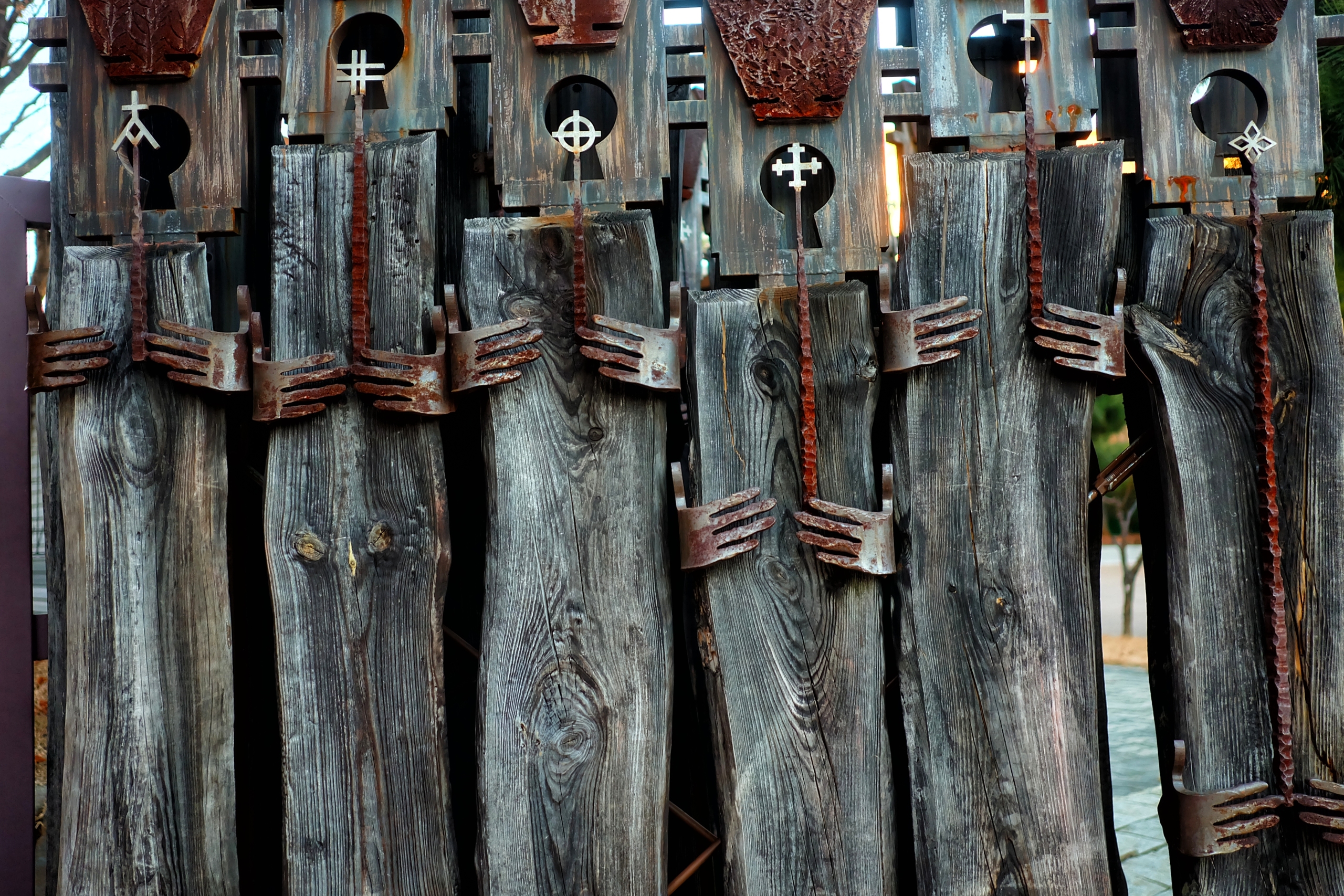
To finish understanding the story, it is worth returning afterwards to Seoul. Saenamteo has today been entirely absorbed by the great metropolis and lies very close to the Han river. Over the former execution ground stands a shrine whose architecture incorporates traditional Korean forms. During the Joseon period, however, that ground was used for executions. Many Catholics died there, among them eleven priests. Andrew Kim was one of them.
Saenamteo does not belong to the Youth Kim Daegeon Trail, but visiting the site allows you to complete the account and, moreover, to link it to another great pilgrim experience: the Seoul Catholic Pilgrimage Route, which connects some of the principal settings of the persecutions in the capital, such as Myeongdong, Seosomun, Danggogae and Jeoldusan.
How to walk the route today
The section that can genuinely be walked as a waymarked trail is: Euni Holy Ground → Shindeok Pass → Mangdeok Pass → Aedeok Pass → Mirinae Holy Site.
Distance: 10.3 km
Time: around 4 hours
Difficulty: moderate
Terrain: forest and rural paths, villages, mountain passes and some sections close to roadsHiking shoes, water and some food are advisable. The route should not be understood as an urban walk with continuous services.
It is also linear: it begins at Euni and ends at Mirinae. For a foreign visitor it is advisable to arrange transport to the start and pick-up or onward travel from Mirinae in advance.
Both Euni and Mirinae have visitor facilities and parking. The former municipal stamp-reward programme for the Youth Kim Daegeon Trail ended in April 2026, though the route remains active and its signage has been improved.When to Go
The most pleasant seasons are spring and autumn, especially between March and May and between September and November.
The Korean summer is hot and humid and coincides partly with the rainy season. This carries some importance for anyone wanting to walk the route around WYD Seoul 2027, scheduled for the height of summer: it will be necessary to check the weather forecast and, if conditions are adverse, to avoid the hottest hours of the day.
From clandestine paths to pilgrimage routes
Andrew Kim spent much of his short life looking for roads. One to leave Korea clandestinely and study. Another to return as a priest. Routes by which new missionaries could enter. Paths to reach hidden communities. And, after his execution, it was others who had to find a road to carry his body to Mirinae. Almost two centuries later, those landscapes receive pilgrims.
As Korea prepares to welcome young people from around the world for WYD 2027, this small trail between Euni and Mirinae offers a different way of approaching its Catholic history. During the nineteenth century, those mountains served for hiding. Today they invite you to walk.
AI Transparency Notice
PilgriMaps uses artificial intelligence tools to assist in the research, drafting and translation of editorial content. All AI-assisted content is reviewed, edited and verified by our editorial team before publication. We contrast information against primary sources, specialist literature and on-the-ground knowledge to ensure accuracy, cultural sensitivity and editorial integrity.
AI is one tool among many in our workflow. The judgement, curation and responsibility for everything published on this platform remain entirely human.
Viator Media S.L. — in compliance with the EU Artificial Intelligence Act (Regulation EU 2024/1689).
This post is also available in: