For millions of people, Ibiza is a name that immediately conjures a precise geography of the imagination: nightclubs, electronic music, yachts, beach clubs, sunsets and nights that seem never to end. It is the global Ibiza, built over time by international tourism and turned into one of the most powerful place brands in the Mediterranean.
But there is another Ibiza. Quieter, older and, in certain respects, surprising. It is the island of bells marking time in small villages, of white churches rising between pines and almond trees, of processions crossing the streets of Dalt Vila, of paths walked for centuries to reach Sunday Mass. It is an Ibiza where religion is not merely a matter of faith: it has been social infrastructure, landscape architecture, an occasion for gathering and a device of collective identity.
To truly understand the island, you may need to start here. Not from the night, but from the day. Not from the dance floor, but from the square in front of a church.
The Christian tradition of Ibiza consolidated after the Catalan conquest of 1235. The political and religious transformation of the island also profoundly altered its landscape: new communities arose or were organised around places of worship, while villages took on the names of saints. The church thus became, above all in the island’s long rural history, far more than a religious building. It is a geographical and symbolic centre. It is the place where baptisms, weddings and funerals are celebrated, but also the place around which a community recognises itself.
The church as the centre of the world
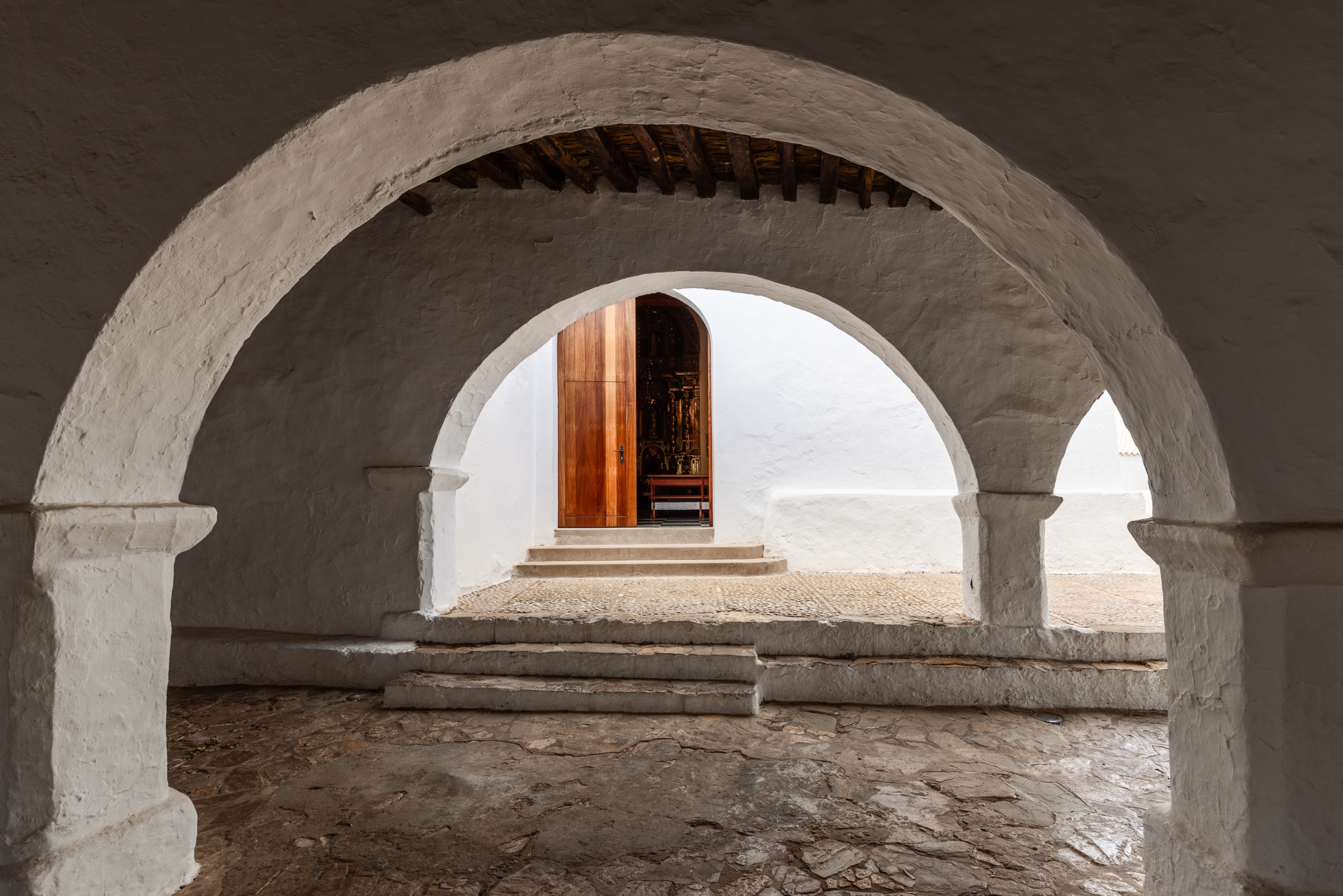
Today, crossing the interior of Ibiza, this history is still legible. The white churches of Sant Josep, Sant Joan, Sant Miquel, Sant Mateu and Santa Gertrudis are architectural landmarks, but also the account of a model of settlement.
For centuries the island was characterised by a population scattered across the countryside. Rural houses could be at great distances from one another, and the nearest neighbour was not necessarily just around the corner. In this context, the parish fulfilled an essential function: it brought together people, relationships and news.
The memory still survives of the camins de missa — the “Mass paths”: ancient routes that connected farmhouses to the parish church. Some crossed private land but were set aside for the passage of the faithful. They were walked to attend religious services, naturally, but also for baptisms, funerals and patron saint festivals. In other words, those paths tell the story of a society in which the sacred and daily life were closely intertwined.
It is an apparently minor detail, but a highly significant one. Contemporary tourism tends to tell Ibiza as a place of ceaseless movement and individual freedom. The camins de missa tell the opposite and its complement: a society founded on the necessity of building community, of meeting, of sharing rituals.
Religion, from this perspective, helped to draw the social map of the island.
The fortress churches and a faith that had to defend itself
Architecture too reveals the particular character of this sacred Ibiza. Some of the island’s historic churches have a massive, almost defensive appearance. This is no accident. In a Mediterranean marked for centuries by raids and attacks from the sea, sacred places could also represent points of protection and refuge.
Faith, here, did not dwell in an abstract space. It had thick walls, strategic positions, towers and sightlines across the territory. It was embedded in the landscape and in its need for defence.
This dual nature — spiritual and practical — is one of the keys to reading Ibiza. The white island of the postcards is also an island of stone, fear and resistance. The church was not only the place where one prayed: it could be the point toward which one headed when the sea, instead of bringing travellers, brought danger.
Today these buildings contribute to one of the least known but most authentic images of Ibiza: that of a community that built its own identity in a complex relationship with isolation.
Holy Week: When Dalt Vila changes voice
The moment when this hidden Ibiza becomes most visible is Holy Week.
In spring, before summer tourism has reached its full intensity, the streets of Eivissa change pace. Processions cross the historic centre and above all the monumental setting of Dalt Vila, the fortified city. The brotherhoods carry sacred images into the streets, while music, silences, candles and rituals transform for several days the very perception of the city.
Ibiza’s Holy Week is not a static tradition. The seven currently active brotherhoods of the city are coordinated by a structure formalised in 2024, but the modern history of the city’s processions goes back at least to the 1940s: the first Good Friday procession organised by the brotherhood of the Santo Cristo Yacente dates to 1944. Over time, new brotherhoods have built a calendar of Masses, novenas, tridua, processions and moments of devotion.
Good Friday is one of the most intense moments, with the Procession of the Holy Burial bringing the brotherhoods together through the streets of Dalt Vila. Easter Sunday, by contrast, changes tone entirely: mourning and penitence give way to the celebration of the Resurrection, with the traditional encounter between the images of the risen Christ and the Virgin.
It is a scene that overturns, at least temporarily, a stereotype. Ibiza, the capital of excess, stops to listen to the sound of footsteps on ancient stone.
The Patron Saints and the calendar as the Island’s story
But the religiosity of Ibiza is not concentrated solely in Holy Week. The island’s calendar is scattered with patron saint festivals and local celebrations. Almost every community has its own saint, its own date, its own moment of festivity.
Sant Antoni celebrates Sant Antoni Abat on 17 January and again its patron Sant Bartomeu on 24 August. Santa Eulària des Riu celebrates on 12 February. Sant Josep de sa Talaia on 19 March. Sant Jordi on 23 April. Sant Joan on 24 June. Sant Miquel on 29 September. Sant Carles on 4 November. Santa Gertrudis on 16 November.
The calendar continues throughout the year, demonstrating how central the patron saint festival has been, and continues to be, to local culture. These are not merely liturgical anniversaries. The celebrations expand to include music, gastronomy, popular activities, sporting events and moments dedicated to traditional culture. The saint becomes, in this sense, a great social occasion: a religious figure is celebrated, but alongside it the very existence of the community is celebrated.
Among the most important dates are the Festes de la Terra, held between 5 and 15 August. The programme revolves around Santa María, patron of the island, celebrated on 5 August, and Sant Ciriac, patron of the city of Ibiza, on 8 August. The festival includes popular traditions, dances, float parades, music and fireworks. It is one of the clearest expressions of how religious heritage can become civic and identity heritage.
Our Lady of Carmel and the sea as sacred space
If the land has its saints, the sea has its protectress.
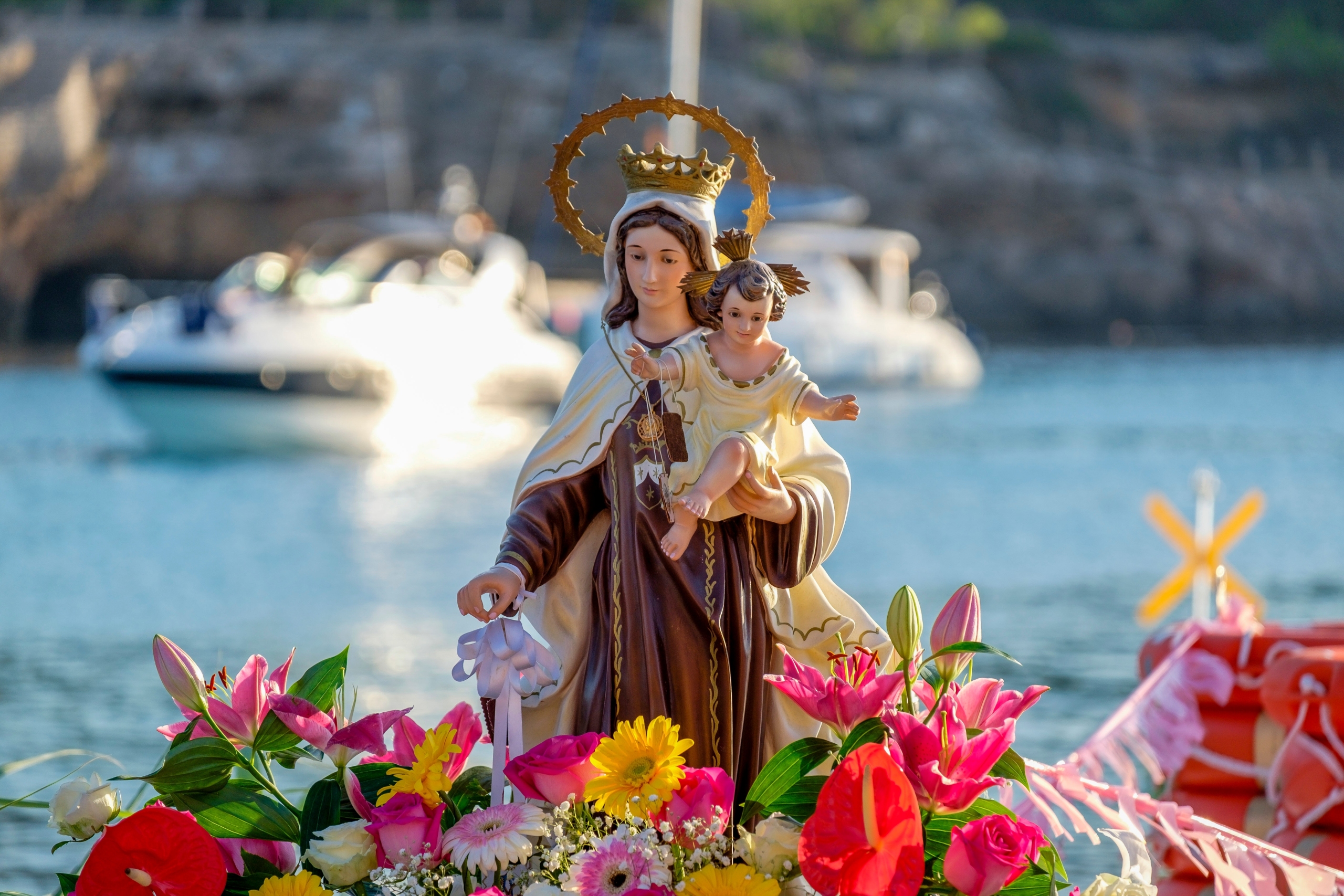
On 16 July, Ibiza celebrates Our Lady of Carmel, traditionally considered the patroness of sailors. On an island society where the sea is simultaneously boundary, resource, communication route and risk, this devotion takes on particular weight. The relationship with the sacred shifts symbolically from inside the church toward the sea — toward the element that more than any other has determined the life of the island.
Here too one of the most interesting characteristics of Ibizan identity emerges: religion binds itself to work and territory. The liturgical calendar becomes a way of interpreting professions, seasons, the cycles of nature and relationships with the landscape.
Ball Pagès: When ritual becomes movement
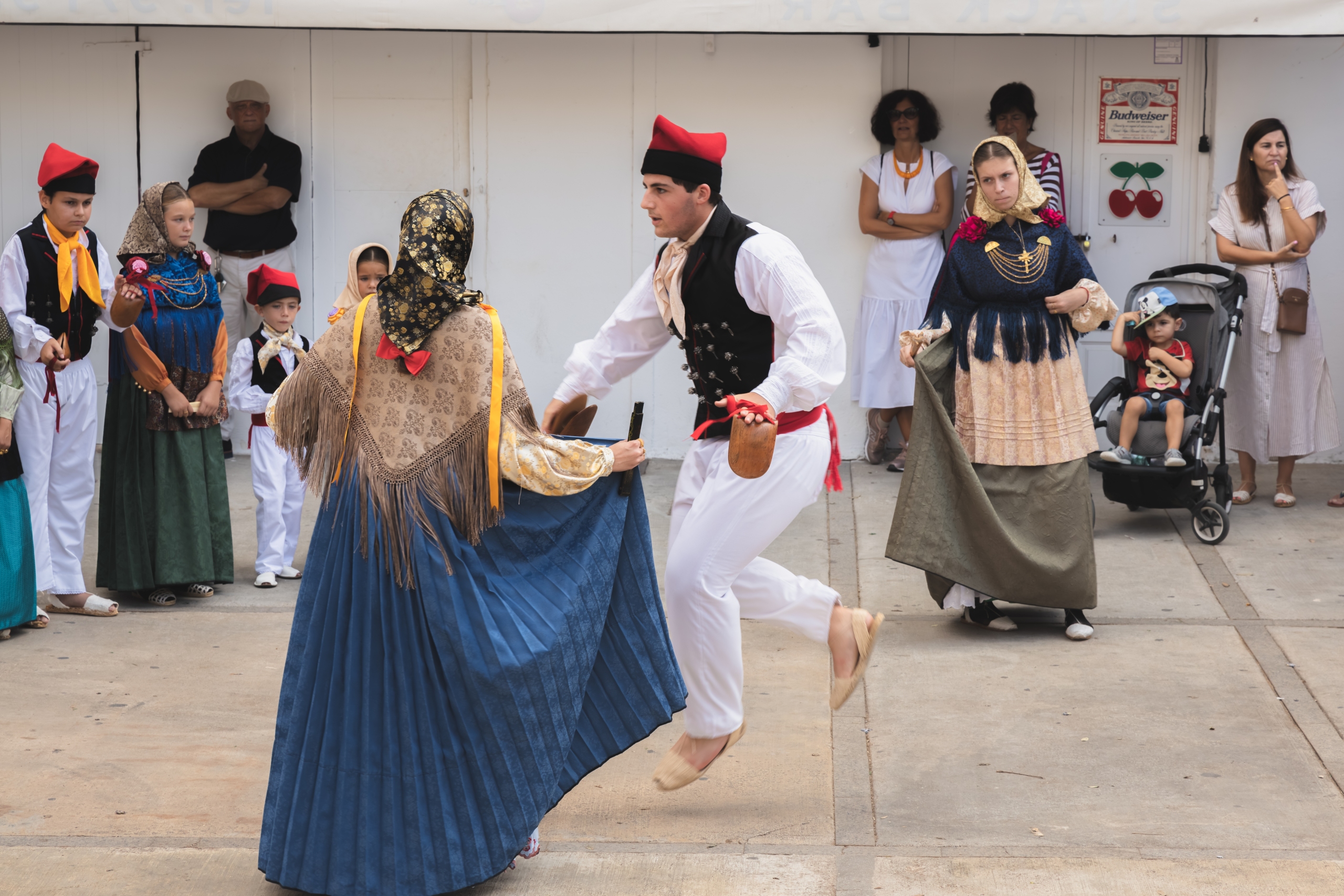
Alongside the properly religious traditions lives a popular heritage equally bound to identity: the Ball Pagès, one of the oldest and most emblematic cultural expressions of Ibiza.
The traditional dance, recognised as an Intangible Cultural Heritage of Interest, is often present at popular and patron saint festivals. Costumes, music and movement tell the story of a rural society that built over time its own aesthetic code.
Here the boundary between sacred and profane is not as sharp as it might appear to a contemporary eye. The patron saint festival begins from a religious reference but then expands: people eat, dance, meet, listen to music. The community renews its sense of belonging through a sequence of shared gestures.
This is perhaps the deepest function of tradition: not to preserve the past as an object behind glass, but to make it present again.
The other Ibiza is not the opposite of the first
It would be a mistake, however, to simply set the spiritual Ibiza against the Ibiza of the night. The reality is more interesting.
The two islands coexist. The same Ibiza capable of attracting the greatest names in international music preserves paths that for generations led farmers to church. The same city that in summer welcomes a global crowd can transform Dalt Vila, during Holy Week, into a space of silence and devotion. This is its complexity.
The problem, if anything, is that the international tourism narrative has favoured only one of the island’s many identities. The night is more easily exportable as an image. A procession requires time, context and attention. A club can be summed up in a photograph; a camí de missa asks you to know the history of the people who walked it.
And it is precisely here that the lesser-known face of Ibiza hides. Not an alternative island, but a more complete one. A place where the sacred continues to survive despite modernity, often blending with it. Where a white church can be a monument, a geographical landmark, a family memory and, even today, the centre of a festival.
Perhaps the best way to discover this Ibiza is to arrive before the music has started. To stop in a village square during a patron saint festival. To follow, in spring, a procession through the walls of Dalt Vila. To enter a rural church without immediately looking for the next place “to see.”
Because behind the Ibiza brand, behind the island the world thinks it knows, a more discreet geography still exists. A geography made of bells, saints, paths, processions and dances. And it is perhaps there, far from the spotlights, that Ibiza stops being merely a destination and returns to what it has always been: a community with a memory, a territory and a soul.
AI Transparency Notice
PilgriMaps uses artificial intelligence tools to assist in the research, drafting and translation of editorial content. All AI-assisted content is reviewed, edited and verified by our editorial team before publication. We contrast information against primary sources, specialist literature and on-the-ground knowledge to ensure accuracy, cultural sensitivity and editorial integrity.
AI is one tool among many in our workflow. The judgement, curation and responsibility for everything published on this platform remain entirely human.
Viator Media S.L. — in compliance with the EU Artificial Intelligence Act (Regulation EU 2024/1689).
This post is also available in: