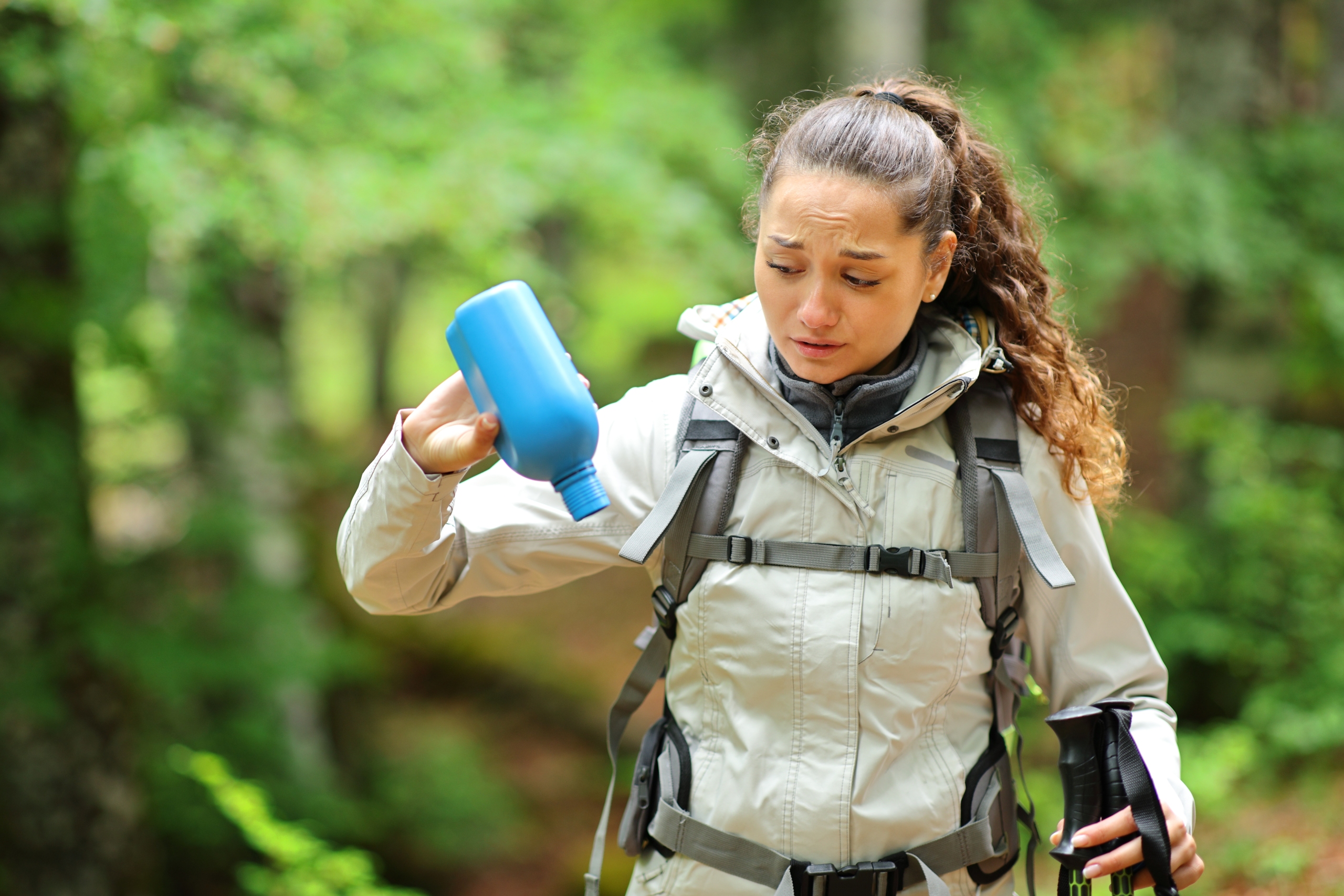
This article is for informational purposes only. It does not replace medical advice. If you notice signs of severe dehydration, confusion or fainting, seek immediate medical assistance.
On the Spanish Meseta, between Burgos and León, there are stretches of more than fifteen kilometres without a single village, fountain or reliable shade. It is one of the most photographed landscapes on the Camino de Santiago precisely because of its almost lunar vastness — and also one of the most treacherous: the same absence of shelter that makes it iconic makes it dangerous for anyone who misjudges their water supply.
Every great pilgrimage route, from the Via Francigena to the Sentiero degli Dei, has at least one stretch like this, where water stops being a logistical detail and becomes the variable that decides how the day will go.
Why water matters more than you think
The human body loses fluid continuously through sweat, breathing and urination, and that loss accelerates considerably under prolonged physical effort and high temperatures. According to Harvard Health Publishing, the first sign of dehydration is not intense thirst but a series of subtler symptoms: headache, dry mouth, less frequent urination, dark-coloured urine, unusual fatigue, difficulty concentrating. Thirst, when it finally arrives, is already a late indicator: the body is signalling a deficit that has been building for some time.
A simple way to monitor yourself on the road, without any equipment, is to observe the colour of your urine: clear or straw-coloured means good hydration, while a colour shifting toward dark amber is a warning sign not to ignore.
If you run out of water during a stage
The priority in these cases is to act before the situation worsens — not to wait for more severe symptoms:
- Slow your pace. Walking more slowly reduces sweat production and extends the time before dehydration becomes a serious problem.
- Find shade. Even a few minutes’ rest under a tree or behind a wall reduces the thermal load on the body and slows fluid loss.
- Assess available sources carefully. Public fountains in villages, cemeteries (often equipped with taps for watering graves), bars and restaurants that are closed to the public but have staff present — these are resources frequently overlooked by those searching only for “pilgrim fountains” marked on maps.
- If you find yourself near a natural watercourse and have no alternative, bear in mind that untreated water may contain bacteria and parasites: it must be boiled for at least one minute or treated with purification tablets before drinking, following official guidelines for treating drinking water while travelling. This is a risk to take only when the alternative is severe ongoing dehydration — not as standard practice.
- Signal your position or difficulties to anyone you meet along the way. On the great caminos, the network of fellow pilgrims is often the fastest and most reliable resource, more so than any app.
When dehydration becomes an emergency
There is a threshold beyond which simply replacing fluids is no longer enough and medical intervention is needed. Warning signs, according to the US National Cancer Institute, include sunken eyes, dry and cold skin, rapid heartbeat, rapid breathing, widespread muscle cramps and fainting. In the presence of one or more of these signs — especially combined with mental confusion or loss of consciousness — the next step is to seek medical help, not to keep walking in the hope it will pass on its own.
Prevention is simpler than treatment, and costs very little
The vast majority of serious dehydration episodes on the road arise from superficial planning, not genuine bad luck. A few habits reduce the risk dramatically:
- Study the day’s stage before you set out: how many kilometres separate one reliable water source from the next? Travel journals and apps dedicated to the great caminos usually flag these “dry stretches.”
- Leave with more water than you think you will need, especially in summer months or on exposed sections like the Meseta.
- Drink regularly throughout the walk, not only at mealtimes: small frequent sips are more effective than large amounts consumed infrequently.
- In conditions of intense heat or heavy sweating, supplement water with mineral salts — through rehydration sachets or simply a little extra salt in the day’s food.
Resources that are often overlooked
Beyond the fountains marked on official maps, there are secondary water sources that more experienced pilgrims learn to recognise along the way: village cemeteries, almost always equipped with a tap for watering graves and generally accessible even outside church opening hours; picnic areas along country roads, common in rural stretches of France and Spain; vending machines in smaller villages, useful as an emergency reserve when bars and shops are closed for the afternoon break.
Fresh fruit bought in the villages you pass through — particularly high-water-content fruits such as watermelon, oranges or peaches — can also supplement hydration on longer stretches, though it can never replace water itself.
Apps dedicated to the great caminos, updated by the pilgrim community itself, now flag dry stretches and seasonally non-functioning fountains with reasonable accuracy. Consulting them the evening before each stage — not the morning itself with your pack already on your back — allows you to calculate your water supply for the following day with a comfortable margin.
Water as a measure of respect for the road
The ancient pilgrimage routes were laid out, not by chance, along watercourses, springs and wells: sacred geography and water geography almost always coincided, because no medieval community could have survived — or welcomed travellers — far from water.
That ancient logic remains the wisest compass today: to plan a camino means, above all, to plan where and when you will drink. It is not a marginal technical detail — it is the very condition that makes arriving at your destination possible.
AI Transparency Notice
PilgriMaps uses artificial intelligence tools to assist in the research, drafting and translation of editorial content. All AI-assisted content is reviewed, edited and verified by our editorial team before publication. We contrast information against primary sources, specialist literature and on-the-ground knowledge to ensure accuracy, cultural sensitivity and editorial integrity.
AI is one tool among many in our workflow. The judgement, curation and responsibility for everything published on this platform remain entirely human.
Viator Media S.L. — in compliance with the EU Artificial Intelligence Act (Regulation EU 2024/1689).
This post is also available in: