There is a tree in Bihar that came home from Sri Lanka. It stands behind the Mahābodhi Temple, on the spot where Siddhārtha Gautama is said to have sat until awakening came. The tree there now was planted in 1881 by the British archaeologist Alexander Cunningham, from a cutting of the Sri Lankan tree at Anurādhapura — which had itself been grown from a sapling of the original, carried to Sri Lanka in 288 BCE by Saṅghamittā, daughter of the emperor Ashoka.
That Sri Lankan tree, the Jaya Sri Maha Bodhi, is still alive, and is regarded as the oldest living human-planted tree with a known planting date. Read the sequence slowly. A cutting left India in the third century BCE. Twenty-one centuries later, when the original was gone, the cutting’s descendant was brought back to replace it.
Buddhist authenticity, it turns out, does not work the way Christian relic authenticity works. Nobody at Bodh Gayā claims this is the tree. What is claimed, and what matters, is that the lineage was never broken.
The Great Awakening Temple
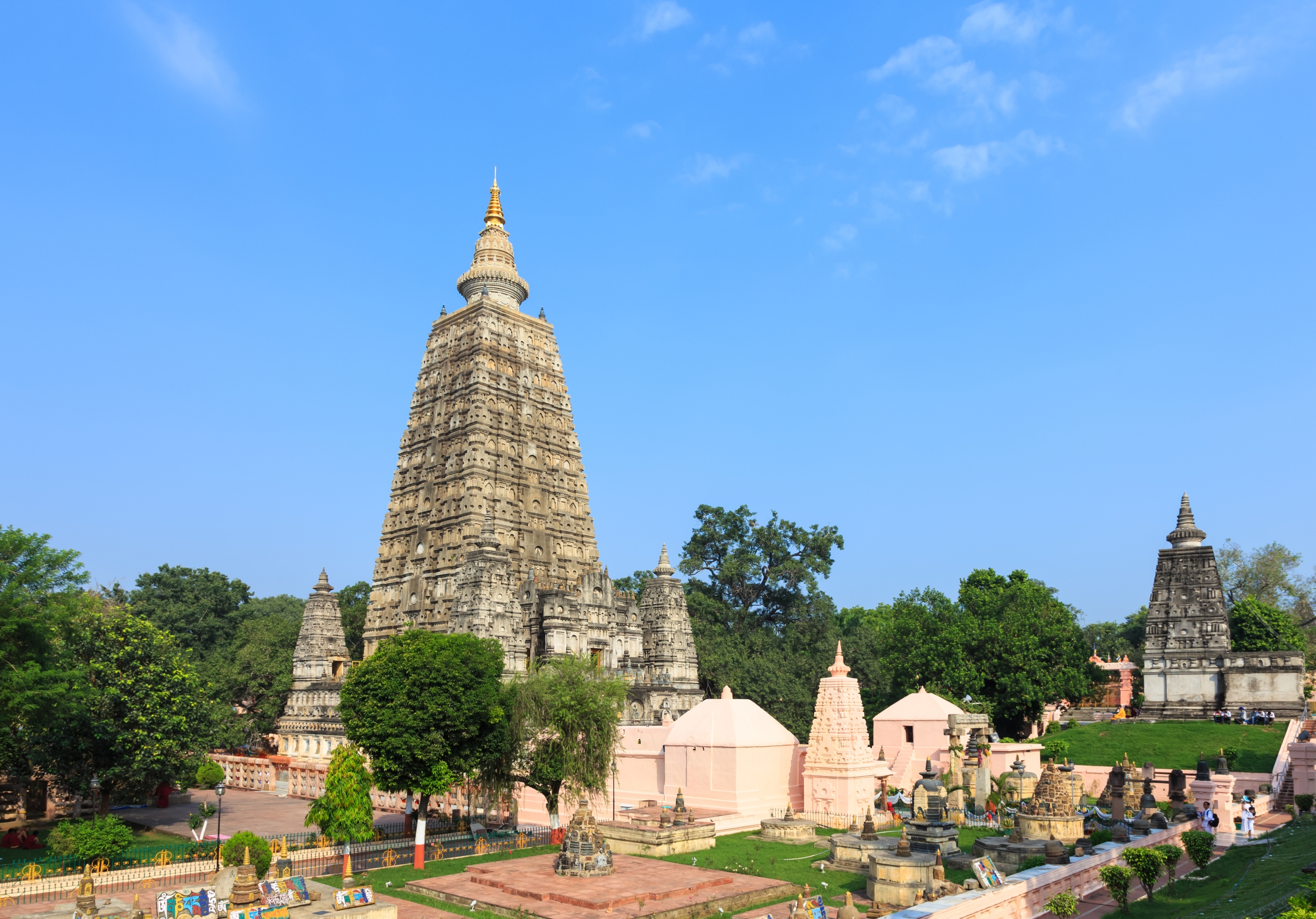
Mahābodhi means “Great Awakening Temple”, and the name belongs first to the event and then to the building raised over its location. The site was monumentalised early. Ashoka built the first temple around 260 BCE, together with the carved stone railings and a memorial column; the present brick structure dates to the Gupta period, the fifth to sixth centuries CE, which makes it one of the oldest brick temples in India. The tower rises roughly fifty metres, a pyramidal shikhara of stacked niches and arch motifs.
Between the temple and the tree lies the object that anchors everything: the Vajrāsana, the diamond throne, a polished grey sandstone slab installed by Ashoka to mark the exact spot — the pṛthvī-nābhi, the navel of the earth. That phrase is worth pausing on. Not a holy place among others. The centre point, from which the rest is measured.
The complex also preserves the seven stations of the seven weeks the Buddha is said to have spent at the site after awakening: the tree itself, the Animeshlocha stupa where he gazed at it without blinking for a week, the Cankamana or jewelled walk, the Ratanaghara, and the rest. The layout is a week of someone’s life converted into architecture.
UNESCO inscribed the complex in 2002. It is administered under the Bodh Gaya Temple Act of 1949 and is open to people of all faiths.
Abandonment and Return
The temple did not stand continuously venerated for two and a half millennia. It was deserted and gradually decayed over the centuries after Buddhism’s decline in India, and what stands today owes a great deal to nineteenth-century restoration — Cunningham and J. D. Beglar’s major campaign, followed by the Sri Lankan revivalist Anagārika Dharmapāla, who founded the Maha Bodhi Society in 1891 and led a global effort to restore Bodh Gayā as the living spiritual capital of world Buddhism.
Which raises the obvious question: what did Buddhists do during the long centuries when the holiest place in their religion was unreachable, overgrown, and in another civilisation’s territory?
They built their own.
The Copies
The desire to visit Bodh Gayā, and the inability of most Buddhists to do so, resulted in replicas of the Mahābodhi Temple being built in several Buddhist countries. This is one of the most remarkable phenomena in the history of sacred architecture, and it is barely known outside specialist circles.
Myanmar went first. A Mahābodhi temple was raised at Bagan in the thirteenth century, and a second at Pegu by the Mon king Dhammaceti in the fifteenth.
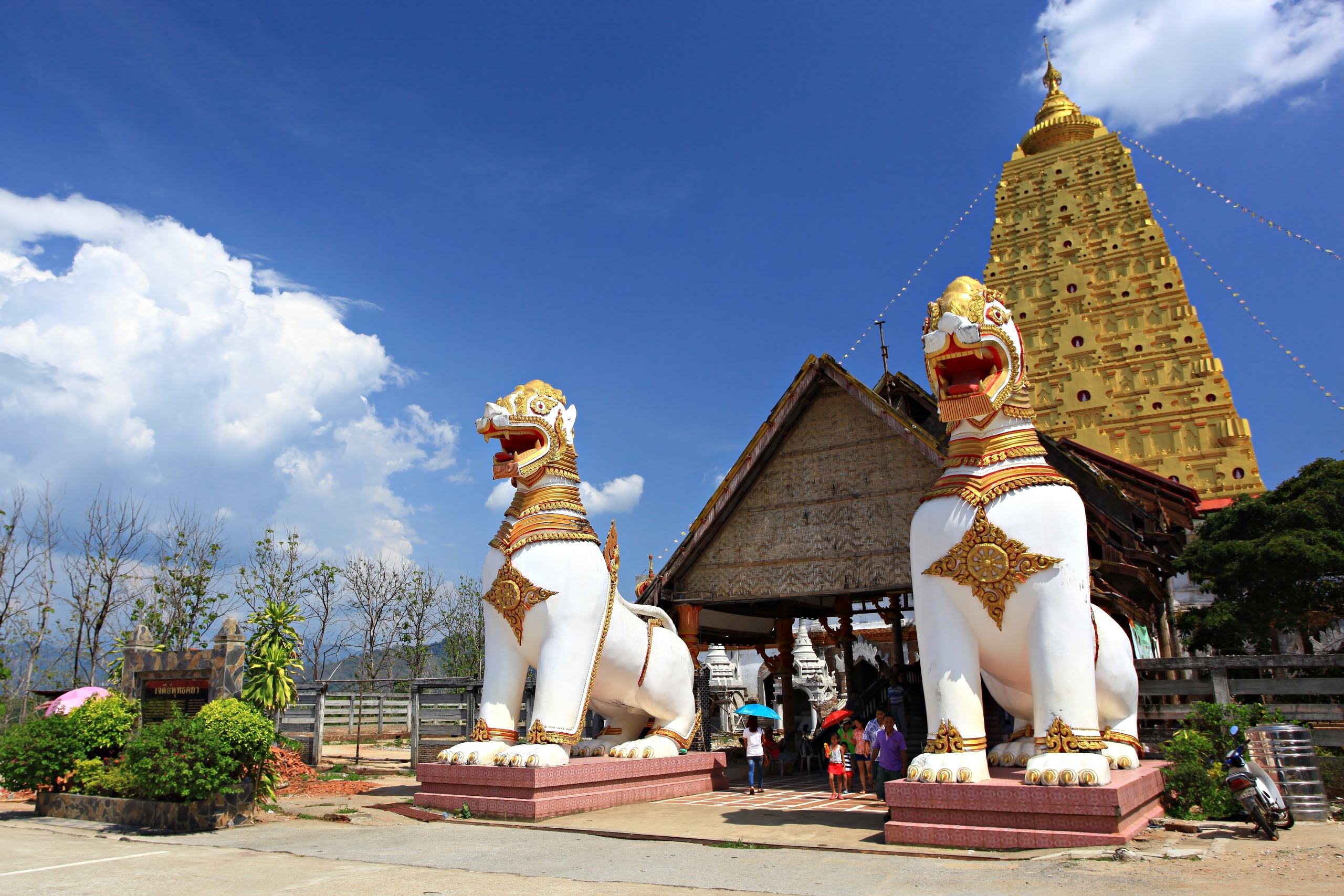
Lan Na followed. King Tilokarāja built Wat Photharam Maha Wihan — Wat Chet Yot — at Chiang Mai between 1455 and 1476. The name means “seven-spired temple,” and the seven spires stand for the seven stages after enlightenment, which are also replicated around the structure. Scholars debate whether the main spire was modelled on the Indian original or on the Burmese copy — a replica of a replica.
China built at least two. In 1473 a copy was raised just outside Peking, and another in 1748. The surviving one is the Zhenjue Temple, known as the Five Pagoda Temple, whose five pagodas represent the towers of the Mahābodhi.
Nepal produced the most touching case. In the sixteenth century a Nepalese layman named Abhaya Raj went on pilgrimage to Bodh Gayā and made both plans and a small model of the temple. On his return he used them to build the Mahābuddha Vihāra at Patan, in delicately moulded terracotta brick. Founded in 1564, it was completed by his descendants in 1601. It was badly damaged in the 1934 earthquake and rebuilt.
A man walked to India, made drawings and a maquette, walked home, and spent the rest of his life building what he had seen. His children finished it.
How a Copy Can Be Real
The mechanism by which these buildings were made is itself revealing. Art historians note that it is likely some replicas were built from the recollections of pilgrims, if not from small portable artworks and models carried away from Bodh Gayā — souvenir temples, sold to travellers, which became the blueprints for full-scale architecture thousands of kilometres away.
The shared design logic is loose but recognisable: four towers surrounding a central larger one. Beyond that, materials and styles vary completely. And a Thai study of the modern replicas found something telling: none of the twentieth-century copies reproduces the layout of the seven stations, and many do not have a Bodhi tree at all — despite the tree being the thing the name refers to.
Which means the replication was never about accuracy. A scholar of the Thai material makes the comparison explicitly: the same thing happens in the Christian world, when one encounters copies of the Holy Sepulchre.
Exactly so. Europe is dotted with Holy Sepulchre replicas built for people who would never reach Jerusalem, and with Sacri Monti reproducing the Via Dolorosa on Italian hillsides. The logic is identical: if the faithful cannot go to the centre, bring a working copy of the centre to them.
The Mahābodhi copies establish, in the phrase used by one museum catalogue, a local sacred place that by proxy evokes the same sentiment and power as the original.
And Still Being Built
The practice never stopped. Lists of Mahābodhi replicas run to dozens of entries across Myanmar, Thailand, Sri Lanka and beyond, with a heavy concentration in the last fifty years — including one in Florida.
Which tells you something. The original is now entirely accessible; Bodh Gayā has an airport and a UNESCO listing and temples built by a dozen national Buddhist communities around its perimeter. Nobody needs a substitute any more.
They build them anyway, because the point was never substitution. A Mahābodhi temple is a claim that the Great Awakening is available here — the same claim Abhaya Raj made in Patan with his drawings, and the same claim the tree makes in Bihar with a root system that has been to Sri Lanka and back.
Go to Bodh Gayā, stand between the temple and the tree at the polished stone slab Ashoka laid down, and you are at the navel of the earth. Then remember that the earth has grown several dozen more navels since, in Myanmar and Thailand and Nepal and Beijing and Florida, and that every one of them was built by someone who understood perfectly well that they were making a copy and did not think that made it less true.
AI Transparency Notice
PilgriMaps uses artificial intelligence tools to assist in the research, drafting and translation of editorial content. All AI-assisted content is reviewed, edited and verified by our editorial team before publication. We contrast information against primary sources, specialist literature and on-the-ground knowledge to ensure accuracy, cultural sensitivity and editorial integrity.
AI is one tool among many in our workflow. The judgement, curation and responsibility for everything published on this platform remain entirely human.
Viator Media S.L. — in compliance with the EU Artificial Intelligence Act (Regulation EU 2024/1689).
This post is also available in: