Two theories of what makes a place holy, both of them Buddhist
A quick clarification before anything else, because the terms get tangled in English-language writing on Buddhism.
Mahābodhi is not a kind of being. It means “Great Awakening” — the event at Bodh Gaya, and by extension the temple built over the spot. It is a place, not a person.
Bodhisattva is the person. And the difference between a tradition organised around the first and a tradition organised around the second produces two entirely different maps of the sacred world.
What the Buddha Told Ananda
The oldest instruction on Buddhist pilgrimage comes from a deathbed.
In the Mahāparinibbāna Sutta, the account of the Buddha’s final weeks, he tells his attendant Ananda that there are four places the sight of which should arouse emotion in the faithful — places that should, in another rendering, cause agitation. The Pali word carries a sense of urgency rather than serenity: not a pleasant visit, but a shock to the complacent.
The four are Lumbinī, where he was born; Bodh Gayā, where he attained awakening; the Deer Park at Sārnāth, where he gave his first teaching; and Kusinārā, where he passed into parinirvāṇa.
Later commentaries added four more, sites of miracles — Rājagaha, Shrāvastī, Saṅkāśya and Vaiśālī — producing the Eight Great Places.
Look at what those four have in common. Every one is biographical. Born here, awakened here, taught here, died here. They are the coordinates of a life, and you visit them for the same reason you visit any site where something once happened.
And there is a doctrinal reason it has to be this way. The Buddha entered parinirvāṇa, which means precisely that he is not available. There is no sense in which he can be met at Kusinārā, or petitioned, or encountered. What remains at these places is relics, the ground itself, and the fact of what occurred.
This is pilgrimage to a memory. It is arguably the purest form of the thing, and it is also a demanding one, because it offers the pilgrim no one to talk to.
The Vow That Changes Everything
Now introduce the bodhisattva.
Across all Buddhist traditions the term means a being on the path to awakening — the Buddha himself is a bodhisatta in the Pali texts before the night at Bodh Gayā. But in the Mahāyāna the concept becomes the centre of the religious life, and it acquires a specific vow: not to pass into final nirvāṇa while beings remain unliberated.
That is a small doctrinal adjustment with enormous geographical consequences. An awakened being who does not exit is an awakened being who is still here. Who can be addressed. Who may respond. And who, in Mahāyāna cosmology, has somewhere to be.
A word of caution before going further. This is a difference of emphasis, not a wall. Mahāyāna pilgrims have always gone to Bodh Gayā in enormous numbers. Theravāda Buddhism has its own rich devotional life and its own bodhisatta figures, Maitreya among them. And the old polemical framing — one tradition selfish, the other compassionate — is a piece of sectarian argument that scholarship has discarded. What follows is about where the centre of gravity lies, not about a border.
Four Mountains, Four Residents
In China, the bodhisattva vow produced a sacred geography with no parallel in the older tradition: four mountains, each identified as the bodhimaṇḍa or daochang — the seat, the place of practice — of a specific bodhisattva.
Mount Wutai in Shanxi, the five-terrace mountain, belongs to Mañjuśrī, bodhisattva of wisdom.
Mount Putuo, an island in the East China Sea south of Shanghai, belongs to Guanyin — Avalokiteśvara, bodhisattva of compassion, who in China took female form. It has been a pilgrimage site for over a thousand years.
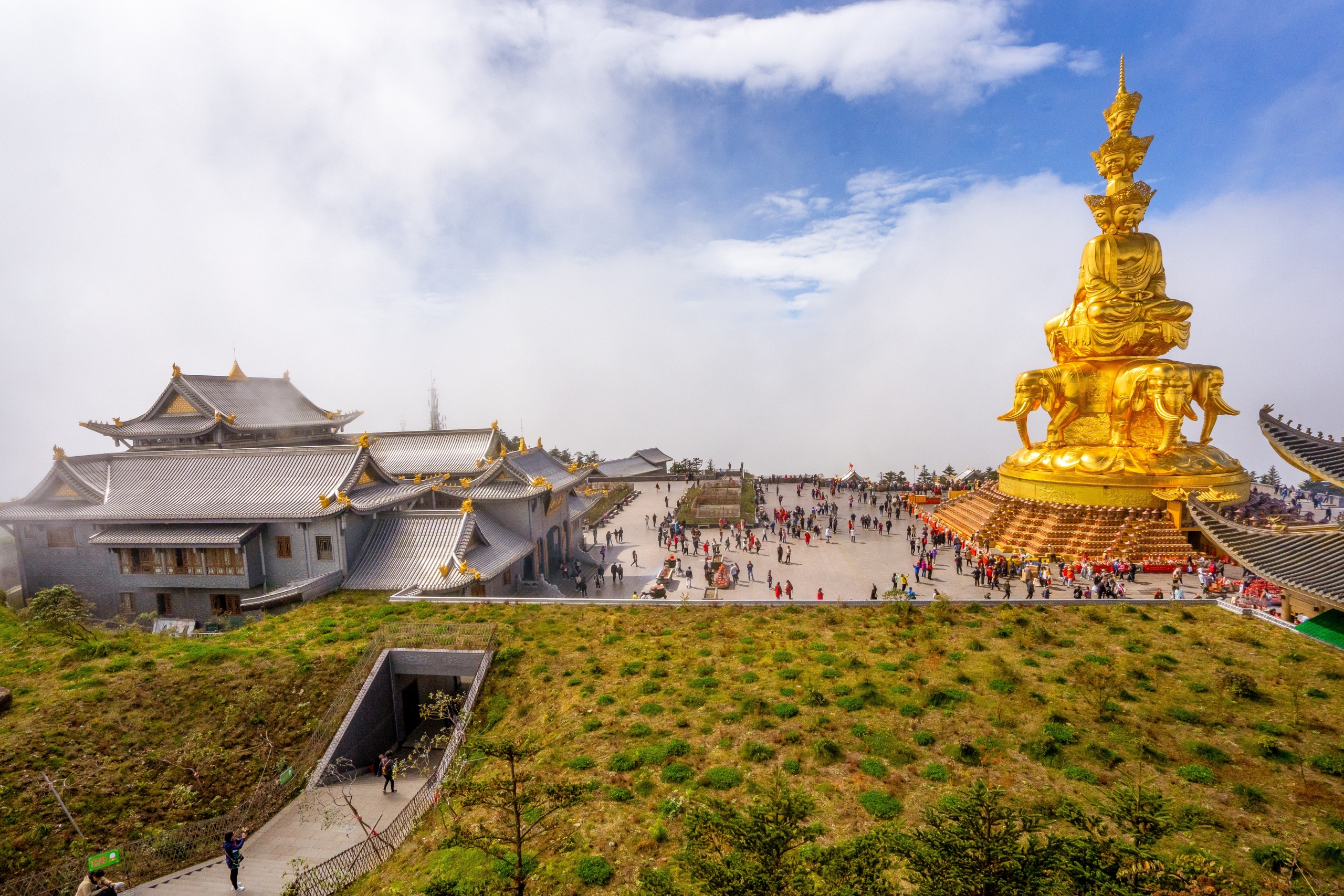
Mount Emei in Sichuan, highest of the four, belongs to Samantabhadra, bodhisattva of practice.
Mount Jiuhua in Anhui belongs to Kṣitigarbha, Dizang, who vowed to empty the hells before accepting buddhahood. The mountain once held some 360 temples and monasteries housing four to five thousand monks and nuns, and is known for its flesh-body relics — the preserved bodies of monks, displayed rather than buried.
The Chinese names for the set are wonderfully blunt about their relative prestige: Gold Wutai, Silver Putuo, Copper Emei, Iron Jiuhua. The tradition holds that these mountains are the sacred abodes where the four bodhisattvas manifested in order to guide sentient beings.
Abodes. Not sites. Addresses.
The Difference on the Ground
Here is what that means for a person who has travelled a long way. At Kusinārā you stand where the Buddha died, and the appropriate response is the saṃvega the sutta names: a jolt of recognition that everything, including a Buddha’s body, ends. Nobody is going to appear. That is the teaching.
At Wutai Shan, pilgrims have for over a millennium climbed the terraces in the specific hope of seeing Mañjuśrī. Not of contemplating him — of seeing him. Chinese and Japanese pilgrim accounts of the mountain are full of lights, apparitions, figures on the ridge, encounters that the writers report as events rather than visions. The mountain is not a monument to a bodhisattva. It is where he lives.
One journey commemorates an absence. The other seeks a presence.
The Christian Parallel
Readers of this publication have the comparison available already, because Christianity contains exactly the same split and almost never notices it. Jerusalem, Bethlehem, the Via Dolorosa, the Holy Sepulchre: these are the Buddhist four. Sites of a life. You go because something happened there, and nobody expects to meet anyone.
Lourdes, Fátima, Guadalupe, Knock: these are the mountains. Sites where someone came — and, crucially, might come again. The pilgrim at Lourdes is not primarily commemorating 1858. They are at a place where the Virgin is understood to be particularly reachable.
The Camino de Santiago sits interestingly between the two, which may be why it has proved so durable. It ends at a tomb, which is biographical. But the Apostle is understood to intercede, which makes Compostela an address as well as a grave.
Why It Matters to a Traveller
Because it tells you what the place is asking of you.
At a biographical site, the work is attention. You are there to look at something that happened and to let it change how you understand your own situation. Nothing will be given to you; the site is not a transaction.
At a residence, the work is approach. There is a correct way to draw near to someone who is present, and the architecture will tell you what it is: the circumambulation, the prostration, the ascent on foot, the offering left at the shrine. These places have a protocol because somebody is home.
Most pilgrims, in practice, do both, often at the same site and without distinguishing them. But the two logics are genuinely different, they arise from a real doctrinal divergence about what an awakened being does after awakening, and between them they account for most of the sacred geography of Asia.
Both are Buddhist. Neither is a corruption of the other. And the place where they meet — where a biographical site was rebuilt across a continent as an address — is the Mahābodhi Temple at Bodh Gayā, which is the subject of the next article.
AI Transparency Notice
PilgriMaps uses artificial intelligence tools to assist in the research, drafting and translation of editorial content. All AI-assisted content is reviewed, edited and verified by our editorial team before publication. We contrast information against primary sources, specialist literature and on-the-ground knowledge to ensure accuracy, cultural sensitivity and editorial integrity.
AI is one tool among many in our workflow. The judgement, curation and responsibility for everything published on this platform remain entirely human.
Viator Media S.L. — in compliance with the EU Artificial Intelligence Act (Regulation EU 2024/1689).
This post is also available in: