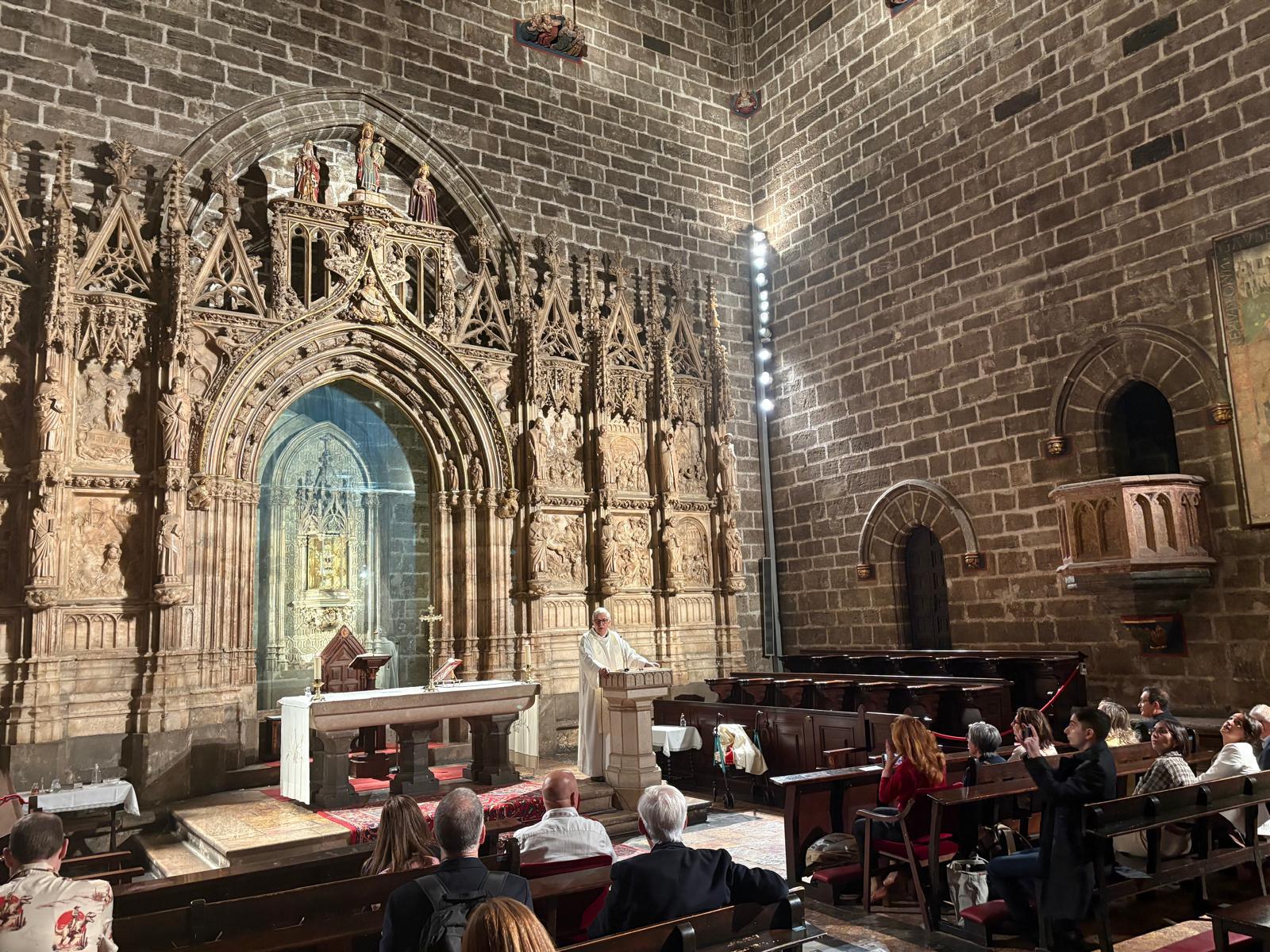
Six hundred thousand visitors in a single year, and nine out of ten arrive with the same question. According to figures from Valencia’s Cathedral cited during the Fourth International Congress on Communication and Journalism of the Holy Grail Trail, 90% of those who entered the cathedral this year asked about the Holy Chalice, the agate cup traditionally identified with the chalice used at the Last Supper, which the cathedral has housed since 1437.
The interest is already there, and it is international. The congress, held on November 12–13 at the Massamagrell Cultural Center, just outside Valencia, focused on the other half of the equation: how to turn a route crossing Spain, France, and Italy, with connections extending to Jerusalem, Turkey, Portugal, and Mexico, into a story capable of reaching newsrooms across Europe. The congress was organized by Asociación Internacional El Camino del Santo Grial and brought together representatives from Turkey, Italy, France among other countries.
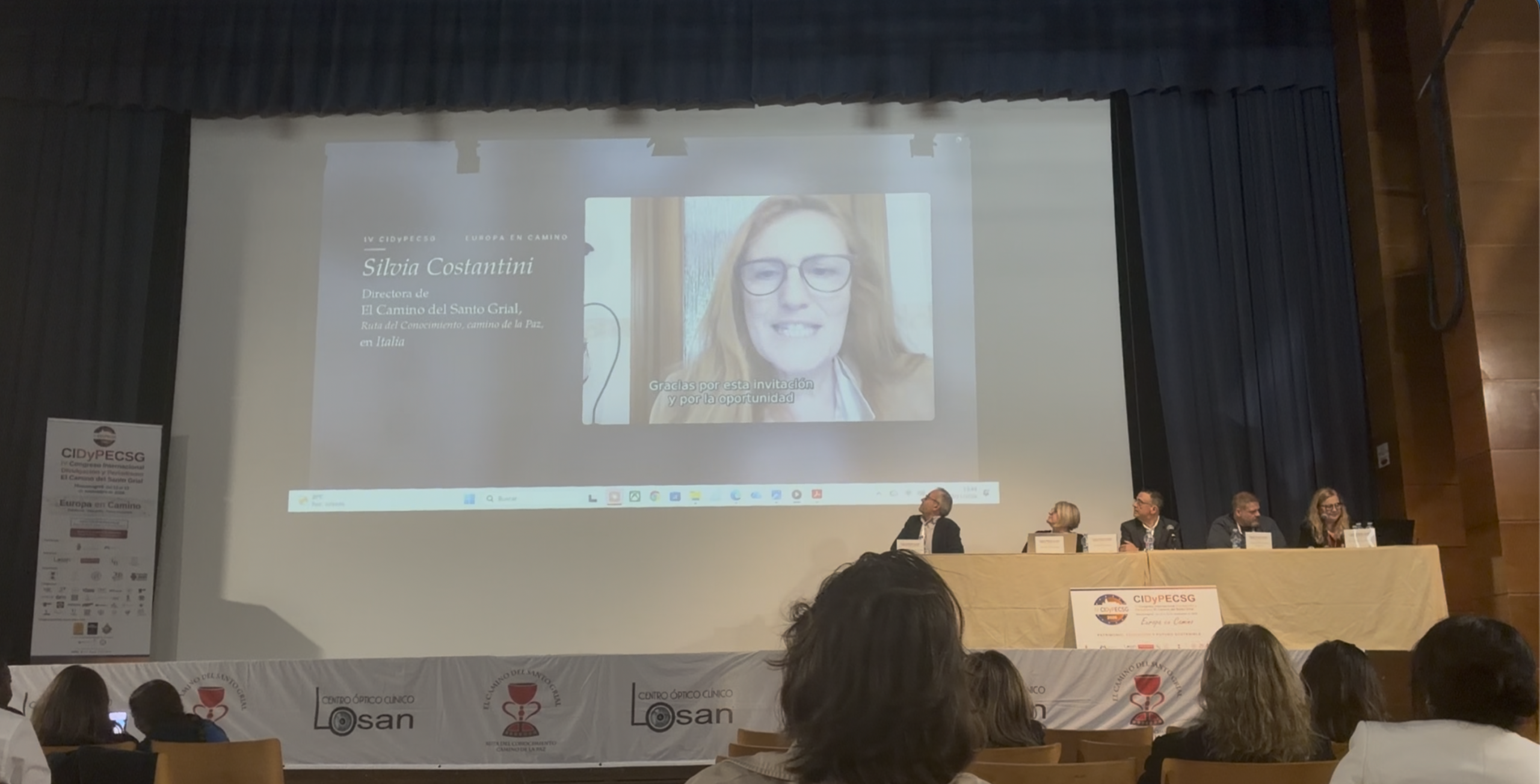
It was in this context that Silvia Costantini, co-founder of PilgriMaps, presented a practical proposal.
Two Days Connecting Research and Local Communities
The congress, named Europa en camino: patrimonio, educación y futuro sostenible (Europe on the Move: Heritage, Education, and a Sustainable Future), followed a carefully structured program.
The opening session brought together Marian Cano, Valencia’s Regional Minister for Innovation and Tourism; Rui Gomes, director of the European Institute of Cultural Routes; Francisco Gómez Laserna, mayor of Massamagrell; Ana Mafé García, president of the international association behind the route; Nathalie Kohl, its managing director; and Álvaro Almenar, custodian of the Holy Chalice.
The discussions began with the scholarly foundations of the route, including iconological methodology and the documentary connections linking Jerusalem, the Mediterranean, and Europe. They then moved into the practical realities of municipalities, schools, libraries, and international networks.
Friday’s closing session, Comunicar Europa y construir futuro (Communicating Europe and Building the Future), placed the media at the center of the conversation.
Panel 9, Contar Europa desde el Camino: periodismo, audiovisual y una narrativa común (Telling Europe’s Story Through the Trail: Journalism, Audiovisual Media, and a Shared Narrative), was moderated by Cristina Monzón Martí, CEO of Avanza Grial. Alongside Costantini, the program featured journalists and publishers from the Valencian media landscape, including À Punt, 24/7 Valencia, El Meridiano, and Grupo D’Aquí.
The Proposal: A European Editorial Strategy
Costantini began by acknowledging the work already accomplished. The route’s technical, historical, and territorial foundations, she said, are “more than firmly established.”
The next step is to “transform this wealth of knowledge into a dynamic, accessible narrative capable of inspiring international audiences.” Her proposal draws on PilgriMaps’ experience.
“For us, cartography goes far beyond a set of coordinates,” she explained. “It provides the infrastructure on which stories are built, the framework that allows travelers and readers to connect places, people, and memories along a route.”
From this perspective, she proposed establishing a European editorial coordination network built directly on the Holy Grail Trail’s existing partnerships.
Its purpose would be to transform historical research and local experiences into compelling journalistic and cultural content capable of attracting media interest across several countries.
The editorial principle is strategic: prioritize stories that become more powerful when told together. One example is the historical and symbolic connection between the austere Pyrenean setting of the Monastery of San Juan de la Peña and Valencia Cathedral.
The same approach could apply to research connecting archives in different regions, living traditions that acquire new meanings, or heritage conservation projects shared by local communities.
With a common editorial direction, Costantini observed, a feature article, a documentary, or a podcast series can become interconnected parts of a single European cultural project, while respecting each creator’s individual voice and perspective.
Models That Are Already Working
Costantini grounded her proposal in three existing examples. The European Association of the Via Francigena has published a magazine in three languages since 2005, helping strengthen the route’s shared identity.
In 2021, the Road to Rome relay covered 3,200 kilometers (approximately 2,000 miles) from Canterbury to Santa Maria di Leuca. The journey was supported by an audiovisual and editorial campaign that, according to ENIT, the Italian National Tourist Board, generated more than 500 articles in the international press.
The third example is World Heritage Journeys, a UNESCO initiative developed with National Geographic and co-funded by the European Union. It brings together 34 heritage sites across 19 countries through four thematic itineraries, presented within a unified storytelling framework.
“Connecting content from different regions,” Costantini concluded, “exponentially increases its reach and international impact.”
Historical Rigor as a Foundation for Credibility
Perhaps the most delicate part of Costantini’s presentation concerned editorial methodology. Historical research, religious tradition, and the fascinating literary mythology surrounding the Grail, she argued, all have a legitimate place in communication, provided they are clearly distinguished.
“Explaining the sources rigorously and drawing clear boundaries between history, devotion, and legend” strengthens the project’s institutional credibility and respects the audience’s intelligence. Contributions from representatives of Valencia Cathedral during the congress illustrated why this distinction matters.
Álvaro Almenar, custodian of the Holy Chalice, emphasized that the cup itself provides significant evidence from a scientific perspective. Jaime Sancho, a cathedral canon and historian, pointed to the body of research supporting the Holy Chalice’s authenticity. Such a substantial body of scholarship offers valuable material for journalism. But turning it into news that resonates across Europe requires precisely what Costantini described: giving newsrooms direct access to research, firsthand accounts, and verified documentation, while fully respecting their editorial independence and freedom to choose their own approach.
Sancho also offered an insight into the experience of pilgrimage itself. Pilgrims, he explained, seek to enter into an experience larger than themselves, one that connects them with those who walked before them and those walking beside them, enriching them both personally and spiritually. That is the raw material of every compelling travel story.
Measuring Impact and Starting Small
To evaluate the proposed strategy, Costantini identified three key indicators: the quality of media coverage, the geographic diversity of the publications involved, and the ability to generate new strategic partnerships. These measures, she added, would also help demonstrate the project’s value to European institutions.
The same questions of governance, funding, and performance indicators were addressed immediately afterward in Panel 10. Her final proposal was deliberately practical: agree on a common editorial direction, identify three pilot themes, and establish a flexible working group, allowing the initiative to develop gradually and in proportion to the resources available.
Six hundred thousand people have asked about the Holy Chalice in a single year. The question now is whether the network can respond with a shared voice, across multiple languages.
For Costantini, the goal is to ensure that every region “gains visibility and relevance by becoming part of a European story that brings us together and helps us understand one another better.”
AI Transparency Notice
PilgriMaps uses artificial intelligence tools to assist in the research, drafting and translation of editorial content. All AI-assisted content is reviewed, edited and verified by our editorial team before publication. We contrast information against primary sources, specialist literature and on-the-ground knowledge to ensure accuracy, cultural sensitivity and editorial integrity.
AI is one tool among many in our workflow. The judgement, curation and responsibility for everything published on this platform remain entirely human.
Viator Media S.L. — in compliance with the EU Artificial Intelligence Act (Regulation EU 2024/1689).
This post is also available in: