On the outskirts of Rabat, near the walled city of Mdina, networks of subterranean chambers (catacombs and hypogea) extend beneath the limestone plateau, forming part of the largest archaeological evidence of Roman culture and early Christianity in Malta, alongside Saint Agatha’s catacombs–also in Malta. These complexes were carved and used between the third and eighth centuries CE, and they preserve burial spaces, inscriptions, and architectural features that reflect a community situated at the maritime crossroads of the central Mediterranean. One of these complexes is known as Saint Paul’s Catacombs, the largest in the Maltese archipelago, probably only second to those found in Rome.
For travelers tracing Mediterranean pilgrimage routes -whether by sea or along Malta’s emerging cultural itineraries—the site offers insight into how small island communities absorbed and reshaped influences from Rome, North Africa, and the Levant.
Malta in the Roman Mediterranean
Malta entered the Roman sphere in 218 BCE. By late antiquity, it functioned as a minor yet strategically placed outpost between Sicily and the North African coast. The island’s Christian memory is closely linked to the shipwreck narrative in the Acts of the Apostles (Acts 27–28), which recounts how Paul of Tarsus was stranded on Malta en route to Rome.
According to Acts, Paul healed the father of Publius, described as the Roman governor of the island, and remained there for three months. The text does not mention catacombs; these developed later, when burial customs shifted from cremation to inhumation and when Christian communities sought collective underground cemeteries.
Catacombs and communal identity
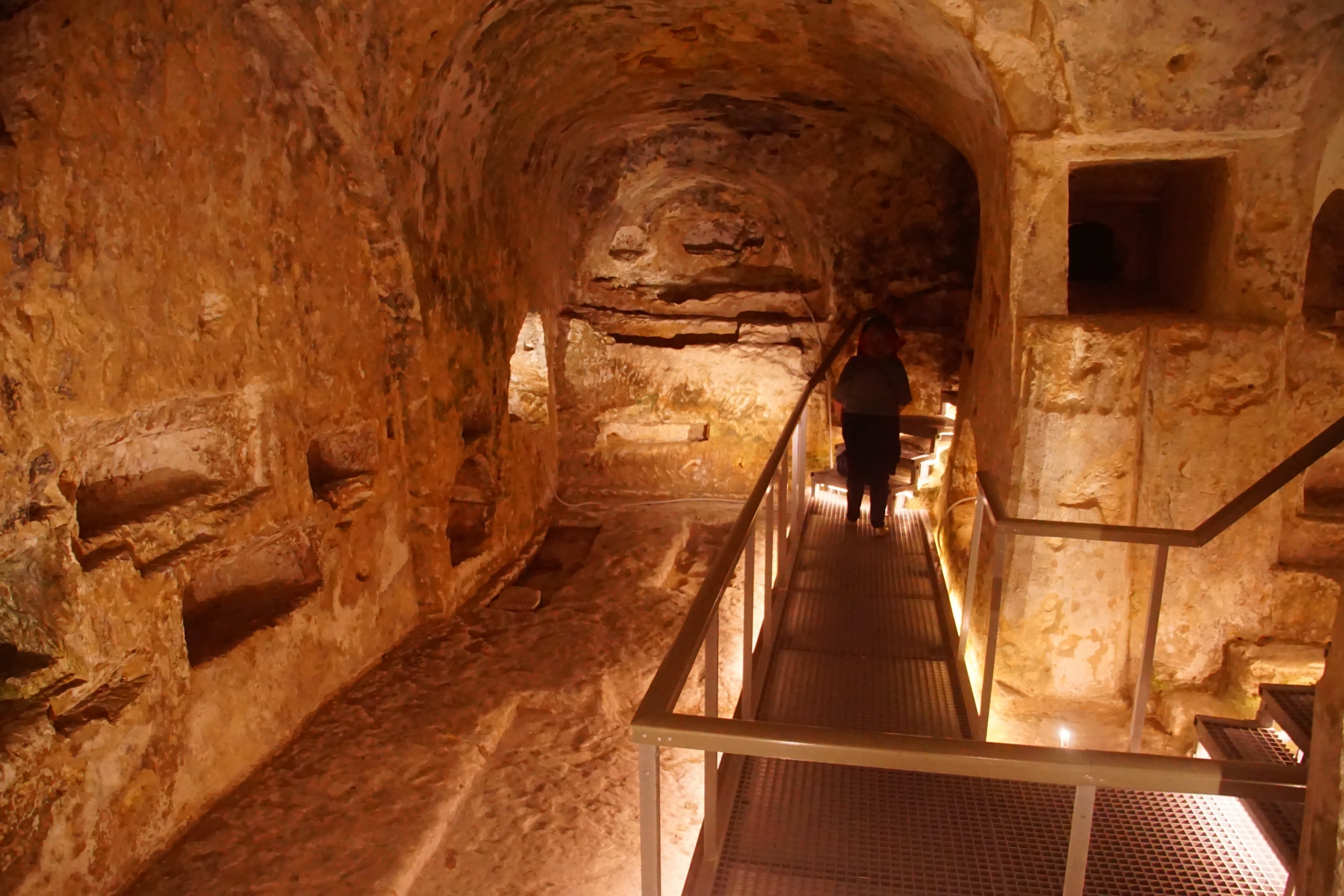
The complex known today as Saint Paul’s Catacombs consists of interconnected hypogea – underground burial chambers cut into soft limestone. Tombs line the walls in loculi (horizontal niches) and arcosolia (arched recesses). Some chambers contain circular tables carved from the rock, often identified as “triclinia” or “agape tables.” These are commonly interpreted as settings for commemorative meals honoring the deceased, though their precise function remains debated.
Unlike the vast catacomb systems of Rome, Malta’s complexes are modest in scale. Their significance lies in density and continuity: they demonstrate an organized Christian presence on the island by the fourth century CE. Inscriptions and symbols, including crosses and chi-rho monograms, indicate evolving funerary language within a broader Roman cultural framework.
One must also keep in mind that Emperor Costantine’s Edict of Milan was also issued in the fourth century (A.D. 313), declaring Christianity as religio lecita (permitted religion) the most probable reason why we only find archealogical evidence of Christianity from this point onwards, in Malta and throughout the territories under Roman rule.
The catacombs also reveal coexistence. Jewish and pagan burial sites have been identified elsewhere in Rabat, suggesting a multi-religious environment during late antiquity. Architectural similarities across communities point to shared artisanal practices and social structures.
The Pauline association
The attribution of the catacombs to Paul arises from later tradition rather than direct archaeological evidence. The nearby grotto venerated as the site of Paul’s imprisonment during his three-month stay on Malta reinforced local identification with the apostolic narrative. Over centuries, devotional geography expanded, linking various sites in Rabat to the events described in Acts.
Ver esta publicación en Instagram
Some Christian interpreters view Malta as one of the earliest points – after the Athens Aeropagus – at which Paul engaged a predominantly non-Jewish audience on European soil. In this reading, the island represents a transitional space in the broader movement toward the Gentile world – a theme central to Pauline literature. The Acts narrative emphasizes hospitality, healing, and exchange rather than formal preaching scenes, yet it situates Malta within the arc of expansion toward Rome – indeed, it is quite telling that Paul healed the father of Publius, the Roman governor. It is also worth keeping in view that according to the Gospels healings lead to conversion of the lealed and his/her family, in fact tradition has it that Publius became the first Bishop of Malta.
From a historical standpoint, the catacombs attest to a Christian community several generations after Paul’s. Their development corresponds to patterns observable throughout the Roman Empire, where urban and semi-urban groups organized collective burial grounds outside city walls.
Subterranean architecture and ritual space
Walking through the catacombs today involves descending narrow staircases into cool, dim chambers. The spatial organization suggests family clusters and extended kinship networks. Carved headrests within tombs reflect attention to bodily positioning in death. Traces of plaster and paint indicate that some chambers were once finished with care beyond bare stone.
The circular tables – distinctive features of the Maltese complexes – have drawn sustained scholarly attention. Their placement within burial chambers implies ritual gatherings connected to remembrance. Comparable installations appear in North African contexts, pointing to maritime cultural exchange across the central Mediterranean.
Above ground, the archaeological park contextualizes the subterranean network within Roman-era Rabat. Remains of domestic structures and roads underscore that these burial sites functioned alongside an active settlement rather than in isolation.
Malta on contemporary routes
Malta underground: From Neolithic shrines to Saint Paul’s grotto
Malta today attracts visitors interested in layered heritage: prehistoric temples, medieval fortifications, and early Christian remains coexist within short distances. Saint Paul’s Catacombs form part of a broader constellation that includes Saint Paul’s Grotto, the parish basilica, the church of Saint Publius and Wignacourt Museum. Together (other sites and artefacts accross Malta) they structure a local route of memory tied to the Acts narrative.
The island’s scale allows travelers to engage these sites within a single day, yet the historical processes they represent span millennia. The catacombs, carved gradually and expanded over time, reflect adaptation rather than a single founding moment.
Spring and autumn offer moderate temperatures for exploration; the underground chambers maintain cooler conditions year-round. Interpretive signage provides archaeological explanations without presuming theological conclusions, enabling visitors from varied backgrounds to approach the site through historical inquiry.
Names, memory, and evidence
As with many locations associated with apostolic figures, the name “Saint Paul’s Catacombs” intertwines tradition and scholarship. Archaeology confirms a robust late antique Christian presence. Textual sources describe a first-century shipwreck and temporary stay. The connection between the two rests on local continuity of memory rather than stratified material proof linking specific chambers to the apostle himself.
Such dynamics are common across Mediterranean pilgrimage landscapes. Names preserve identity; stone preserves practice. In Rabat, the subterranean architecture speaks of communal organization, evolving funerary customs, and participation in imperial networks. The Pauline narrative situates the island within a wider Mediterranean story of movement, trial, and cultural contact.
Descending into the catacombs, visitors encounter an environment shaped by chisels and belief, by geology and social bonds. Emerging again into Maltese sunlight, they rejoin a surface world long accustomed to exchange. The site endures as a record of how insular communities engaged global currents – carving memory into stone beneath the island’s layered terrain.
This content comes to you in collaboration with VisitMalta
AI Transparency Notice
PilgriMaps uses artificial intelligence tools to assist in the research, drafting and translation of editorial content. All AI-assisted content is reviewed, edited and verified by our editorial team before publication. We contrast information against primary sources, specialist literature and on-the-ground knowledge to ensure accuracy, cultural sensitivity and editorial integrity.
AI is one tool among many in our workflow. The judgement, curation and responsibility for everything published on this platform remain entirely human.
Viator Media S.L. — in compliance with the EU Artificial Intelligence Act (Regulation EU 2024/1689).
This post is also available in: