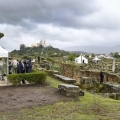
Along the northern coastline of the Maltese archipelago lies St Paul’s Bay, a broad inlet opening toward the central Mediterranean. More than a contemporary seaside town or sheltered harbor, this bay holds a distinctive place in the history of early Christianity. According to long-standing tradition, it was here that the ship carrying Paul of Tarsus ran aground during the winter voyage described in Acts 27–28. That involuntary arrival transformed the bay into one of the most enduring locations of Pauline memory.
While many Mediterranean sites associated with Paul recall dispute, imprisonment, or execution, St Paul’s Bay is remembered as a place of safety. In the narrative of Acts, the shipwreck interrupts hardship and introduces encounter. For Malta, this moment is understood as the beginning of an uninterrupted Christian tradition extending nearly 2,000 years.
The shipwreck and the meaning of arrival
Acts identifies the location simply as Melitē, but from late antiquity onward, Maltese tradition has consistently associated the shipwreck with the sheltered waters of St Paul’s Bay. The text emphasizes reception rather than danger: “The islanders showed us unusual kindness” (Acts 28:2). Fires were lit, the shipwrecked were sheltered, and Paul remained on the archipelago for several months.
This emphasis on hospitality gives St Paul’s Bay a particular symbolic weight. Unlike other Pauline sites defined by preaching, confrontation, or confinement, the bay is defined by welcome and care. In Maltese historical memory, Christianity arrives not through force or argument, but through shelter offered to those in need.
Pauline memory along the shore
The coastline of St Paul’s Bay is marked by monuments that anchor this memory in place. Most prominent is the statue of Paul facing the open sea, positioned near the area traditionally associated with the shipwreck. Offshore lie the small islets known as St Paul’s Islands (Selmunett), frequently included in visual representations of the event.
Churches and chapels dedicated to Paul in and around the bay reinforce the connection between text, tradition, and landscape. These sites form part of a wider network of Pauline locations across the Maltese archipelago, linking the shoreline to Rabat, Mdina, and the island’s interior.
St Paul’s Bay and pilgrimage in Malta
Although St Paul’s Bay is not organized as a formal pilgrimage destination in the way of major sanctuaries, it plays a central role in Pauline itineraries across Malta. For many visitors, it is the first place where the narrative of Acts is anchored to physical geography before moving inland to sites associated with Paul’s winter stay and early local leadership.
Walking routes increasingly connect the bay with Rabat and Mdina, echoing the movement from coast to settlement described in the biblical account. In this way, the bay functions as the point of arrival from which the broader Pauline landscape of Malta unfolds.
Each year on 10 February, during the Feast of St Paul’s Shipwreck, the bay’s role is publicly reaffirmed. While the principal celebrations extend across the archipelago, St Paul’s Bay retains a strong local observance tied to its historical role.
Why visit St Paul’s Bay
For travelers interested in Pauline traditions, St Paul’s Bay offers a rare convergence of narrative, geography, and accessibility. The shape of the bay, its exposure to prevailing winds, and its proximity to ancient routes make the shipwreck account plausible not only symbolically but physically.
Beyond religious history, the site provides insight into how collective memory attaches itself to landscape. The bay illustrates how a brief episode—only a few verses in Acts—can generate centuries of cultural continuity, ritual practice, and place-based meaning.
Practical access
St Paul’s Bay is easily reached from Valletta by public bus or car, typically within 30–45 minutes depending on traffic. Its accessibility distinguishes it from many Pauline sites elsewhere in the Mediterranean, which often require extensive travel or archaeological context to interpret.
This ease of access makes the bay particularly suitable for visitors who wish to integrate pilgrimage themes into a wider cultural itinerary, whether through guided routes or independent exploration.
A place of refuge in the Pauline world
Within the wider geography of Paul’s journeys, St Paul’s Bay represents a contrast. Elsewhere, his path is shaped by hostility, trials, and eventual execution in Rome. Here, the narrative pauses. The sea releases its hold, strangers become hosts, and movement gives way to stability.
For Malta, this distinction has long been central. St Paul’s Bay is remembered not as a site of suffering, but as the place where continuity begins. In the Mediterranean context, it stands as a reminder that early Christian history was shaped not only by persecution and martyrdom, but also by moments of welcome and care.
To visit St Paul’s Bay is therefore to encounter a foundational scene of arrival—where travel becomes encounter, and where a brief refuge gave rise to a lasting tradition.
This content comes to you in collaboration with VisitMalta
AI Transparency Notice
PilgriMaps uses artificial intelligence tools to assist in the research, drafting and translation of editorial content. All AI-assisted content is reviewed, edited and verified by our editorial team before publication. We contrast information against primary sources, specialist literature and on-the-ground knowledge to ensure accuracy, cultural sensitivity and editorial integrity.
AI is one tool among many in our workflow. The judgement, curation and responsibility for everything published on this platform remain entirely human.
Viator Media S.L. — in compliance with the EU Artificial Intelligence Act (Regulation EU 2024/1689).
This post is also available in: