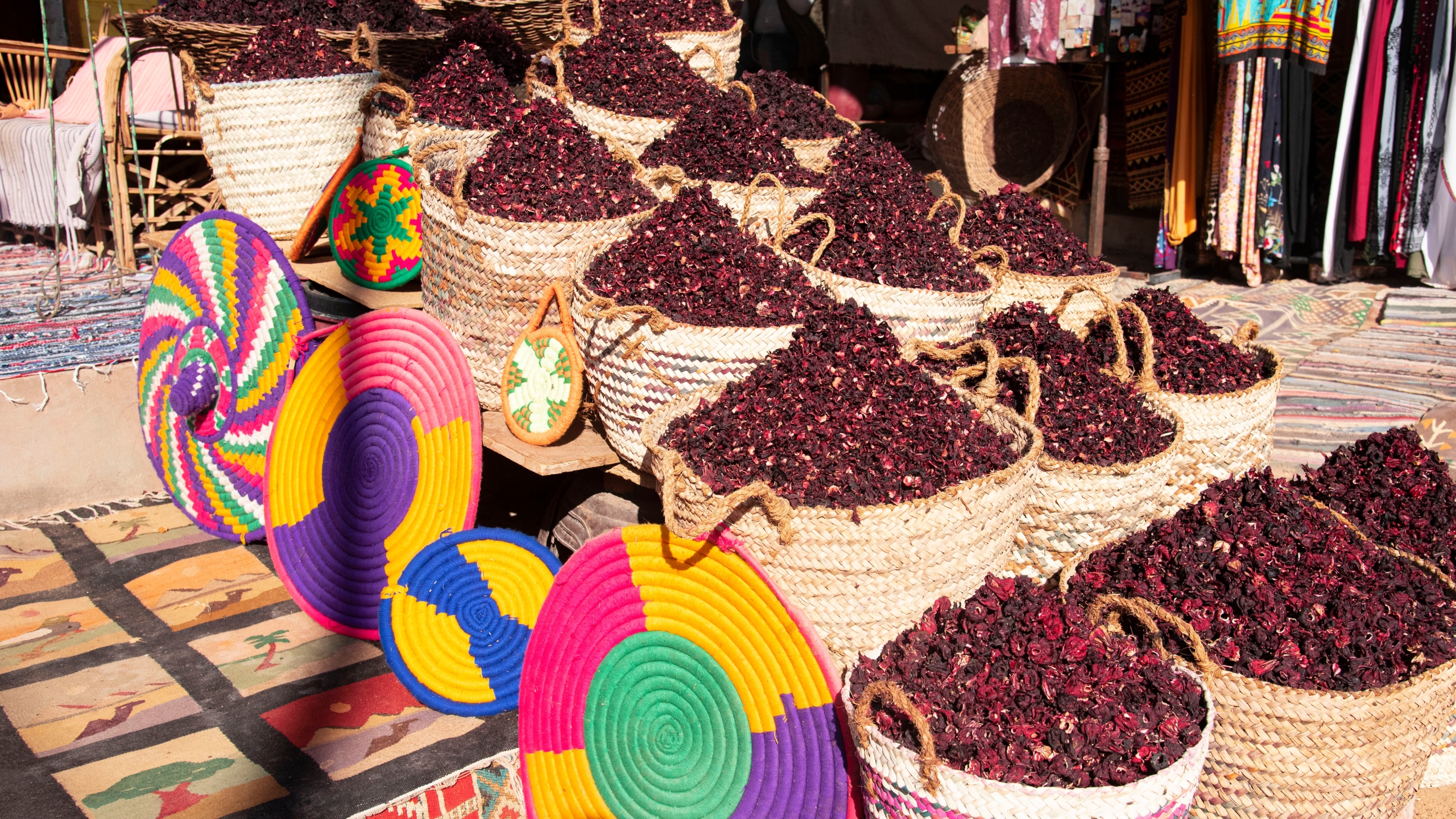
In Aswan, the harvest begins when the suffocating heat finally breaks. It is November, and the sun falls at an angle over the Nile. In the fields stretching between Kom Ombo and Daraw, women pick the fleshy hibiscus calyces by hand, one by one. Contrary to what many people believe, these are not the flowers. The actual flower is pale, lives for a single day, and then withers. What is harvested, and what will become karkadè, is the calyx: the crimson casing that swells around the seed immediately after flowering.
It has the color of a ripe pomegranate and feels waxy to the touch, almost damp.
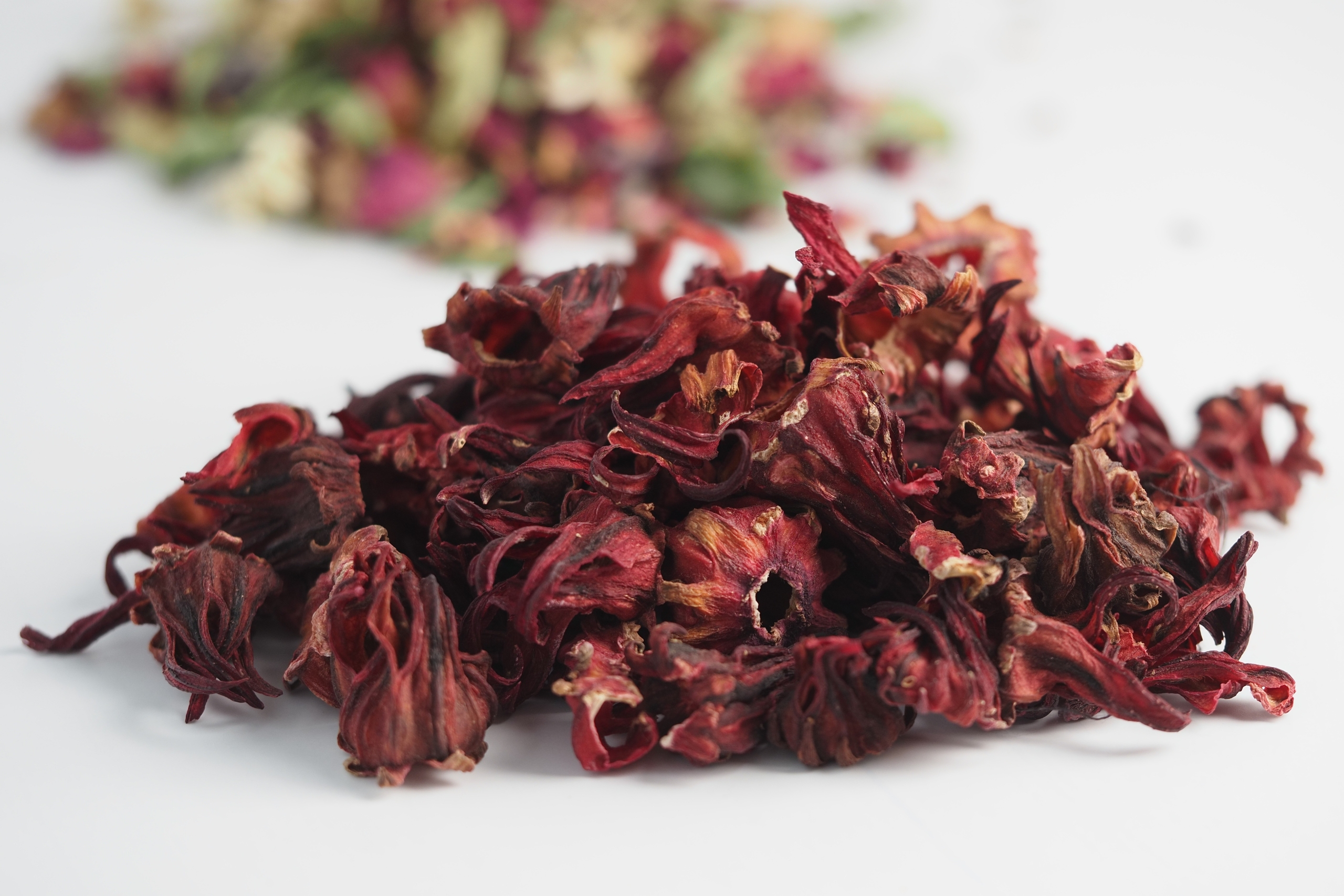
Then the drying begins. The calyces are spread across packed-earth terraces, exposed to the relentless, enveloping sun of Upper Egypt. In three days they lose water and gain concentration, turning into dark, light, fragile flakes. It takes about ten kilos of fresh harvest to produce a single kilo of dried karkadè.
From those dusty courtyards, the flakes set off for the markets of Cairo. And from there, to the rest of the world.
What karkadè really is: the flower that is not a flower
Its scientific name is Hibiscus sabdariffa L., and it belongs to the mallow family. It is botanically related to cotton and cacao: plants that have shaped the world economy in quiet but profound ways.
In Arabic it is called karkadeh (كركديه), in Senegal it is known as bissap, in Mexico it becomes agua de jamaica, and in Nigeria it is called zobo. In Italy, because of a curious historical interlude, it is also known as carcadè.
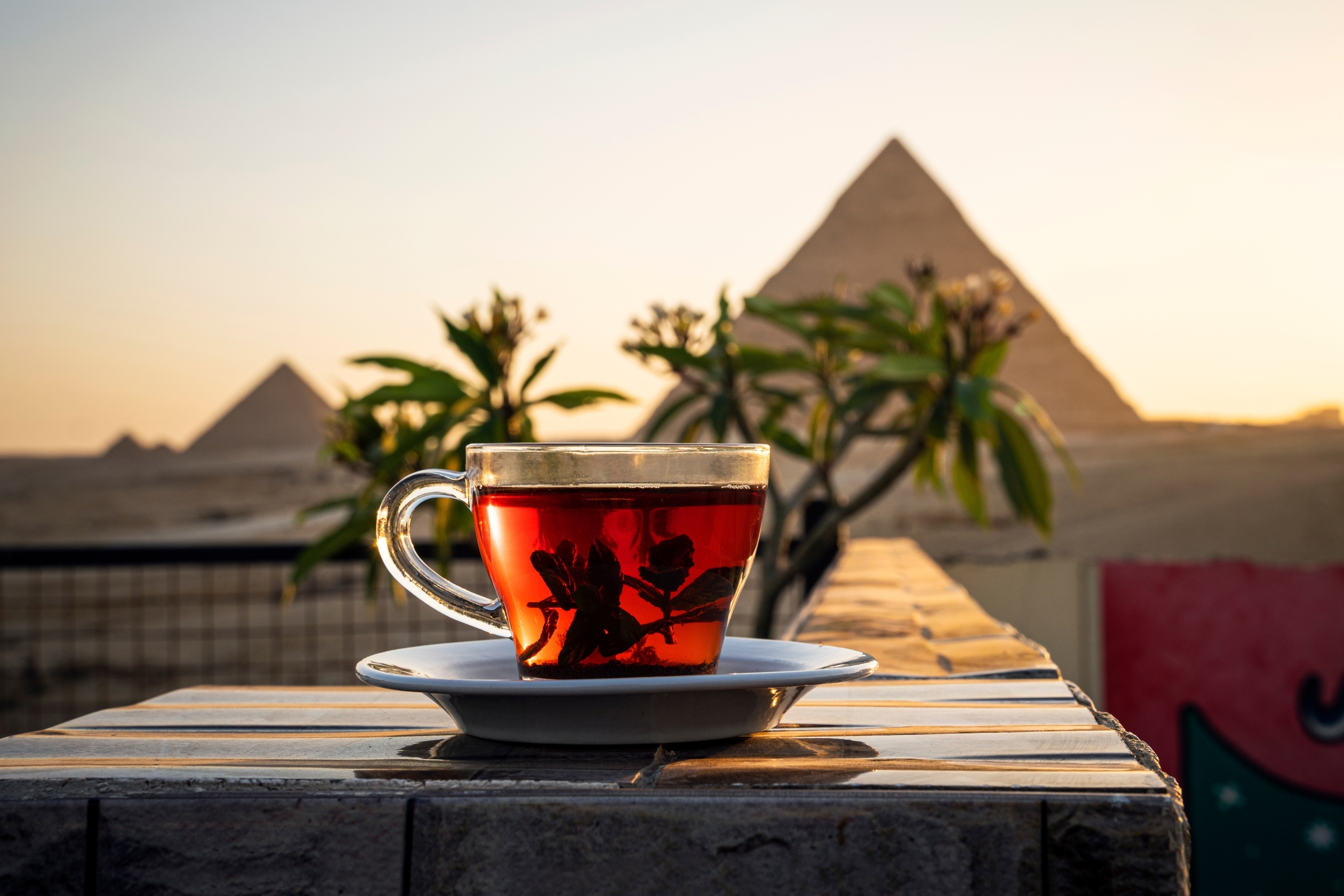
In Egypt, this caffeine-free infusion is served and drunk hot in winter, iced in summer, and always presented in clear glass cups so its vivid red color can put on a show.
Its flavor is sharp, clean, and tart, with a lingering note reminiscent of cranberry and red currant. It is a vigorous drink, and a difficult one to give up.
Nubian roots: a history older than the pyramids
According to major botanical and anthropological studies, from George Peter Murdock’s 1959 research to scientific databases such as PROTA, the plant’s first domestication is placed in sub-Saharan Africa, more specifically in western Sudan, before 4000 BCE. This suggests that Hibiscus sabdariffa is not originally Egyptian.
The plant was first domesticated for its seeds, rich in oil and protein. Only later did people begin using the leaves and, finally, the calyces.
Karkadè traveled up the Nile Valley. Its route followed the ancient Nubian pathways: from Kordofan and Darfur toward Nubia, and then into Upper Egypt. It was the same corridor along which gold, ivory, and incense once moved. Later, trans-Saharan caravans carried it westward as far as Senegal, while transatlantic trade routes brought it to the Americas. There, the African diaspora planted it in the Caribbean and Mexico as an act of memory, preserving part of its own food culture.
Today, agua de jamaica is a pillar of Mexican gastronomy, even though few remember that its roots actually lie in the lands of Sudan.
The “tea of the pharaohs”: myth and historical reality
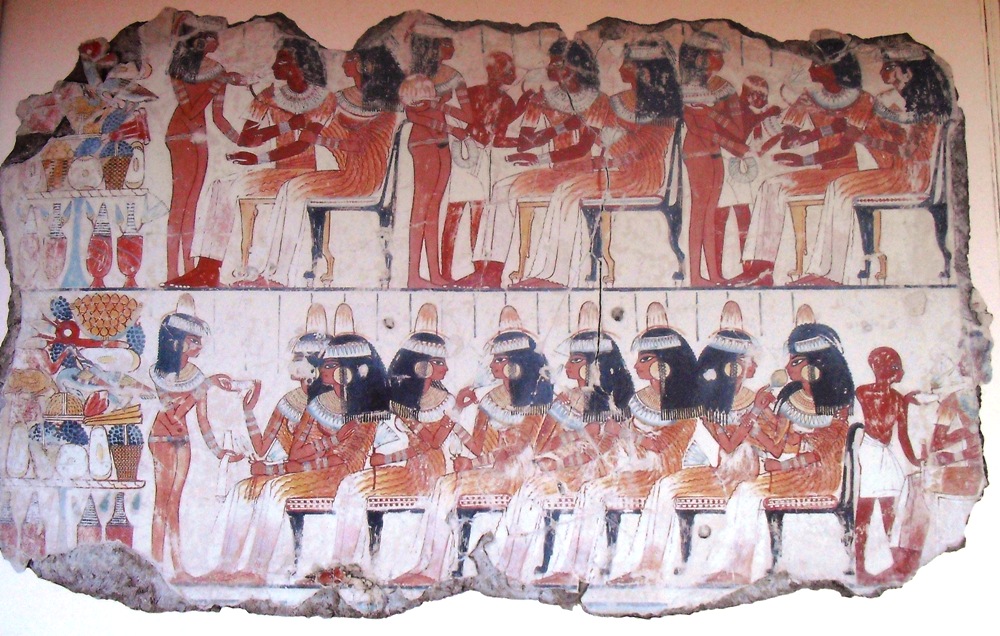
In the souks of Cairo, karkadè is often sold as the “drink of the pharaohs.” Many packages aimed at tourists even cite the Ebers Papyrus, the famous medical treatise from around 1550 BCE, as proof that even Tutankhamun sipped chilled hibiscus.
From a historical point of view, a clarification is needed. Identifying plant species in Egyptian papyri is a complex field, often lacking clear botanical certainty. Solid documentary evidence for the widespread consumption of karkadè in Egypt dates to much more recent periods than the Eighteenth Dynasty. What is historically established, however, is the millennia-old cultivation of hibiscus throughout the Nile basin and the inseparable bond between Egyptian and Nubian traditions.
The story of karkadè does not need false myths. Its real African genealogy is already ancient and fascinating enough on its own.
The art of preparation and the ritual of hospitality
In Egypt, karkadè is a drink to be sipped in company. It is a codified social gesture. It is offered to guests as soon as they cross the threshold of a home. Among the spice stalls and market shops of Khan el-Khalili, it is served almost by default: refusing it is impolite, while accepting it lays the foundation for a conversation.
It is consumed during wedding banquets, where its red color symbolizes a wish for vitality, and it plays a central role during Ramadan evenings. After many hours of fasting, its marked acidity helps rehydrate the body and naturally reawaken the palate.
Preparation varies depending on the desired temperature. Cold version, or karkadè innab: this is made by maceration. The calyces are left in cold water for about eight hours, or overnight, then filtered and sweetened. The result is a clear, bright infusion with gentle, pleasant tones.
Hot version: this is prepared by bringing water to a boil with the calyces for a few minutes. Prolonged boiling would make the drink excessively bitter. It is often enriched with cinnamon sticks, cloves, or a few drops of lemon.
Flavor nuances also vary by region: in Luxor it is prepared in a concentrated, syrup-like form; in Nubia, a lighter and more aromatic version is preferred; while in the Nile Delta, generous sweetening is common.
What science says: properties and clinical studies
The intense red color of karkadè is the visible expression of its biochemical composition. The calyces are rich in anthocyanins, especially delphinidin-3-sambubioside and cyanidin-3-sambubioside, as well as chlorogenic acid, flavonoids, and organic acids. In recent years, scientific research has extensively investigated the properties of this plant, especially its effects on the cardiovascular system.
Blood pressure: several studies have shown that regular intake of three cups a day of hibiscus infusion may help reduce systolic blood pressure levels in mildly hypertensive individuals. Meta-analyses and clinical data: several systematic reviews confirm the effectiveness of hibiscus in supporting blood pressure reduction compared with placebo, thanks to its natural vasodilatory and diuretic properties.
Awareness and limits: although the results are promising, karkadè should be understood as a useful dietary support, not as a substitute for any pharmacological treatment.
Warnings and interactions
As with many active botanical substances, consuming karkadè requires some caution.
- Drug interactions: hibiscus may alter the absorption or metabolism of certain medications, including anti-inflammatory drugs, statins, and specific active compounds.
- Low blood pressure and pregnancy: people with naturally very low blood pressure, as well as pregnant women, should consume it in moderation or after consulting a medical professional.
The economic impact in Upper Egypt
Beyond its cultural and health-related aspects, karkadè represents a crucial component of the local agricultural economy. Cultivation is concentrated mainly in the governorates of Qena and Aswan and in the Fayyum region, areas whose hot, dry climate is ideal for the plant’s maturation.
For thousands of farming families, the hibiscus supply chain is a primary source of income. In recent years, Egypt has consolidated its position among the world’s leading exporters of Hibiscus sabdariffa, supplying both European markets for the herbal tea industry and American markets, where demand for natural products continues to grow.
Egypt’s allure is often associated with its stone monuments: the temples of Karnak, the pyramids of Giza, the tombs of the Valley of the Kings. And yet the authentic identity of a country does not live in granite alone. It is found in everyday gestures, in the culture of hospitality, and in the sips of a deeply colored infusion served in the shade of a portico.
Asking whether karkadè really was the pharaohs’ favorite drink becomes secondary. What matters is its ability, still today, to tell a millennia-old story that links Africa to the Mediterranean.
Frequently asked questions about karkadè
- Does karkadè contain caffeine? No. Hibiscus does not come from the tea plant (Camellia sinensis) and is completely free of caffeine or theine, making it suitable for evening consumption.
- Does karkadè help reduce blood pressure? Scientific studies indicate that the flavonoids and anthocyanins found in hibiscus may support blood vessel relaxation and help control systolic blood pressure. However, it does not in any way replace prescribed medical treatment.
- Is it better to drink it hot or cold? It can be enjoyed both ways. Cold maceration enhances its freshness and reduces bitter notes, while hot extraction intensifies its aroma and spicy tones.
AI Transparency Notice
PilgriMaps uses artificial intelligence tools to assist in the research, drafting and translation of editorial content. All AI-assisted content is reviewed, edited and verified by our editorial team before publication. We contrast information against primary sources, specialist literature and on-the-ground knowledge to ensure accuracy, cultural sensitivity and editorial integrity.
AI is one tool among many in our workflow. The judgement, curation and responsibility for everything published on this platform remain entirely human.
Viator Media S.L. — in compliance with the EU Artificial Intelligence Act (Regulation EU 2024/1689).
This post is also available in: