There is another way to know the island: follow the religious calendar through its kitchens. From the cuinat of Holy Week to the Easter flaó, from the salsa de Nadal to the sweets of the patron saint festivals, food tells the story of a domestic, rural and deeply communal Ibiza.
To know Ibiza you must also learn to read its calendar through what arrives at the table.
Not only the summer, the season of the clubs or the long succession of sunsets that have built the island’s contemporary myth. There is another time, older and less spectacular, marked by religious festivals, vigils, days of fasting and days of abundance. A time in which the kitchen was not a simple accompaniment to celebration, but a part of the rite itself.
In Ibiza, as in many Mediterranean cultures, the Christian calendar contributed for centuries to organising the rhythms of eating. Lent imposed limits; Easter marked the return of abundance; Christmas brought families together around elaborate, handed-down preparations. The patron saint festivals, still today, are occasions where gastronomy, devotion and local identity meet.
It would be wrong, of course, to claim that every traditional Ibizan dish has a directly religious origin. The cuisine of an island is the result of many layers: the landscape, the seasonal availability of ingredients, poverty or abundance, migrations, dominations and Mediterranean exchanges. But some foods are linked in precise ways to the Christian calendar, while others have entered collective memory precisely because they were consumed on the great family and communal occasions.
This is the key to discovering an Ibiza that few tourists know: the one where the sacred has left its traces even in flavour.
Lent: When the kitchen learned restraint
For centuries, religion had a very concrete consequence for the larder. The days of abstinence and the restrictions of Lent guided food choices, encouraging a cuisine capable of using what the land offered and of doing without — at least on certain days — meat.
In Ibiza, one of the most representative dishes of this period is cuinat, a vegetable preparation that belongs to the gastronomic memory of Holy Week. Ibiza Travel defines it as a “vigil soup,” placing it explicitly in the relationship between kitchen and religious calendar. The dish is born from garden and spring landscape ingredients: pulses and various vegetables, combined according to family recipes that can vary from house to house.
Cuinat is interesting not only for what it contains, but for what it represents.
It is a cuisine of the season and of patience. It is made in quantity, can accompany several days of eating, and preserves that domestic logic that precedes contemporary restaurants: cooking does not simply mean producing a dish, but organising family time. A preparation linked to Holy Week thus also becomes a way of marking the duration of the festival.
Religious cooking, after all, rarely arises from abstraction. The spiritual rule meets available matter. Fasting or the renunciation of meat translates into a valorisation of vegetables, pulses and local produce. In Ibiza, cuinat tells exactly this intersection: faith sets a rhythm, the land provides the ingredients.
In the island’s tradition, Holy Week was not lived only in the church or along the processional route. It was lived in the kitchens, in the smell of the pots and in the repetition of gestures known for generations.
Easter and the flaó: Cheese, eggs, mint
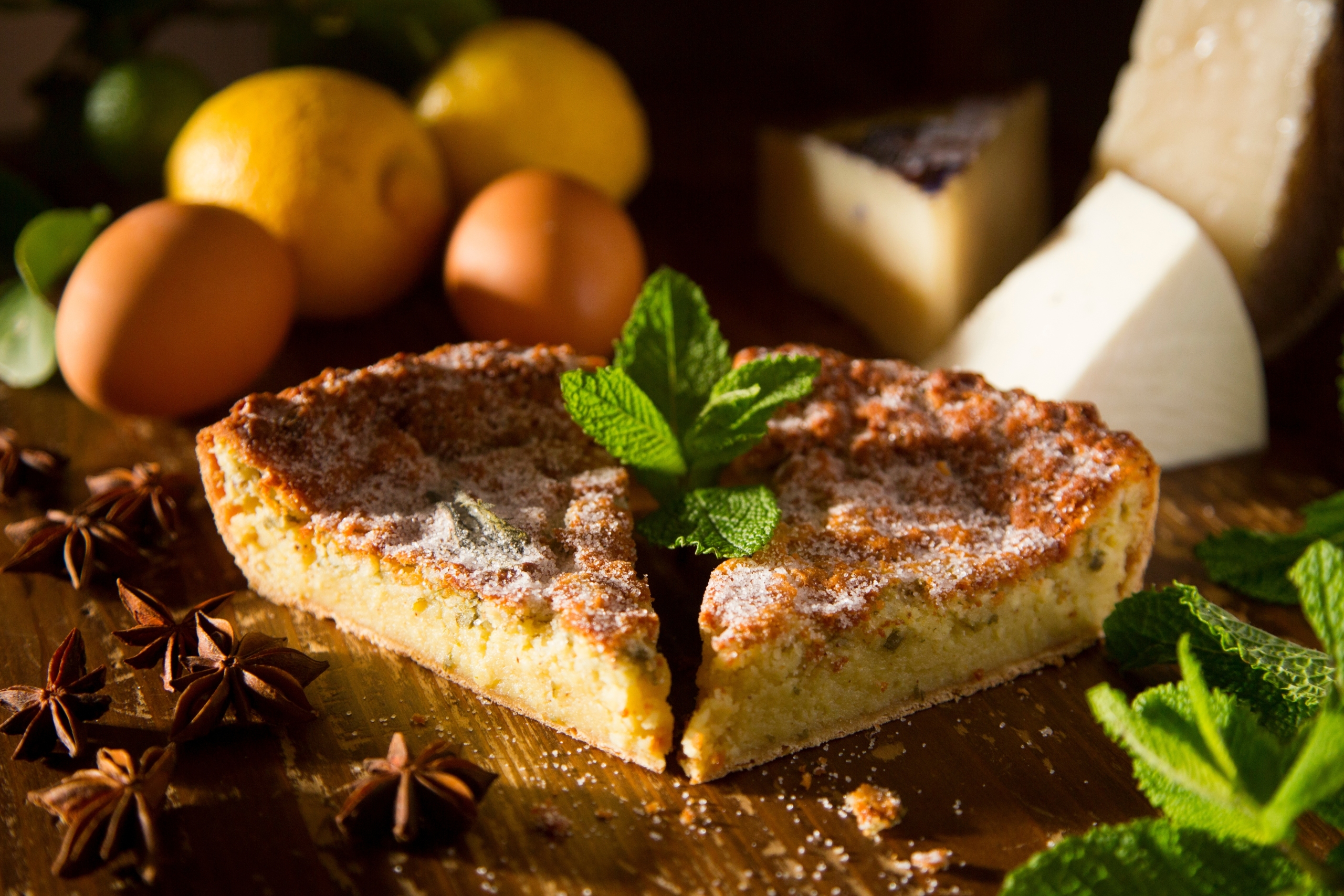
If cuinat represents the restraint of the vigil, the flaó is the great flavour of Ibizan Easter.
Today it is found throughout the year and has become one of the island’s most recognisable gastronomic symbols. But its traditional association is with Easter: it was prepared above all for Easter Sunday. Spring, the end of the period of restriction and the return to celebration all meet in a tart that combines eggs, fresh cheese and wild mint — a particular aromatic note that distinguishes Ibiza’s flaó from other similar Mediterranean preparations.
Its history is layered. According to Ibiza Travel, the name derives from flado, a term documented as far back as late antiquity for a preparation of pastry with cheese and eggs, while the Ibizan flaó has passed through different influences and cultures over the centuries. For this reason, it is more accurate to read it as a product of long Mediterranean sedimentation than as the result of a single origin.
Its link with Easter, however, is perfectly clear.
After Lent, the ingredients of abundance return to the fore: eggs, milk transformed into cheese, sugar. It is the gastronomic language of celebration. But what makes the flaó particularly Ibizan is the mint — the wild mint — which introduces into the sweet an almost vegetable element, fresh and surprising.
For those who taste it for the first time, the encounter between cheese and mint can be unexpected. And it is precisely here that the flaó reveals its identity: it does not seek to be universally reassuring. It has a precise flavour, born of a territory and a tradition.
In a culture dominated today by standardisation, the flaó preserves an important characteristic: there is no single, definitive formula. Recipes change according to families, the quality and type of cheese available, the quantity of aromatics. Tradition is therefore not a frozen recipe, but a transmission.
Orelletes and bunyols: the sweet side of the festival
Holy Week in Ibiza also has its repertoire of sweets.
Among these are orelletes — literally “little ears,” named for their shape. They are thin fried preparations, flavoured with ingredients such as anise and lemon zest and finished with sugar. The island’s tourist sources associate them with patron saint festivals, family celebrations and popular events, while contemporary tradition places them also among the flavours of Holy Week.
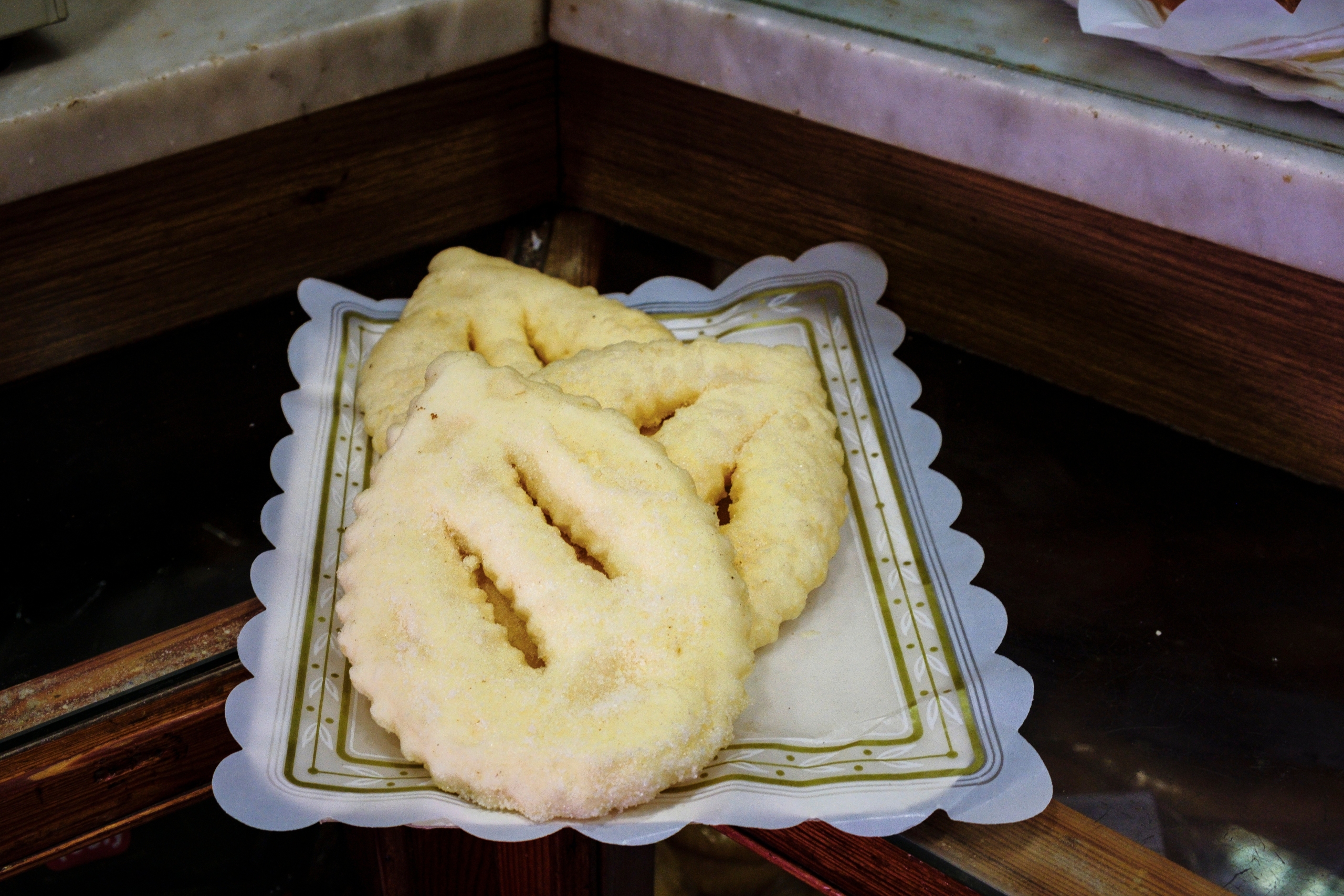
Alongside them appear bunyols, fritters. Their presence in the Easter calendar should be read within a broader Mediterranean culture of fried preparations linked to feast days and celebrations. In Ibiza, together with cuinat and flaó, they figure among the flavours that are still prepared today during Holy Week.
The sweet, at religious festivals, has a function that goes beyond dessert.
After the days of limitation, it represents the return to celebration. Sugar, eggs and frying are also a form of exception: ingredients and techniques that mark the passage from everyday life to festival. To eat something special means to acknowledge that this day is not like the others.
Orelletes also tell another dimension of Ibizan culture: that of handcraft. The dough is worked, rolled, shaped. It is a cuisine in which knowledge resides not only in the words of the recipe, but in the hands. How thin should the dough be? When is the oil ready? How much sugar? These are questions to which tradition often responds with experience.
Christmas: Memory has the taste of salsa
If Easter is the gastronomic moment most clearly marked by the alternation between abstinence and celebration, Christmas opens another chapter of Ibiza’s religious kitchen.
Here the symbolic dish is Salsa de Nadal, one of the island’s most singular preparations. Despite what the name might suggest, it is a kind of sweet soup, traditionally served at Christmas and accompanied by bescuit, a soft sweet intended to absorb its texture and flavours.
The ingredients of the salsa are surprising for a palate accustomed to keeping sweet and savoury strictly separate: almonds, eggs, chicken and lamb broth, sugar, saffron, salt and pepper. A combination that speaks of an older Mediterranean, in which gastronomic categories were often far less distinct than they are today. The preparation requires time and slow stirring: here too, the food of the festival is a food that demands work.
Salsa de Nadal is not simply a dish. It is a family memory.
Each house may have its own proportions, its own secrets, its own variants. And it is precisely this variability that makes traditional food so important from a cultural perspective. Two families can cook the same dish and recognise, in the differences, their own history.
Alongside the salsa and bescuit, Ibizan Christmas includes other preparations that can vary from family to family: broths, meat, fish and, in some rural contexts, forms of peasant nougat based on almonds. The Christmas meal thus becomes a space in which the religious calendar meets domestic culture.
Christmas is perhaps the festival that best shows how difficult it is to separate religion from social life. The liturgical celebration continues to exist, but around the table another rite is built: that of the family returning to repeat the same flavours.
The Patron Saint festivals: Eating to belong
There is finally another great dimension of Ibizan religious cuisine: that of the patron saint festivals.
In the calendar of the island’s villages, the religious festival does not remain confined to the Mass. It expands into public space. It may include music, traditional dances, gatherings and, naturally, food. It is in this context that many products of the local gastronomy acquire particular value.
Orelletes, for example, are associated with patron saint festivals and popular celebrations. Other dishes from the traditional cuisine continue to appear at family and communal festivities. The official gastronomic promotion of Ibiza itself emphasises how many traditional recipes still form part of the island’s popular and family celebrations.
Here a fundamental concept emerges: food is not only what one eats, but what allows people to be together.
The patron saint festival builds a “we.” The saint provides the symbolic reference, the square becomes the place of gathering and food completes the ritual. It is not necessary for every preparation to be liturgical in order to be part of religious culture: it is enough that its consumption has entered the grammar of celebration.
It is a mechanism found in many societies, but in Ibiza it takes on particular meaning because it preserves the memory of a rural island, scattered across small settlements and accustomed to turning the great festivals into moments of communal recomposition.
A gastronomy that tells another Ibiza
Ibiza’s religious cuisine is not to be found in a single recipe book. It is distributed throughout the year.
It has the green flavour of the Lenten cuinat, the mint fragrance of the Easter flaó, the scent of orelletes and bunyols at the festivals, the almost enigmatic complexity of the Salsa de Nadal. Each preparation tells a different moment of the calendar and, with it, a different relationship between the inhabitants and their territory.
There is a thread that unites these dishes: seasonality, local produce, domestic labour and family transmission.
Religion helped to mark time. The kitchen transformed that time into sensory memory.
This is perhaps the most interesting aspect for the visitor arriving on the island. Ibiza is not only a place to look at: it is a place to taste according to the time of year. A flaó in high summer can be excellent, but knowing its link with Easter Sunday changes the meaning of the tasting. A Salsa de Nadal is not simply a curious recipe: it is a doorway into the domestic Christmas of an island. Cuinat is not only a vegetable soup: it carries within it the story of the vigil and of renunciation.
For the contemporary traveller, accustomed to seeking “the typical dish” as an object to tick off a list, this is perhaps the most precious lesson.
Traditional food is not a souvenir. It is an edible calendar. And in Ibiza, following that calendar, one discovers an island very different from the one of the clichés: more rural than glamorous, more domestic than spectacular, more slow than nocturnal. An island in which, for centuries, knowing what one would eat also meant knowing what day it was, which festival was approaching and which community was about to gather.
Behind every table another geography of Ibiza appears. Not the one drawn by the beaches and the clubs, but the one of the houses, the churches, the countryside and the families. A geography in which the sacred is not confined to religious buildings.
Sometimes it smells of mint. Sometimes of anise. Sometimes of almonds, saffron and broth. And above all, it continues to live because someone, every year, returns to cook.
AI Transparency Notice
PilgriMaps uses artificial intelligence tools to assist in the research, drafting and translation of editorial content. All AI-assisted content is reviewed, edited and verified by our editorial team before publication. We contrast information against primary sources, specialist literature and on-the-ground knowledge to ensure accuracy, cultural sensitivity and editorial integrity.
AI is one tool among many in our workflow. The judgement, curation and responsibility for everything published on this platform remain entirely human.
Viator Media S.L. — in compliance with the EU Artificial Intelligence Act (Regulation EU 2024/1689).
This post is also available in: