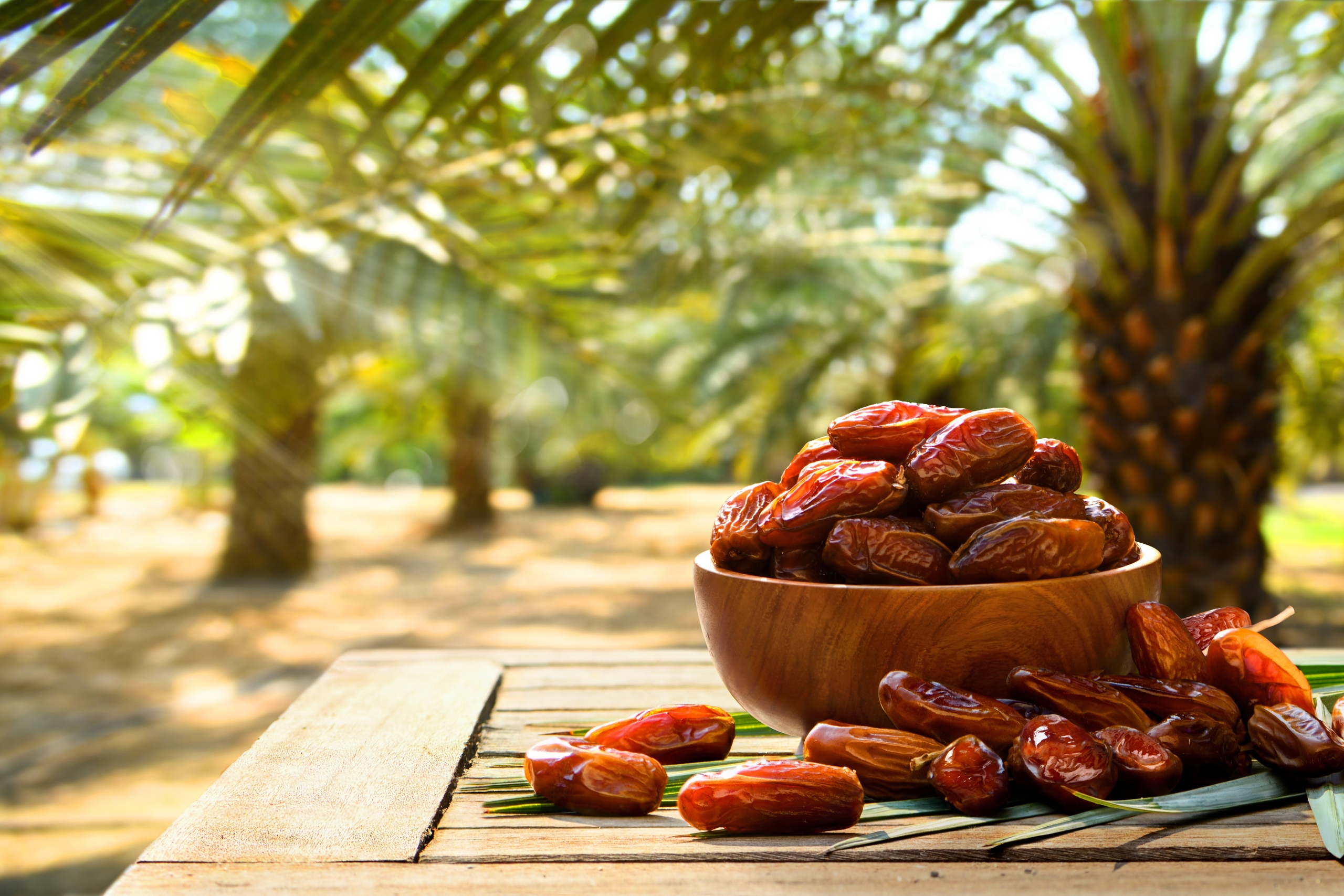
The date, fruit of the Phoenix dactylifera palm, occupies a distinctive place in the environmental and cultural history of arid regions stretching from North Africa to Southwest Asia. Its cultivation, documented as early as the 4th millennium BCE in Mesopotamia, reflects a long-standing relationship between human mobility, oasis agriculture, and subsistence strategies in marginal landscapes. Within pilgrimage traditions, the date emerges not only as nourishment but also as a portable symbol of continuity, resilience, and shared cultural reference.
Environmental context and early cultivation
Date palms thrive in hot, dry climates where water is accessible below the surface, often through irrigation or natural aquifers. This ecological niche made them indispensable in oasis systems, where they provided shade for understory crops such as cereals and legumes, creating layered agricultural environments. For itinerant populations and pilgrims traversing desert routes, dates offered a compact, energy-dense food that could be stored and transported over long distances without significant spoilage.

Archaeological evidence from sites in present-day Iraq and Egypt indicates that date cultivation was already systematized by the Bronze Age. Over centuries, techniques for pollination, harvesting, and drying were refined, allowing the fruit to become a staple commodity along caravan networks. These same routes later intersected with established pilgrimage paths, embedding the date within both economic and ritual geographies.
Dates in biblical traditions
In biblical literature, the date palm appears primarily as a marker of fertility, prosperity, and uprightness. The city of Jericho is described in the Hebrew Bible as the “city of palm trees,” indicating both its ecological setting and its agricultural abundance. In the Book of Psalms (92:12), the flourishing of the righteous is compared to the growth of the palm tree, suggesting endurance and vertical aspiration rather than fragility.

Dates themselves are less frequently named than the palm, yet their presence is implied within descriptions of sustenance in fertile valleys and oases. In the context of pilgrimage to Jerusalem, particularly during major festivals in antiquity, agricultural products including dried fruits would have been integral to both sustenance and offering. The palm branch, later associated with ritual observances such as Sukkot, reinforces the symbolic association between this tree and cycles of movement, shelter, and seasonal return.
Dates in Qur’anic narratives
In the Qur’an, the date palm and its fruit appear with notable frequency, often in contexts that combine subsistence with narrative symbolism. One of the most cited passages occurs in Surah Maryam (19:23–25), where Maryam (Mary), during childbirth, is instructed to shake the trunk of a palm tree so that fresh dates fall to sustain her. The episode situates the date as immediate nourishment in a moment of physical vulnerability, linking the fruit to themes of care and provision.
Dates are also associated with hospitality and daily practice. The tradition of breaking the fast during Ramadan with dates reflects both continuity with early Islamic custom and the fruit’s practical nutritional profile. Although this practice is not mandated in the Qur’an itself, it is widely observed across Muslim-majority societies and among pilgrims undertaking the Hajj or Umrah in Mecca. In these settings, dates function as both a pragmatic and symbolic food, marking transitions between states of abstention and renewal.
Pilgrimage, trade routes, and survival
The relationship between dates and pilgrimage is grounded in geography. Major pilgrimage routes—whether toward Jerusalem, Mecca, or other regional centers—often traversed arid or semi-arid terrain. In these environments, dates offered a reliable source of carbohydrates, minerals, and fiber. Their durability reduced the need for frequent resupply, making them especially valuable for long-distance travel.
Caravanserais and oasis settlements along these routes frequently cultivated or traded dates, embedding the fruit within a broader infrastructure of movement. Pilgrims, merchants, and guides shared access to this resource, blurring distinctions between sacred and commercial travel. In this sense, the date can be understood as part of the material culture of pilgrimage—an object that sustains the body while participating in networks of exchange and encounter.
Gastronomy and cultural variation
Across regions, dates have been incorporated into diverse culinary traditions, reflecting local tastes and available ingredients. In North Africa, they are combined with grains in dishes such as couscous, or processed into pastes used in pastries. In the Eastern Mediterranean and the Gulf, dates are often served with coffee, emphasizing hospitality and social exchange.

Processed forms—including date syrup (known as dibs) and fermented products—extend the fruit’s utility beyond fresh consumption. In some contexts, dates are stuffed with nuts or citrus peel, creating layered flavors that balance sweetness with texture. These preparations often appear during communal gatherings, including those associated with religious observance, though their use is not limited to such occasions.
The global circulation of date varieties, such as Medjool and Deglet Nour, reflects modern trade patterns while maintaining continuity with older systems of cultivation. Today, dates are consumed far beyond their original ecological zones, yet their association with arid landscapes and historical routes of movement remains central to their identity.
Continuity and interpretation
The enduring presence of dates in religious texts, pilgrimage practices, and culinary traditions points to a convergence of environmental adaptation and cultural meaning. Rather than serving a singular symbolic function, the date operates across registers: as food, as metaphor, and as a trace of historical movement. Its role in pilgrimage contexts underscores the practical realities of travel while also connecting contemporary journeys with longstanding patterns of human mobility.
In this layered context, the date persists as a modest yet significant element within the broader study of pilgrimage—an object shaped by climate, carried across distances, and integrated into narratives that continue to evolve.
AI Transparency Notice
PilgriMaps uses artificial intelligence tools to assist in the research, drafting and translation of editorial content. All AI-assisted content is reviewed, edited and verified by our editorial team before publication. We contrast information against primary sources, specialist literature and on-the-ground knowledge to ensure accuracy, cultural sensitivity and editorial integrity.
AI is one tool among many in our workflow. The judgement, curation and responsibility for everything published on this platform remain entirely human.
Viator Media S.L. — in compliance with the EU Artificial Intelligence Act (Regulation EU 2024/1689).
This post is also available in: