This article is intended for informational and educational purposes. It does not replace medical, podiatric, or nursing evaluation. In case of persistent pain, signs of infection, or fever, consult a healthcare professional or the nearest medical assistance point along your route.
In 1209, in Carrión de los Condes, a nobleman named Gonzalo Rodríguez Girón ordered the construction of a hospital for pilgrims on their way to Santiago. It was intended, to a large extent, for feet — not so much for epidemics or war wounds. Chronicles from the period speak of walkers arriving in Palencia limping, unable to continue, stopped by a blister the size of a coin. Eight hundred years later, little has changed. The blister remains the number one enemy of anyone who decides to walk for several consecutive days, far more than rain, far more than muscle fatigue.
There is something almost comical in the disproportion: a 2,000-meter elevation gain can be faced with training, a sheepdog can be calmly avoided, but two centimeters of detached skin can bring to an end a journey begun after months of preparation. Those who organize long-distance expeditions know this well, to the point that travel medicine manuals devote more pages to blisters than to many far more serious conditions.
Why blisters form, and why it is not bad luck
A blister is the body’s response to repeated friction: layers of skin slide against one another until they separate, and fluid fills the space created in order to protect the underlying tissue. The mechanism is purely physical, not “genetic,” as many pilgrims assume on the first day of walking.
Military studies cited in ultramarathon training manuals show a fact every future long-distance walker should know: gradual exposure to effort — that is, weeks of progressively longer walks before departure — thickens the skin’s stratum corneum and measurably reduces the likelihood of blisters. In other words, skin trains like a muscle. Anyone who puts on new hiking boots the night before setting out is asking their skin to perform a task for which it has not been prepared.
Prevention: what really works
An emergency physician at Texas Tech University Health Sciences Center, interviewed about the risks of day hikes, summarizes prevention in a few verifiable principles:
- Avoid cotton socks: they retain moisture and increase friction. Technical fibers or merino wool are better, as they wick sweat away from the skin.
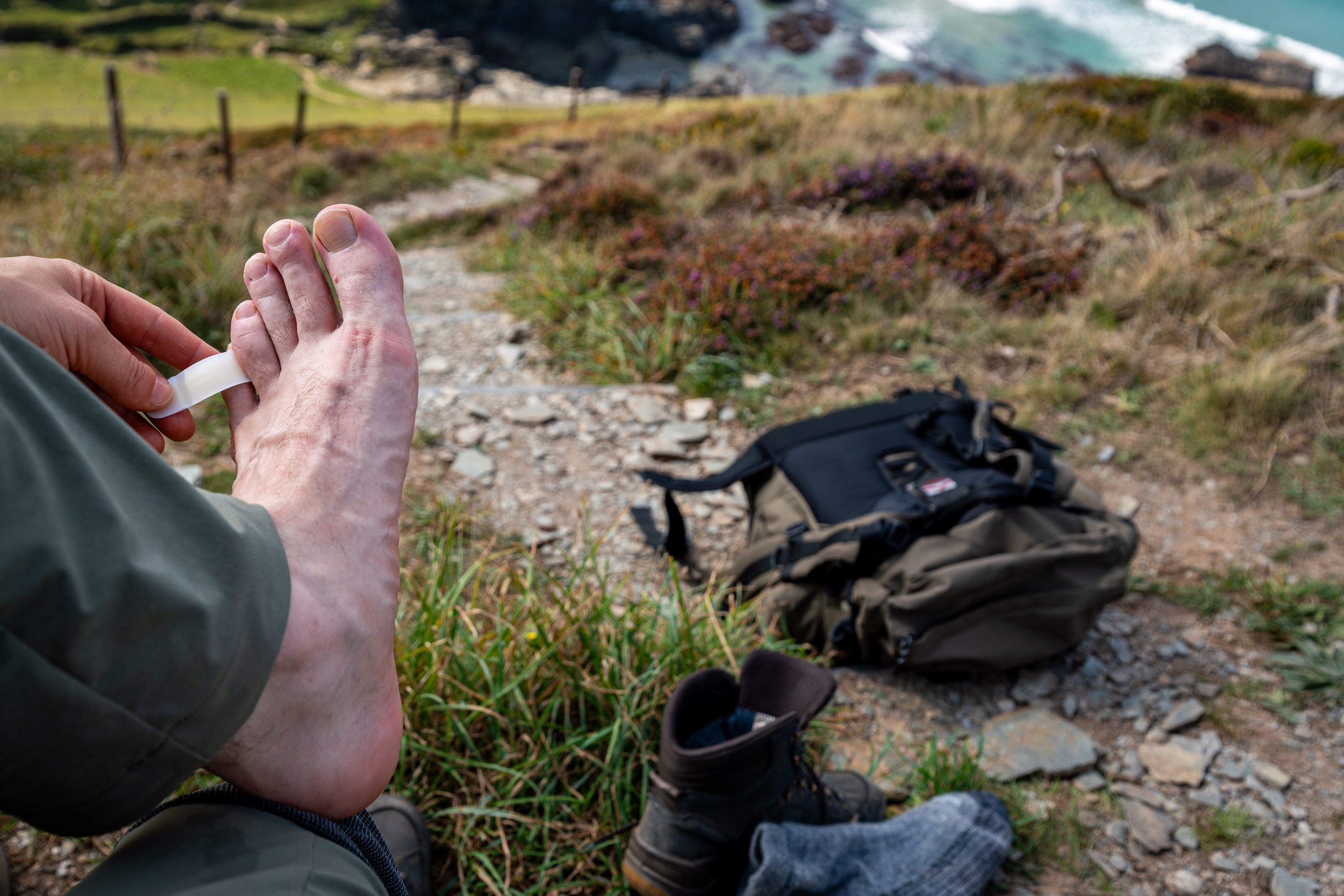
- Protect critical points in advance — heels, big toes, the outer sides of little toes — with moleskin or specific adhesive tape before redness appears, not after.
- Use your footwear before departure, with weeks of real walking, not just by trying it on in the store.
- Build mileage progressively: the first day of a long walk is not the time to break your personal record.
- Pay attention to moisture: feet wet from rain or sweat are more vulnerable. Changing socks halfway through the day, when possible, significantly reduces the risk.
The best moment for prevention is the first sign of discomfort, not once the blister has already formed. A hot spot — a slightly burning area, as English-speaking hikers call it — is still reversible: stopping for two minutes to apply a dressing can save the entire next stage.
No more blisters: Caring for your feet before and after a pilgrimage
If the blister has already formed
Clinical guidance shared by medical sources such as WebMD and Healthline converges on several practical points.
If the blister is small and not too painful, the best choice is to leave it intact. The skin covering the fluid is a natural barrier against infection: cover it with a soft dressing or a specific bandage and continue walking carefully.
If, however, the blister is large, painful, or located in a spot that makes it impossible to continue, draining it may relieve the pain, but it must be done carefully:
- Wash your hands thoroughly and clean the blister with soap and water.
- Disinfect a thin needle with alcohol.
- Pierce the edges, not the center, and allow the fluid to drain without removing the overlying skin: that skin will continue to protect the wound as it heals.
- Apply an over-the-counter antibiotic ointment and cover with a non-stick gauze.
- Change the dressing every day, or whenever it becomes wet.
There are warning signs that should not be ignored, and that mark the line between a walking-related nuisance and a medical problem: pus, spreading redness, intense heat around the wound, red streaks moving up toward the ankle or leg, or fever. In these cases, the next step is not another stage, but a clinic.
The foot as a way of reading the road
There is an anthropological reason why medieval pilgrims took such care of their feet, to the point of building hospitals that today we might almost call “podiatric outpatient centers.” In pilgrimage culture, the walking body is not a means of transport: it is the instrument through which the road, the weather, fatigue, and even one’s own patience are read. A well-cared-for foot is not vanity. It is maintenance of what makes the entire experience possible.
Anyone setting out today on a Camino or any multi-day trail would do well to treat the first two stages as an adaptation period: already broken-in footwear, technical socks, regular pauses to check the feet, and moleskin always within reach. It is a form of respect for one’s own body, not unlike the respect medieval hospital builders showed to those who arrived after weeks of walking, with ruined feet and still a long way ahead.
Sources cited in this article: Wikipedia, Hospital de la Herrada; TTUHSC, “Emergency Medicine Expert Shares Day Hike Tips”; WebMD, “Understanding Blister Treatment”; Healthline, “How to Get Rid of a Blister”; VeloPress / Jason Koop, “Blisters: A 9-Step Plan for Trail Runners”
AI Transparency Notice
PilgriMaps uses artificial intelligence tools to assist in the research, drafting and translation of editorial content. All AI-assisted content is reviewed, edited and verified by our editorial team before publication. We contrast information against primary sources, specialist literature and on-the-ground knowledge to ensure accuracy, cultural sensitivity and editorial integrity.
AI is one tool among many in our workflow. The judgement, curation and responsibility for everything published on this platform remain entirely human.
Viator Media S.L. — in compliance with the EU Artificial Intelligence Act (Regulation EU 2024/1689).
This post is also available in: