There’s no right answer. But there’s a real difference — and understanding it before you set out might change everything.
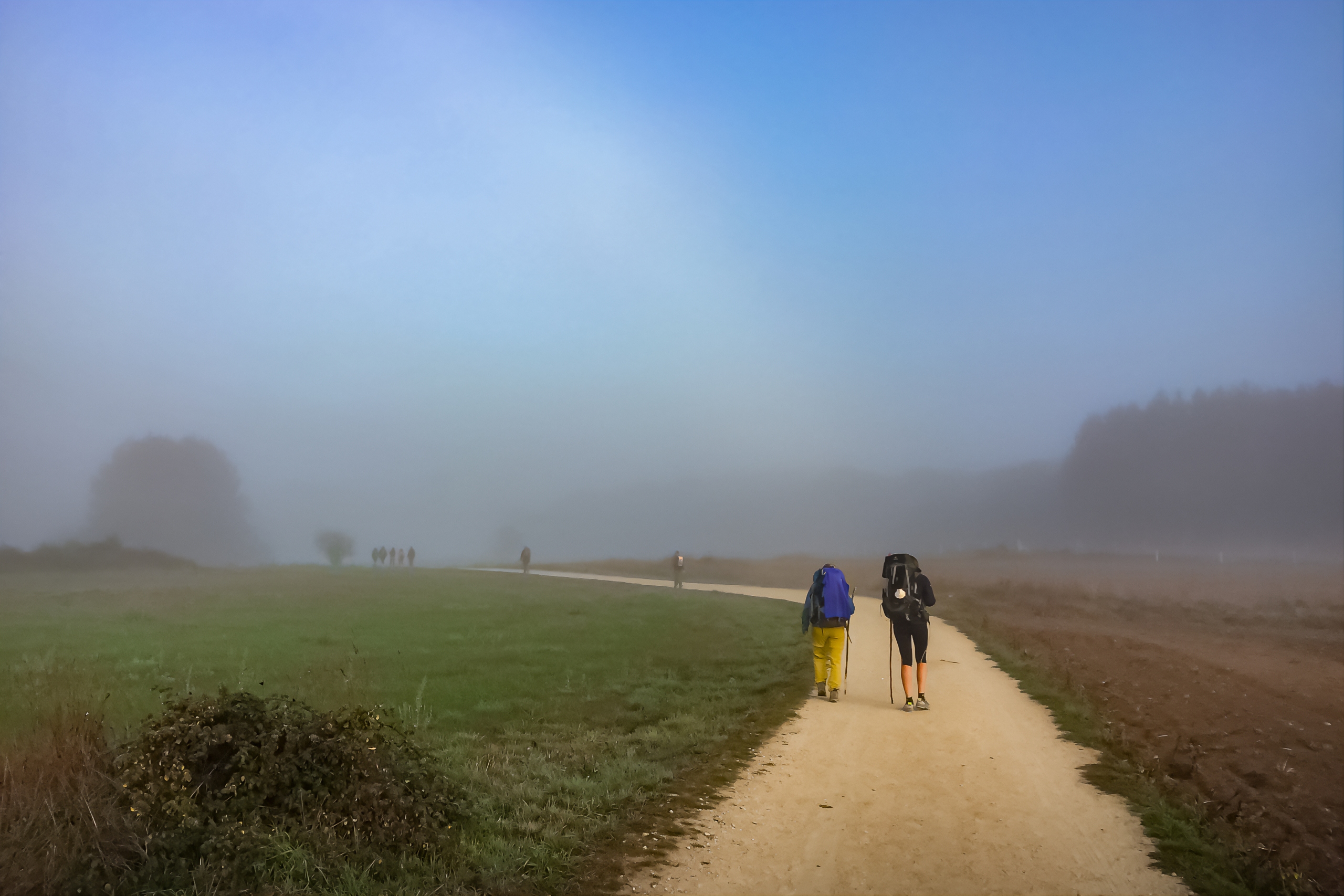
Jacinta was sixty-three when she decided to walk the Camino de Santiago alone. Her daughter had pushed to come along — it would have been a beautiful project, time to finally talk, to know each other as adults, to recover years of quiet distance. Her sister had proposed the same. Even a friend she shared the occasional pizza with had offered, with sudden enthusiasm, to join her.
Jacinta thanked them all politely, with the calm firmness of someone who has already decided, and packed exactly what one person needs. When she returned, her daughter asked how it had gone. “Like thirty years ago,” she said. She didn’t specify of what.
On the other side is Marco, forty-two, a project manager at a consulting firm, who has walked the same route three times over ten years: the first alone, leaving Lisbon on a Monday in February when the Portuguese Camino is nearly empty; the second with a close friend he’d known for twenty years and almost never argued with; the third with an organized group of fourteen, several of whom he’d never met before departure.
“Three completely different experiences,” he says. “Almost three different caminos. Maybe four, because I was different each time.” He can’t say which he preferred. It depended on what he was looking for.
What happens when you walk alone
The distinction between walking alone and walking with others comes down to what kind of experience you’re after, and what kind of inner work you’re willing — or ready — to do.
Walking alone, the mind is free to go wherever it wants, answerable to no one. Thoughts that in ordinary life never find the right moment to surface — because there are always interruptions, notifications, conversations, requests — show up here, on the path, with the ease of something that knows it has time. Sometimes they’re welcome: pleasant memories, creative ideas, reflections that unfold slowly. Sometimes they’re not: anxieties held at bay that return with force, unresolved conflicts demanding attention, parts of yourself you haven’t yet made peace with. Solitary walking doesn’t guarantee you’ll find what you’re looking for. It guarantees you’ll find what’s there.
Walking as meditation in motion: An ancient practice confirmed by Neuroscience
Philosophers who walked — Rousseau, who in the Rêveries described solitary walks as the only context in which he could think with real clarity; Nietzsche, who composed much of his work mentally during long daily walks around Sils-Maria; Wordsworth and Coleridge, who would walk together in silence for hours, each inside his own world, before stopping to speak — all left consistent testimony: solitude in motion produces a quality of thought that stillness and company do not produce in the same way. As if the moving legs carry something that stays inert when the body does.
What happens when you walk with others
Walking with others activates something entirely different. Physical rhythms tend to synchronize — pace, breath, rest stops — and emotional states and energy levels often follow. One person’s fatigue becomes legible to the other. Good humor transmits without announcement. Shared exhaustion produces an intimacy many describe as surprisingly fast: people who met the day before find themselves saying things on the path they’ve never said to people they’ve known for years.
The walk lowers the guard. The common rhythm, the common effort, the absence of every usual context that defines who you are — all of this makes it easier to simply be yourself.
The strength of a group: Walking together improves motivation and well-being
Wisdom embedded in pilgrimage traditions
Pilgrimage traditions have managed this duality with practical wisdom refined over time. The Hajj is by definition a collective experience: two million people performing the same gestures in the same space at the same moment, a synchronization of intention and movement that verges on the vertiginous. And yet within it are moments of individual, silent, untransferable prayer.
The Camino de Santiago in its medieval form was walked by people who traveled together for stretches and then separated — not through disorganization, but because the route naturally made room for both modes.
The risks of each choice
The risk of walking with company is well known to anyone who has done a long route with someone else: conversation can become a refuge, a way of not having to be alone with yourself. You can walk for thirty days and never really reach interior silence, because there’s always something to say, comment on, share. This isn’t necessarily a lesser experience. But it’s a different one from what a long walk can offer in silence.
The risk of walking alone is less discussed but equally real: solitude can amplify whatever you wanted to work through until it becomes oppressive rather than clear. Without the counterweight of another presence, certain thoughts circle rather than open. Being alone with yourself for weeks doesn’t always produce clarity. Sometimes it produces only intensified noise.
What long pilgrimages teach
The honest answer is that we probably need both — and long walks offer both across their span of weeks: companionships that form spontaneously at the albergues and dissolve just as spontaneously a few days later, moments of absolute solitude in the early morning hours before the others set out, deep conversations with someone met by chance and never seen again. The solitary walk returns us to ourselves. The shared walk returns us to others.
A long walk containing both teaches something no short pilgrimage can: that we are capable of being alone, and capable of being together, and that neither condition, on its own, is enough to describe who we are.
Walking Together: Is Pilgrimage the Ultimate Relationship Test?
AI Transparency Notice
PilgriMaps uses artificial intelligence tools to assist in the research, drafting and translation of editorial content. All AI-assisted content is reviewed, edited and verified by our editorial team before publication. We contrast information against primary sources, specialist literature and on-the-ground knowledge to ensure accuracy, cultural sensitivity and editorial integrity.
AI is one tool among many in our workflow. The judgement, curation and responsibility for everything published on this platform remain entirely human.
Viator Media S.L. — in compliance with the EU Artificial Intelligence Act (Regulation EU 2024/1689).
This post is also available in: