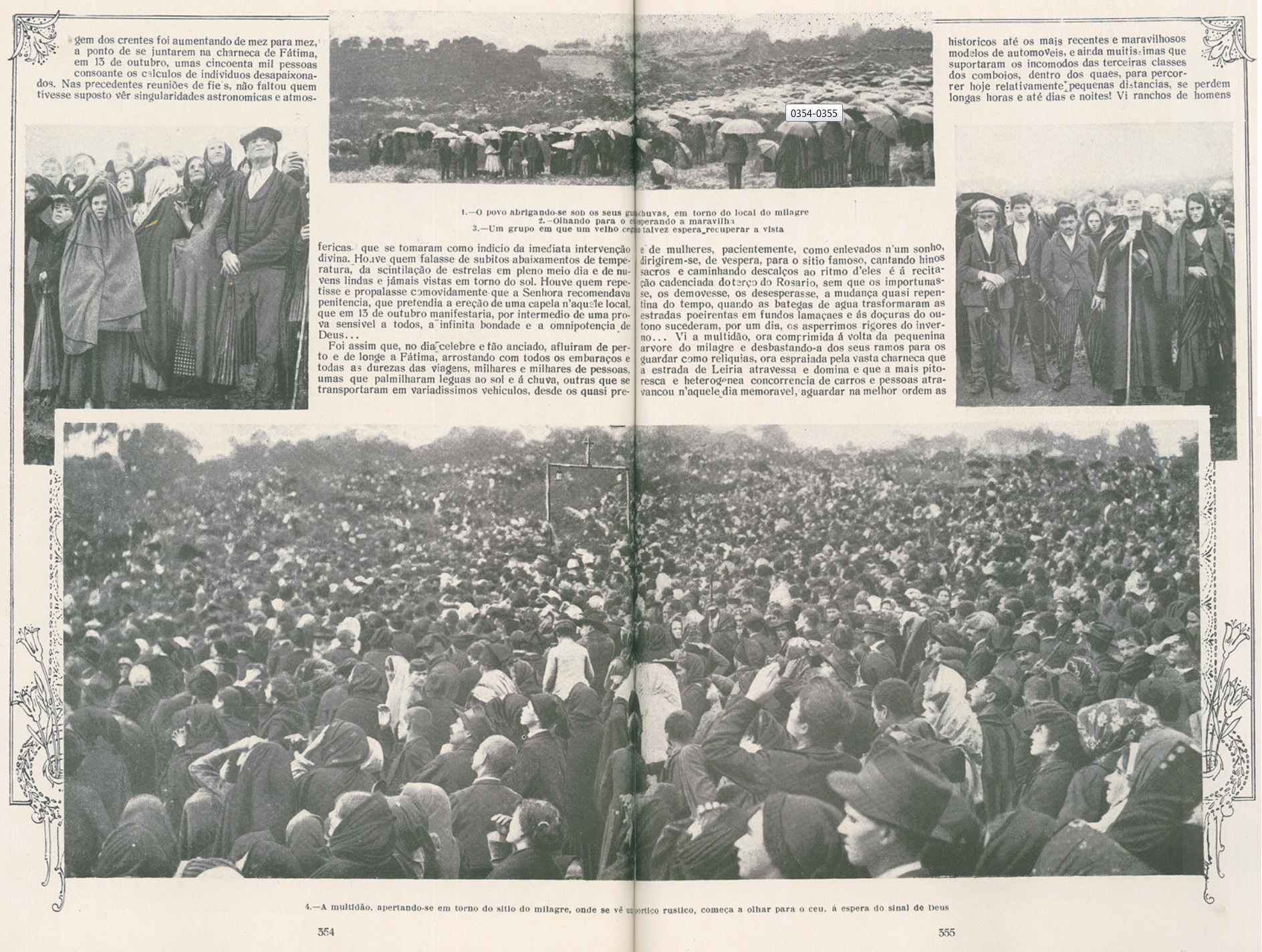
On the morning of 13 October 1917, a persistent rain was falling on the fields of Fátima, a small town in central Portugal. The roads had turned to mud, and thousands of people — some of whom had come from very distant places — pressed together beneath umbrellas and soaking blankets. There were farmers, priests, entire families, onlookers and journalists. There were also sceptics who wanted to see what would happen.
They had all come for the same reason: three shepherd children claimed that an extraordinary sign would occur that day.
Toward midday, according to numerous witnesses, the rain stopped and the clouds began to part. Then something happened that bewildered a great many of those present. The sun appeared as a silver disc of unusual brightness, and seemed to spin on itself. Some said it gave off flashes of different colours; others described abrupt movements and the unsettling sensation that the star was hurtling toward the Earth.
There were cries, tears, people kneeling on the wet ground. For many, what they were witnessing was a miracle.
More than a century later, the nature of that phenomenon remains open to differing interpretations. Its historical consequences, however, are far easier to identify: from that day onward, Fátima began to become one of the great spiritual landmarks of Portugal and, in time, of the Catholic world.
Three children in a divided Portugal
The story had begun five months earlier. On 13 May 1917, ten-year-old Lúcia dos Santos and her cousins Francisco and Jacinta Marto, aged nine and seven, said they had seen the apparition of a lady dressed in white while tending their flocks at the Cova da Iria.
According to their accounts, the apparitions were repeated in the months that followed. The news spread through the surrounding villages and soon began to draw growing numbers of people. Some received the children’s words with fervour; others reacted with disbelief.
These events took place at a particularly delicate moment in Portuguese history. In 1910 a revolution had put an end to the monarchy and proclaimed the Republic. The new regime set in motion a profound transformation of relations between public institutions and the Catholic Church.
The separation law of 1911 reduced the privileged position Catholicism had historically occupied within the State. For those republican sectors most committed to secularisation, these reforms represented a necessary step toward the country’s modernisation. For many Catholics, by contrast, they amounted to an assault on traditions that formed an essential part of their identity.
The division was particularly visible between urban circles, where republican and anticlerical ideas had gained influence, and broad rural areas where religious devotion remained deeply rooted.
To this climate of confrontation was added the First World War. Portugal was taking part in a conflict that brought human losses, economic hardship and growing uncertainty.
In that setting, the message of prayer and peace attributed to the children of Fátima acquired a particular significance.
The phenomenon that surprised the sceptics
13 October 1917 became an exceptional event because of the number and diversity of people who claimed to have witnessed the solar phenomenon.
Among them was Avelino de Almeida, a journalist for O Século, one of the principal Portuguese newspapers of the period, known for its republican and anticlerical orientation.
His presence carried particular weight. He had not come as the spokesman of a religious institution, but as a reporter assigned to cover an event that had aroused enormous public curiosity.
On 15 October, O Século published his piece under a striking headline: “Astonishing things! How the sun danced at midday in Fátima.” Almeida described the reaction of a crowd gazing at the sky in amazement. Other accounts published in the Portuguese press spoke of changes of colour, apparent movements of the solar disc, and moments of intense fear among the onlookers.
Not all the descriptions agreed. Some witnesses spoke of a genuine dance of the sun, while others perceived less spectacular phenomena, or observed nothing out of the ordinary.
That diversity of experience constitutes one of the principal difficulties in understanding what occurred. But one thing proved decisive: the story no longer belonged solely to the realm of popular devotion. It now circulated in the press, provoked debate, and placed a small Portuguese town at the centre of a national controversy.
From place of pilgrimage to national symbol
The events of 13 October did not put an end to the tensions surrounding Fátima. In a sense, they intensified them. In the years that followed, pilgrims continued to come to the Cova da Iria, while various republican sectors viewed these gatherings with mistrust. In 1922 the small chapel built at the site of the apparitions was attacked with explosives. It was later restored and once again received the faithful.
That continuity demonstrated the strength of a devotion that had arisen from the base of society, before receiving definitive ecclesiastical recognition. That came on 13 October 1930, when the Bishop of Leiria, José Alves Correia da Silva, declared the apparitions of 1917 worthy of belief and officially authorised the cult of Our Lady of Fátima.
By then Portugal had changed political course once again. The military coup of 1926 had ended the First Republic, and in 1933 the Estado Novo would be consolidated — the authoritarian regime associated with António de Oliveira Salazar.
The new political order promoted traditional values and granted Catholicism a prominent place in social life. In that context, Fátima acquired a dimension beyond religious devotion: it could also stand for the historical and spiritual continuity of the Portuguese nation.
The relationship between the shrine and the regime was, however, more complex than it might appear. Although the Estado Novo found affinities with certain values associated with the sanctuary, the mobilisation of pilgrims retained considerable autonomy. Indeed, during the Portuguese colonial war between 1961 and 1974, many families came to Fátima to pray for their soldiers and to ask for peace.
Those religious expressions revealed human concerns that did not always fit the regime’s official rhetoric. The historical importance of Fátima lay precisely in that capacity to transcend the structures of power.
Between faith and science
The nature of the so-called “miracle of the sun” has prompted numerous investigations and controversies. Among the explanations proposed are optical effects resulting from looking directly at the sun, possible particular atmospheric conditions, and the influence of collective expectation on perception.
The absence of instrumental records of the phenomenon, however, together with the diversity of the testimonies, makes it impossible to establish a conclusive scientific reconstruction of everything those present experienced.
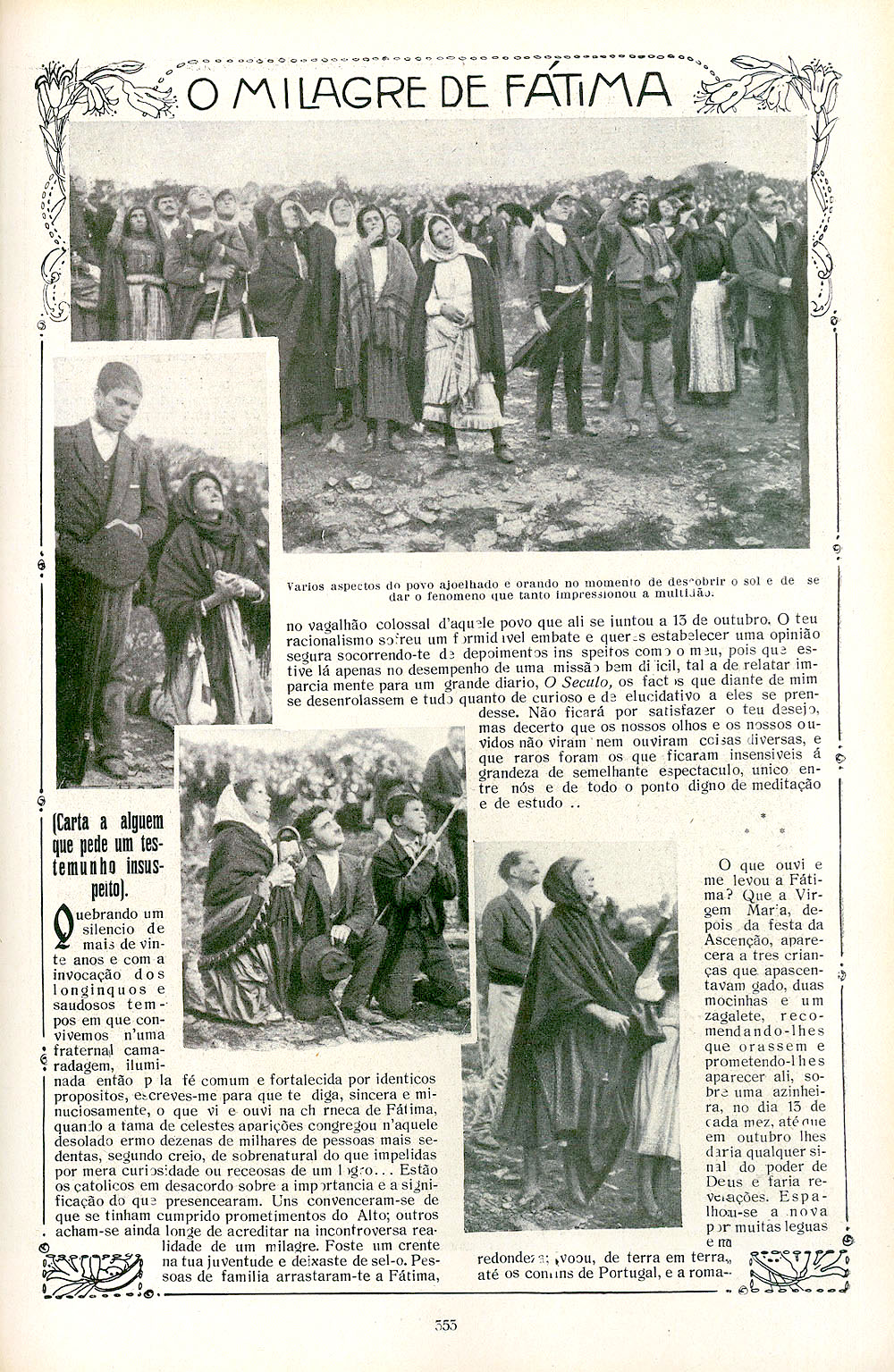
Nor are there contemporary photographs documenting any extraordinary movement of the star. The surviving images show mainly the crowd gathered that day. For believers, what happened retains the meaning of a supernatural intervention bound to the Marian apparitions. For historical research, what can be documented with greater confidence are the testimonies, their dissemination, and the social consequences of the event.
The two approaches answer different questions. History can study how a belief was born, how it was received and what transformations it produced, without claiming to settle definitively matters that belong to the terrain of faith.
A symbol that outlived history
On 25 April 1974, the Carnation Revolution brought an end to the Portuguese dictatorship and opened the way to democracy. Fátima, however, remained. Its power to draw people did not disappear with the regime that had governed Portugal for decades. On the contrary, the sanctuary continued to consolidate itself as a place of pilgrimage, and its international reach acquired new dimensions.
The visits of successive pontiffs, particularly those of John Paul II, helped reinforce its presence in the Catholic world. Emigrant Portuguese communities and Marian movements carried the devotion to Europe, the Americas, Africa and Asia.
Over time, millions of people came to identify Fátima with a place of prayer, hope and spiritual searching. Its significance also became part of Portuguese cultural heritage. The sanctuary transformed the landscape of the region, drove international pilgrimage and projected Portugal’s name far beyond its borders.
What had begun as the testimony of three peasant children ended by becoming an event of worldwide reach. On that 13 October 1917, thousands of people lifted their eyes to the sky convinced they were witnessing something extraordinary. More than a century later, the debate over the nature of what they saw remains open.
But the passage of time has left one enduring consequence of that day: a phenomenon that thousands interpreted as a sign from heaven ended by leaving a deep mark on the history of a nation.
AI Transparency Notice
PilgriMaps uses artificial intelligence tools to assist in the research, drafting and translation of editorial content. All AI-assisted content is reviewed, edited and verified by our editorial team before publication. We contrast information against primary sources, specialist literature and on-the-ground knowledge to ensure accuracy, cultural sensitivity and editorial integrity.
AI is one tool among many in our workflow. The judgement, curation and responsibility for everything published on this platform remain entirely human.
Viator Media S.L. — in compliance with the EU Artificial Intelligence Act (Regulation EU 2024/1689).
This post is also available in: