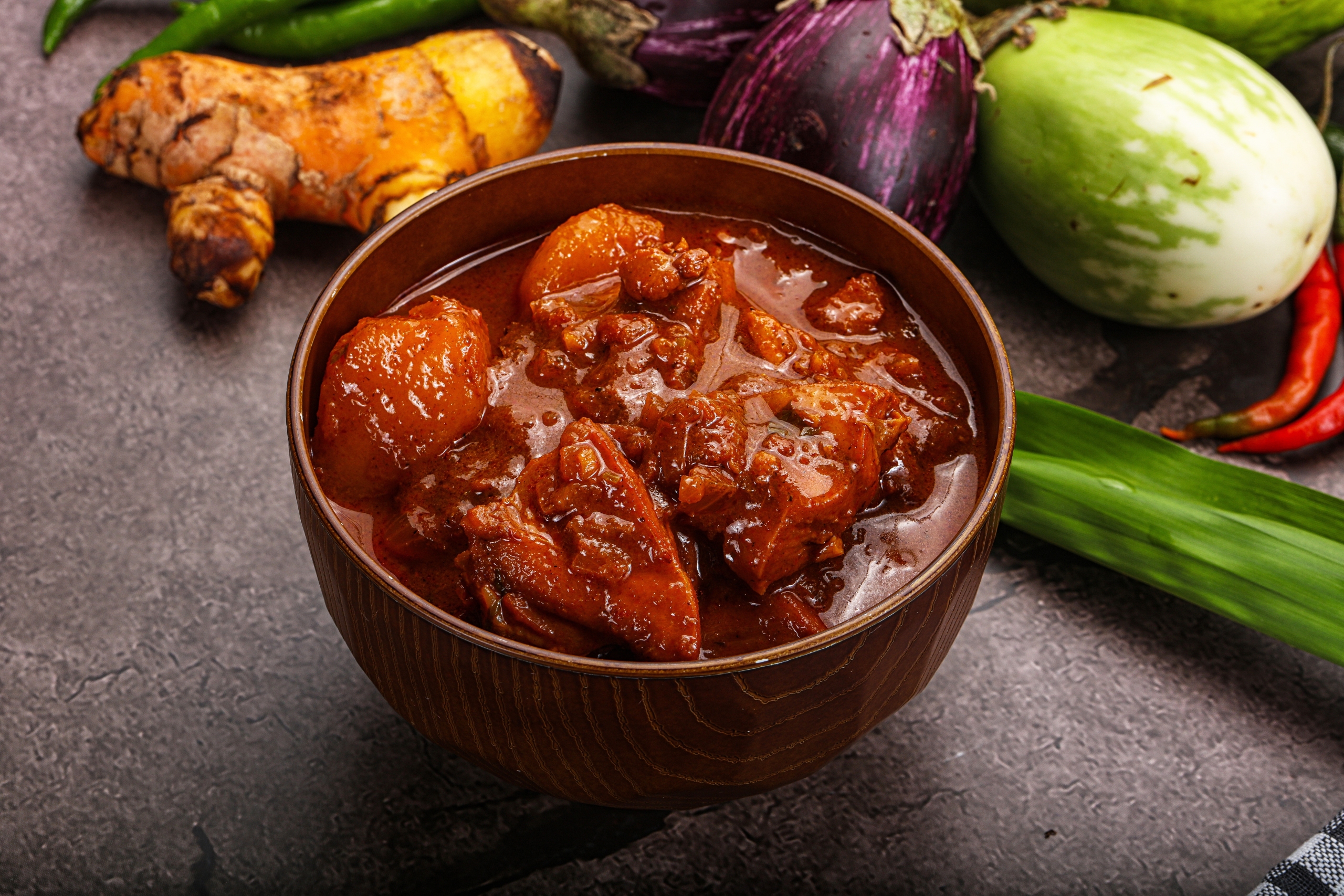
Chicken vindaloo is one of the best-known dishes in Indian cuisine, but its history begins in the Portuguese kitchens of the sixteenth century. Its transformation in Goa, at the hands of the local Catholic communities, gave rise to a speciality that combines ingredients from three continents and five centuries of cultural exchange.
A pot of red, spiced curry served in a house in Goa can tell a story that begins thousands of kilometres from India. Inside it are a Portuguese culinary technique, an ingredient that arrived from the Americas, and a combination of Asian spices. Even its name, vindaloo, preserves the memory of a European language. And for generations, this dish has had its place on the festive tables of many Indian Catholic families.
Today it is common to find chicken vindaloo in Indian restaurants all over the world, where it tends to be presented as one of the hottest curries on the menu. Its origin, however, is rather different. To discover it, one must travel to Goa, a small state on the western coast of India, where more than four centuries of Portuguese presence left a deep mark on architecture, religious custom and food.
From Portugal to the Kitchens of Goa
In 1510 the Portuguese conquered Goa, which soon became one of the principal centres of their commercial empire in Asia. Their rule lasted until 1961, when the territory was incorporated into India.
The Portuguese presence transformed the region profoundly. Churches and convents were built, religious communities were established, and Catholicism spread among part of the local population. Even today, the great churches of Old Goa — some recognised as UNESCO World Heritage — recall that period.
But Portuguese influence also penetrated everyday life. Numerous families adopted Portuguese surnames, certain Christian celebrations acquired cultural expressions of their own, and kitchens began to incorporate ingredients and techniques arriving from Europe.
Among the preparations introduced by the Portuguese was carne de vinha d’alhos, particularly associated with the culinary tradition of Madeira. It consisted of marinating meat — generally pork — with wine, garlic, salt and spices before cooking it. It was a technique that added flavour and helped preserve the meat.
In Goa, that preparation began to change. European wine was not as accessible an ingredient as it was in Portugal, while the region had vinegars produced through local fermentations, especially of palm and coconut. These ended up occupying a central place in the recipe.
Ingredients common to the kitchens of South Asia were also incorporated: cumin, black pepper, cinnamon, cloves and tamarind.
To these was added a decisive novelty: the red chilli.
Although today it seems inseparable from much of Indian cuisine, the chilli is native to the Americas. It was the Portuguese trading networks that brought it to the subcontinent during the sixteenth century.
Thus a European preparation came to bring together ingredients from three continents. The old vinha d’alhos was progressively transformed into the Goan vindalho, the origin of today’s vindaloo.
Vindaloo and the Celebrations of Goa’s Catholics
The development of this speciality was closely bound to the Catholic communities of Goa, who took up and adapted various elements of Portuguese cooking until they became part of their own tradition.
One of the most significant features was the prominence of pork. Its consumption held particular importance among certain Christian groups in Goa, although dietary practices varied between communities and families.
For that reason, before chicken vindaloo became popular, the most representative version was pork vindalho, made with pork marinated in vinegar, garlic and spices.
The dish became part of the festive repertoire of numerous Catholic families, alongside other specialities of Indo-Portuguese influence such as sorpotel, Goan sausages and certain traditional sweets.
At celebrations such as Christmas, Easter, weddings and patronal feasts, food took on a communal dimension. Preparing these dishes brought together relatives and neighbours, but it also transmitted culinary knowledge across generations.
The Goan historian Fatima da Silva Gracias, author of Cozinha de Goa: History and Tradition of Goan Food, has studied how the region’s culinary customs evolved through the encounter between local and European traditions. Her work also shows that the Catholic communities were not a uniform group: dietary practices could vary according to social origin, region and family customs predating conversion.
This diversity is important for understanding the history of vindaloo. Goan Catholic cooking was not simply a reproduction of Portuguese cuisine, but the result of a process of adaptation that extended over generations.
That process took place within a colonial society, marked also by inequalities of power and by the religious policies of the Portuguese authorities. Yet Goan families made numerous preparations their own, transforming them with local produce and passing them on as part of their identity.
Cooking thus became an everyday expression of a singular culture: profoundly Indian, and shaped by its history of contact with Portugal.
From Traditional Vindalho to Chicken Vindaloo
Although the historical vindaloo was principally associated with pork, versions made with chicken, fish and other ingredients appeared over time. Chicken vindaloo is today one of the most widespread.
Its preparation preserves the essential elements of the Goan tradition: vinegar, garlic, chilli and a combination of aromatic spices.
Dried chillies are usually blended with garlic, ginger, cumin, pepper, cinnamon and cloves to form a paste known as masala. The vinegar provides the dish’s characteristic acidity and is used to marinate the meat before cooking. The chicken is then stewed slowly with the spices until a concentrated sauce of deep reddish colour is achieved.
The secret of vindaloo lies not in using as much chilli as possible, but in striking a balance between acidity, aroma and heat. In Goa, recipes vary from one family to another. Some include onion or tamarind; others add a small quantity of jaggery, a traditional sugar that softens the acidity.
The cook Merciana D’Souza, of the restaurant Bhatti Village, has shared a version of chicken vindaloo learned from her mother, made with coconut vinegar, chilli, garlic, spices and even feni, a traditional Goan spirit.
Her example helps us understand how this cuisine is preserved: through family recipes passed on and modified without losing their essential character.
Vindaloo also undertook a second international journey when South Asian restaurants began to flourish in Britain during the twentieth century.
There its name ended up becoming, in many establishments, a synonym for an extremely hot curry. The British version frequently incorporated more chilli, tomato and sometimes potato.
This interpretation contributed enormously to its spread, though it also left many consumers unaware of its Portuguese roots and its connection to the Catholic communities of Goa.
Today, local culinary initiatives are attempting to preserve that heritage. One such is Mum’s Kitchen, a restaurant in Panaji founded in 1997 with the purpose of recovering traditional Goan recipes and working with cooks who know the domestic preparations. Their work is a reminder that cuisine is a way of preserving a community’s memory, especially when migration and tourism transform its customs.
Five centuries after the arrival of the Portuguese in Goa, vindaloo continues to be prepared in homes and restaurants across the region, while its variants circulate around the world.
Among its ingredients survive the traces of the old maritime routes, the exchanges between continents and the family traditions of Goan Catholics. A history that can still be recognised in the aroma of a freshly made pot of chicken vindaloo.
AI Transparency Notice
PilgriMaps uses artificial intelligence tools to assist in the research, drafting and translation of editorial content. All AI-assisted content is reviewed, edited and verified by our editorial team before publication. We contrast information against primary sources, specialist literature and on-the-ground knowledge to ensure accuracy, cultural sensitivity and editorial integrity.
AI is one tool among many in our workflow. The judgement, curation and responsibility for everything published on this platform remain entirely human.
Viator Media S.L. — in compliance with the EU Artificial Intelligence Act (Regulation EU 2024/1689).
This post is also available in: