The Camino del Norte is full of legends and traditions. Some belong to the Jacobean world; others come from the territories it crosses. And among them there is one singular story that speaks of kings, sorcerers, vanished cities and princesses waiting to be freed.
A few kilometres from Mondoñedo, one of the historic towns on the Camino del Norte, the entrance to the Cova do Rei Cintolo opens up: an enormous underground labyrinth whose explored length already exceeds eleven kilometres. It can be visited today through guided tours and under a regulated access system designed to protect both visitors and the cave itself.
We know of no medieval pilgrim accounts that mention this king, nor ancient documents connecting the cave to Santiago. It is, rather, one of those stories a traveller can encounter when crossing a territory: a legend that intersects with the Camino without having been born from it, yet weaves itself into the traditions a walker finds along the way.
And perhaps that is precisely what makes it more interesting.
The kingdom that disappeared
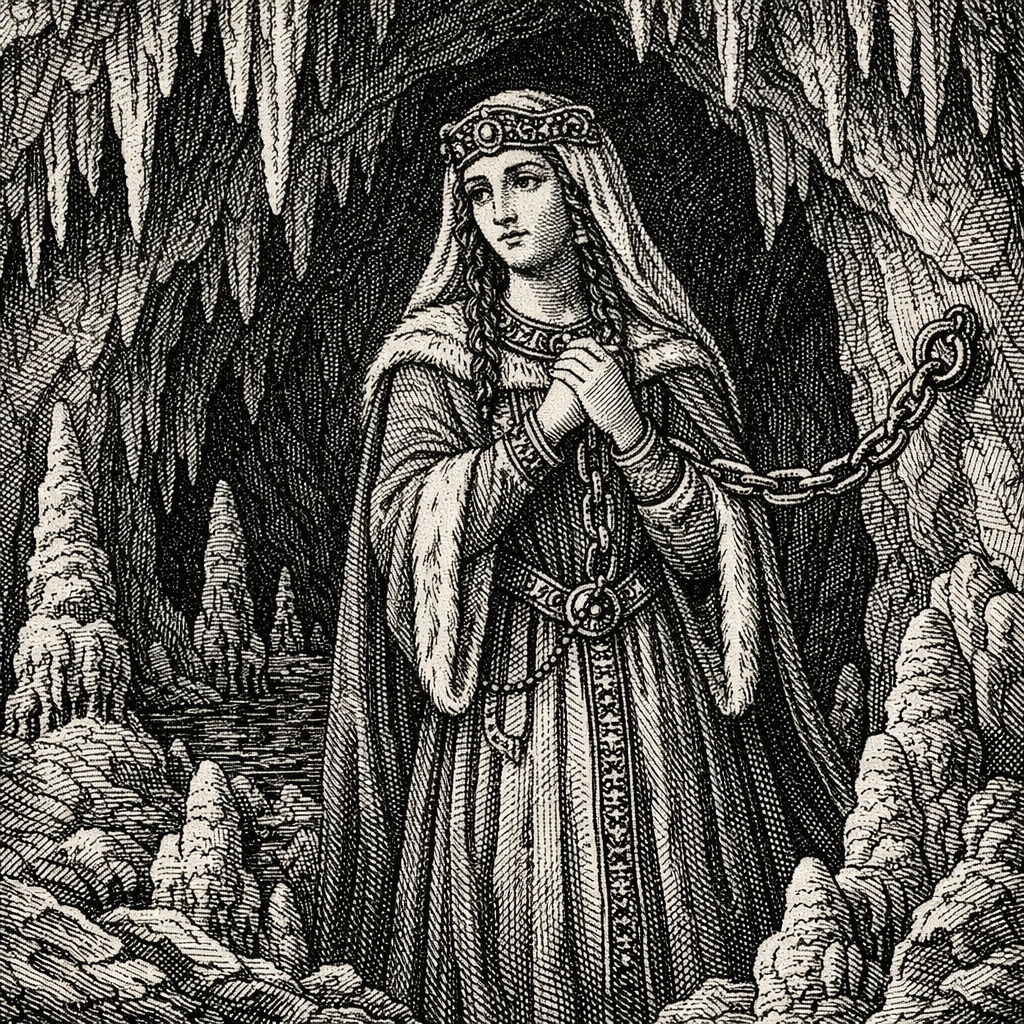
Cintolo was king of a prosperous territory. He had a daughter of extraordinary beauty who, depending on who tells the legend, was called Xila or Manfada. The young woman was in love with a nobleman, though other versions introduce a rival suitor, powerful and dangerous. When he is rejected, magic intervenes. The kingdom is destroyed, buried or condemned to disappear, and the princess is left trapped in an underground world.
In some versions she has been waiting ever since for the arrival of a knight capable of breaking the enchantment. In others the plot grows more complex: the beloved is given the name Holvrudet and the rival is Tuba de Oretón, presented as a king and sorcerer from a distant “land of mouros.” There is combat, spells and a city called Brea that vanishes at the very moment the cave comes into being.
That mechanism is common to many legends. Faced with a crevice, a ruin, a rock formation or a strange landscape, the imagination constructs an explanation. Geography is transformed into evidence: if a cave of extraordinary dimensions exists, perhaps something extraordinary happened there.
In Rei Cintolo, the story turns the underground landscape into the memory of a catastrophe. The galleries become the remains of a lost kingdom.
A medieval legend?
The cave is ancient. The story, at least as we know it today, is far harder to date. In 1873, the scholar José Villaamil y Castro published the first known plan of Rei Cintolo. That drawing marks a milestone in the history of the cavity’s exploration. Little more than two decades later, in 1896, Gabriel Puig y Larraz noted that numerous popular tales and stories were told about it.
The detail matters: by the late 19th century, Rei Cintolo already possessed a strong legendary reputation. But we do not know exactly which stories made up those tales. None of the sources located allows us to confirm that the full account of Xila or Manfada, Holvrudet, Tuba and the vanished kingdom was already being told in all its details at that time. Nor has any medieval source, or any source from the early modern period, been found that contains the legend in its present form.
Over a century and a half of explorations, maps, excavations and scientific studies of the cavity have followed. The genealogy of the legend, by contrast, remains full of blank spaces.
Xila or Manfada is not alone in the imaginative world of the northwest of the peninsula. Galicia has many stories of enchanted mouras — female figures associated with caves, rocks, springs and treasures. In Asturias there are the xanas, young women of extraordinary beauty connected with water, hidden places and certain rites of disenchantment.
The stories change from one district to another, but certain motifs repeat themselves: a woman belongs in some way to a world different from the everyday one; she remains trapped by a spell; someone must pass a test to free her; and the entrance to that other world is usually found at a singular place in the landscape. The princess of Rei Cintolo fits easily into that vast narrative universe.
Speleology has its own story
There is something singular about the visual history of Rei Cintolo: its first great image was not that of a king or a princess, but a topographical plan.
From the drawing published by Villaamil in 1873 to the modern digital surveys, generations of explorers have tried to turn the underground space into comprehensible lines on a page.

That effort produces a curious correspondence between science and legend. The story claims that beneath the mountain there is a hidden world. Speleology reveals that one indeed exists — though not the world of enchanted palaces imagined by the storytellers.
The cavity has kilometres of galleries, underground watercourses and spaces that have been progressively explored and mapped. The figures given for its length have changed over time precisely because knowledge of the system continues to grow. Modern maps reveal a labyrinth far more extensive than the first researchers ever knew.
Archaeology adds another level of mystery. In an interior area known as the Camarín, animal remains were found whose arrangement has led some researchers to consider the possibility of a symbolic deposit. A bone sample has provided evidence of human presence in the Mesolithic.
Researchers have noted that it cannot be claimed that Rei Cintolo was a prehistoric sanctuary or an underground temple. Nor is there any basis for connecting those remains to the later legend of the king and his daughter.
What is certain is that thousands of years before anyone drew the first plan of the cave, other human beings had already entered it. We do not know what they were looking for there, or what meaning they attached to that space.
A story on the margins of the Camino
The pilgrim who reaches Mondoñedo today is walking one of the great historic itineraries of the northern peninsula. From the city, the Cova do Rei Cintolo lies in Argomoso and requires the walker to make a deliberate detour to visit it.
The legend of Rei Cintolo undoubtedly connects with the deep inner history that makes the Galician landscape so compelling. The Camino crosses a territory that already has its own stories — some religious, others historical, fantastical, domestic or local. To walk is also to come into contact with them.
Much about Rei Cintolo still remains to be discovered. Speleologists continue to refine the physical map of the cavity. Folklore researchers may one day reconstruct with greater precision the map of its legend: finding out when the name Manfada first appeared, at what moment Tuba de Oretón entered the story, or which version the inhabitants of the area were hearing a century ago.
They are, in a sense, two maps still incomplete: one made of galleries, rock and water; the other made of names, memories and versions. Over both runs a third road — the one that passes through Mondoñedo on the way to Santiago. There is no need to turn King Cintolo into a Jacobean figure for both worlds to meet. It is enough to imagine the traveller arriving in an unknown land and discovering that every mountain, every spring and every cave may contain a story.
AI Transparency Notice
PilgriMaps uses artificial intelligence tools to assist in the research, drafting and translation of editorial content. All AI-assisted content is reviewed, edited and verified by our editorial team before publication. We contrast information against primary sources, specialist literature and on-the-ground knowledge to ensure accuracy, cultural sensitivity and editorial integrity.
AI is one tool among many in our workflow. The judgement, curation and responsibility for everything published on this platform remain entirely human.
Viator Media S.L. — in compliance with the EU Artificial Intelligence Act (Regulation EU 2024/1689).
This post is also available in: