On the thirtieth of August, in the southern winter, boats converge on a small island in the inland sea of Chiloé. They come from Achao, from Quinchao, from the Isla Grande, loaded past what any insurance company would consider reasonable. The crossing can be rough. People make it anyway.
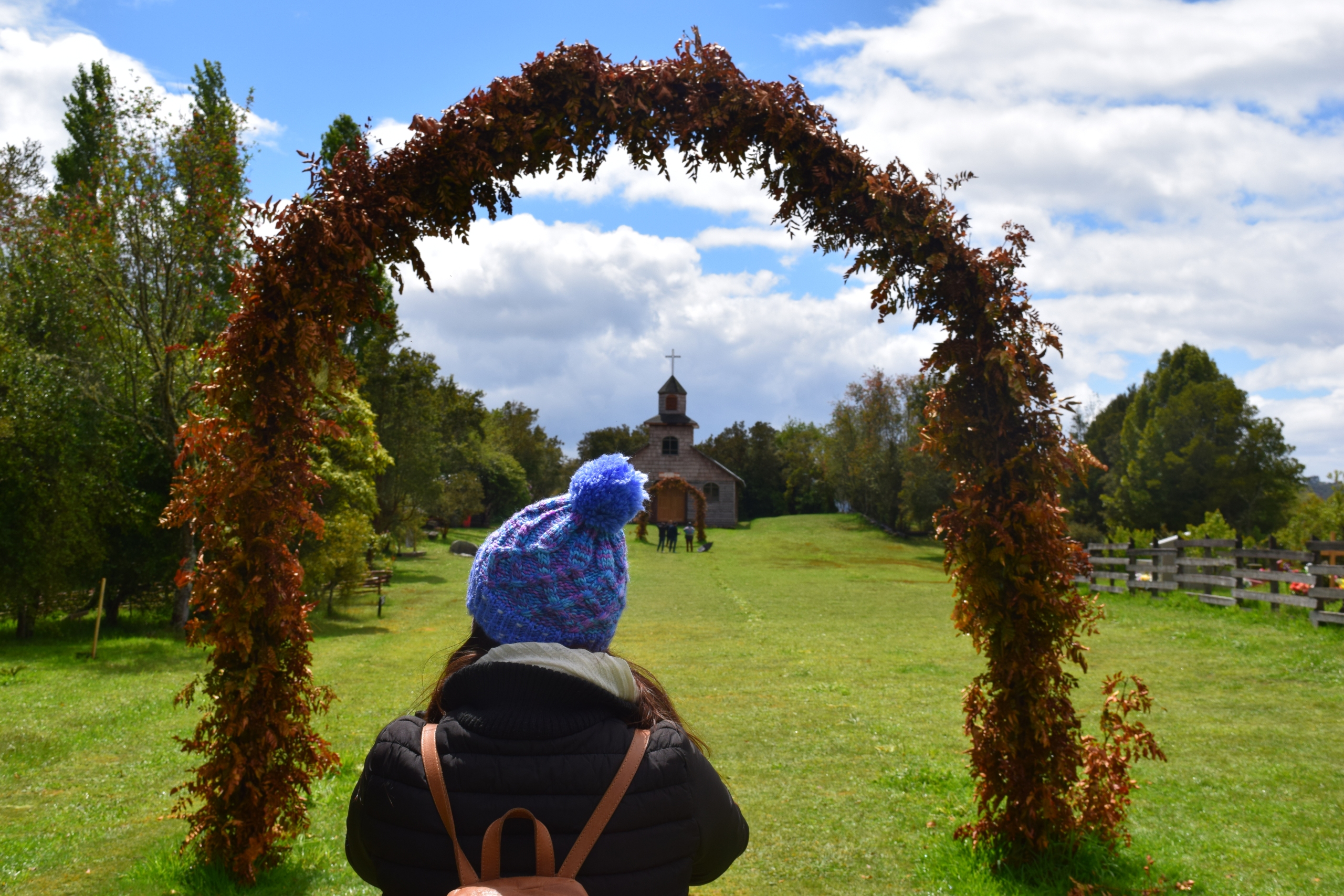
They are going to Caguach, an island of a few hundred inhabitants, to see a wooden statue of Christ carrying the cross. The festival dates from 1778, and it is the largest religious gathering in the archipelago.
The church that receives them is made entirely of wood, roofed and clad in alerce shingles, and it is a UNESCO World Heritage Site — one of sixteen churches in Chiloé that together represent something that exists nowhere else on earth.
Sixteen Churches
The Churches of Chiloé were inscribed on the World Heritage List in 2000 under criteria (ii) and (iii): fourteen initially, with the listing extended in 2001 to reach sixteen. (Sources disagree on which two came in the extension, which tells you something about how administratively quiet this corner of Chile is.)
The sixteen are Achao, Aldachildo, Caguach, Castro, Chelín, Chonchi, Colo, Dalcahue, Detif, Ichuac, Nercón, Quinchao, Rilán, San Juan, Tenaún and Vilupulli.
Read the dedications and a map of devotion emerges: Santa María de Loreto at Achao, Jesús Nazareno at Aldachildo and at Caguach, San Francisco at Castro, Nuestra Señora del Rosario at Chonchi and Chelín, Nuestra Señora de los Dolores at Dalcahue, Natividad de María at Ichuac, Nuestra Señora del Patrocinio at Tenaún, San Juan Bautista, San Antonio at Colo and Vilupulli — and, on the island of Lemuy, Santiago Apóstol de Detif. Saint James the Apostle, at the far end of the Americas, facing a cold sea.
UNESCO’s citation names what makes them exceptional: the successful fusion of European and indigenous cultural traditions producing a unique form of wooden architecture, and the mestizo culture born of Jesuit missionary activity in the seventeenth and eighteenth centuries, which has survived intact in the archipelago and reaches its highest expression in these churches.
That phrase — survived intact — is doing a great deal of work, and it is the reason to go.
The Circulating Mission
To understand the buildings you have to understand the system that produced them, and the system was an inversion of everything we normally mean by pilgrimage.
The Jesuits began sending members to Chiloé in 1608, into an archipelago of dozens of inhabited islands, bad weather, and no roads worth the name. A parish system was impossible. There would never be enough priests, and even if there were, they could not reach anybody.
So they inverted it. The misión circular — the circulating mission — sent small groups of Jesuits on annual circuits through the temperate months, departing from the Order’s college at Castro and travelling by boat from settlement to settlement, staying a few days at each chapel before moving on.
The pilgrims, in other words, were the clergy. The faithful stayed put, and the priest arrived once a year by sea. Which raises the obvious question: what happened for the other three hundred and sixty days? The answer is the fiscales — lay leaders chosen by each community who kept the chapel, led prayers, taught catechism, buried the dead and maintained the building between visits. The institution still exists. It is, more than any single church, the thing that UNESCO means by a culture surviving intact: a Catholicism administered locally by laypeople for four centuries because the alternative was no Catholicism at all.
The Jesuits were expelled from Spanish territories in 1767. The Franciscans took over. The fiscales carried on regardless, which is rather the point.
Built by Boatbuilders
The churches themselves are the work of a tradition with a name: the Escuela Chilota de Arquitectura Religiosa en Madera, the Chilote school of wooden religious architecture, which developed across almost four centuries and reached maturity in the mid-nineteenth.
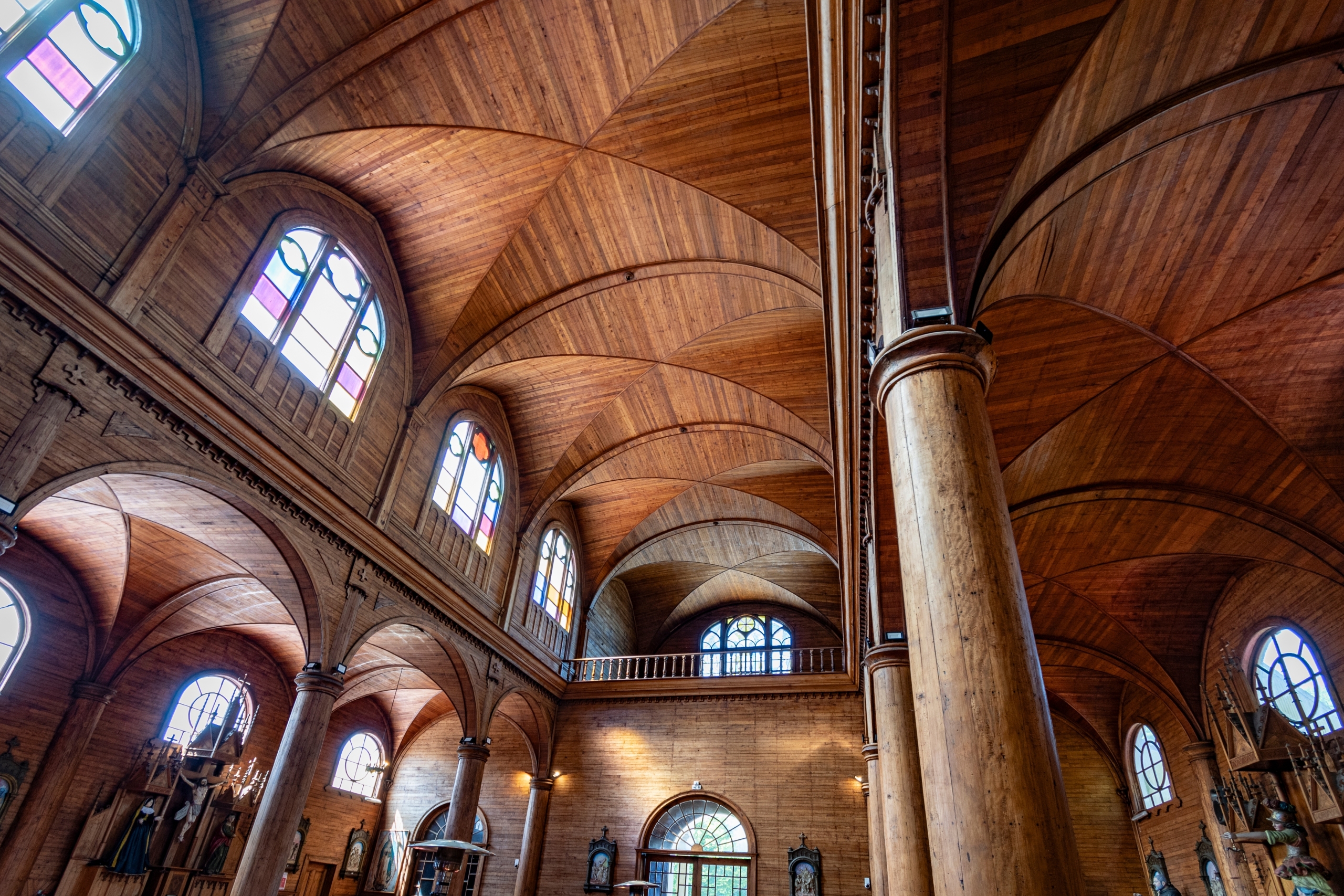
They were built by shipwrights, and it shows. The vaulted ceilings are hulls turned upside down. The joinery is a boatbuilder’s joinery — timbers pegged rather than nailed, because iron rusts and wood pegs swell. The native timbers do the rest: alerce, coigüe, ciprés de las Guaitecas, mañío. The exteriors are clad in alerce shingles, tejuelas, cut and overlapped like scales.
The plan is consistent enough to be recognisable anywhere in the archipelago: a rectangular hall, a portico of arches across the front, a tower rising above it, and an esplanade facing the water. Always facing the water. These are churches with a harbour rather than a car park, because everyone arrived by boat.
And many of them stand on ground that was sacred before. The Spanish evangelisation established chapels on ancient huilliche ngillatuwe — Mapuche-Huilliche ceremonial sites — and the present churches were later built over them. The fusion UNESCO cites is not only a matter of carpentry.
The oldest survivor is Santa María de Loreto at Achao, built around 1730, which still preserves original elements of its construction.
Wood Burns
There is a shadow over all of this, and it is worth stating plainly. These are wooden buildings, lit for centuries by candles, in a region of storms. The old church at Caguach was completely destroyed by fire in 1919. The one standing today was rebuilt in 1925 by the people of the commune — in wood, with an alerce shingle exterior, exactly as before.
That is not a restoration. That is a community rebuilding its church from scratch using knowledge it still had, six years after losing it. Conservation today is a partnership: the churches belong to the Diocese of Ancud, the Consejo de Monumentos Nacionales supervises, and the Fundación Iglesias Patrimoniales de Chiloé — established in 2010 as successor to the Fundación Amigos de las Iglesias de Chiloé — coordinates the work. In 2012 the community at Quinchao and the Friends of the Churches shared a conservation award for their restoration there.
How to Make the Journey
There is no waymarked route, and inventing one would misrepresent how the archipelago works. What there is instead is a circuit, and the honest way to travel it is the way the missionaries did: by water, in stages, accepting that the weather decides.
Castro is the natural base. San Francisco de Castro is the largest of the sixteen and the most immediately startling — a great yellow-and-violet timber basilica standing over the town. Nercón is four kilometres away.
Dalcahue is the ferry point for Quinchao island, and has its own church on the waterfront.
Achao, on Quinchao, holds the oldest church in the archipelago. The church of Quinchao itself is among the largest, and its festival is the main religious celebration in Chiloé after Caguach.
Lemuy island holds three of the sixteen — Ichuac, Aldachildo and Detif — and is reached by ferry from Chonchi.
Caguach is the hardest to reach and the reason to try. Boats run from Achao and Dalcahue; the schedule depends on the sea.
Tenaún and Colo lie along the eastern coast north of Dalcahue, and Tenaún’s blue-and-white façade with three towers is one of the great sights of the archipelago.
The southern summer, December to March, gives the most reliable crossings. The thirtieth of August gives you Caguach at full capacity, in winter, with every boat in the inland sea pointed at one small island.
Bear in mind that these are working parish churches, not monuments. Opening depends on whoever holds the key, which is frequently the fiscal, who lives nearby and will open up if asked.
What Survives
Most World Heritage sites preserve something that has stopped. A ruin, a palace, a monastery emptied of monks. Chiloé preserves something that never stopped. The fiscales still keep the keys. The statue of the Nazarene still crosses to Caguach and back. The churches still fill. The shingles are still replaced, in alerce, by people who learned how from their fathers.
The Jesuits designed a system on the assumption that the priest would come once a year and the community would manage the rest. Four hundred years later the priests are more frequent and the principle is unchanged: these buildings belong to the people who row out to them.
You arrive the same way everybody always has. You watch the weather, you find a boat, and you cross.
AI Transparency Notice
PilgriMaps uses artificial intelligence tools to assist in the research, drafting and translation of editorial content. All AI-assisted content is reviewed, edited and verified by our editorial team before publication. We contrast information against primary sources, specialist literature and on-the-ground knowledge to ensure accuracy, cultural sensitivity and editorial integrity.
AI is one tool among many in our workflow. The judgement, curation and responsibility for everything published on this platform remain entirely human.
Viator Media S.L. — in compliance with the EU Artificial Intelligence Act (Regulation EU 2024/1689).
This post is also available in: