The Tagus was running high. Its waters, swollen and turbulent, seemed to raise an impassable barrier. On one bank, a French monk stood watching the current. He carried no sword and wore no armour. His only mount was a humble donkey. Yet according to an old medieval account, that man entered the river and crossed its raging waters without the current managing to drag him under.
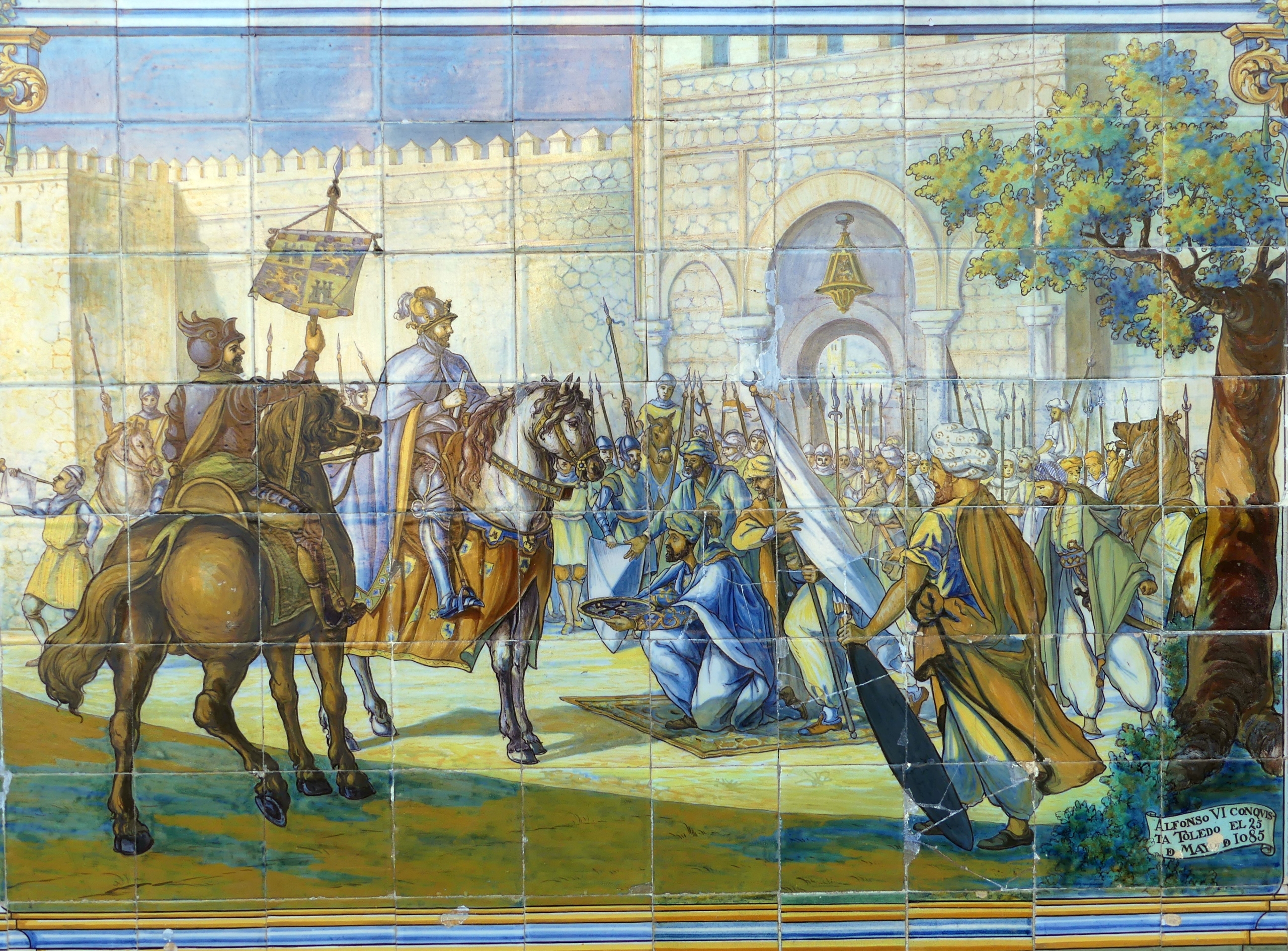
The scene, worthy of an epic, would end up woven into one of the most surprising legends connected with the conquest of Toledo. Over the centuries, tradition would place King Alfonso VI and his army as witnesses to the prodigy, set in a landscape associated with the great Castilian-Leonese conquest of 1085.
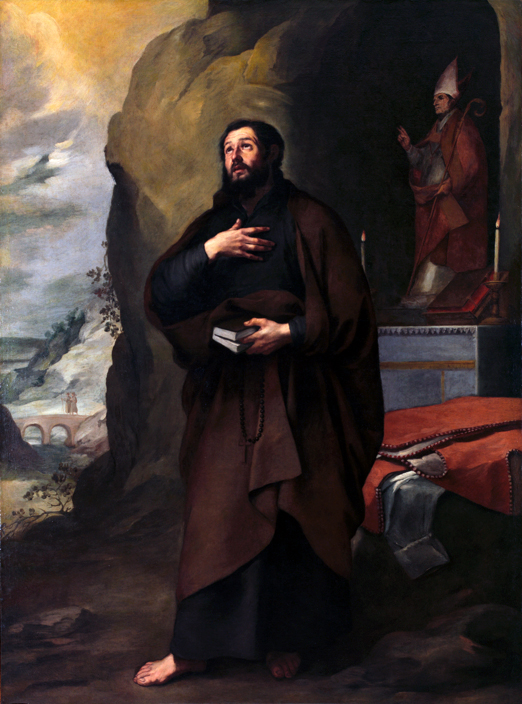
The protagonist of this story was Adelelmus, later known as San Lesmes, a French religious whose life unfolded between the monasteries of Europe, the court of Alfonso VI and the pilgrimage roads of the Iberian Peninsula.
The episode appears in the Vita sancti Adelelmi, written by Rodulfus of La Chaise-Dieu probably between 1102 and 1104, a few years after the monk’s death. It is a hagiographical account presenting the prodigy as a manifestation of sanctity, echoing the biblical crossing of the Jordan by Joshua
Centuries later, Juan Tamayo de Salazar expanded the narrative by introducing the army of Alfonso VI. His soldiers are said to have watched the monk’s crossing and then forded the river themselves with great difficulty. This version encouraged the supposed miracle to become linked to the conquest of Toledo, although the chronicles and historical documents of that campaign attest to no military involvement on the part of Lesmes.
The legend had begun a journey of its own through the centuries.
A story for the pilgrims of the Camino de Levante
Pilgrims walking the Camino de Santiago de Levante today find in Toledo one of the great historical and cultural landmarks of their itinerary. The route, coming from Valencia and the lands of La Mancha, reaches the old Visigothic capital and continues afterwards toward Torrijos and the west of the peninsula.
Passing through Toledo, the walker can recall that medieval account of the monk who supposedly defied the waters of the Tagus. The exact place where tradition located the prodigy is unknown, and there is no evidence that Lesmes ever travelled the itinerary of the present-day Camino de Levante. Even so, the legend offers a curious connection between the history of Toledo, the pilgrimage routes and the figure of a religious who would end up deeply bound to the Camino de Santiago.
Because although his adventure beside the Tagus belongs to the world of legend, his relationship with the pilgrims who passed through Burgos has far firmer historical roots.
Who was San Lesmes really?
Adelelmus was born at Loudun, in the French region of Poitou, probably during the first half of the eleventh century. Tradition places his birth around 1035, though no contemporary documents allow that date to be confirmed.
According to his medieval biography, he came from a well-off family and may have begun a military career. He abandoned secular life, however, and after making a pilgrimage to Rome, entered La Chaise-Dieu, an important French monastic community founded by Robert of Turlande and governed by the Benedictine observance.
Tradition holds that he rose to become abbot, the title by which he is still known in Burgos. His arrival in the Hispanic kingdoms took place during a period of profound transformation. Alfonso VI, king of León and Castile, was pursuing a policy of openness toward Europe, and particularly toward France. Cultural exchange, monastic reform and the growing prominence of the Camino de Santiago all encouraged the arrival of religious from beyond the Pyrenees.
Tradition attributes to Constance of Burgundy, the monarch’s wife, a decisive role in bringing Lesmes into the orbit of the court. Although the details of this invitation come principally from his hagiographical biography, his subsequent establishment in Burgos is documented.
Adelelmus belonged to a generation of religious who crossed the Pyrenees carrying with them new monastic experiences, forms of organisation and practices of care. His presence reflects how far the peninsular kingdoms were integrating into the great cultural currents of medieval Europe.
Burgos, a city open to pilgrims
By the end of the eleventh century, Burgos occupied a strategic position on the Camino de Santiago. Through its streets moved travellers from various European regions, merchants, clerics and pilgrims making their way toward Compostela.
The Camino Francés was far more than a religious route. It constituted a corridor of communication along which ideas, knowledge, goods and customs travelled, encouraging the development of towns, markets, churches and institutions of care.
Those who undertook those long stages needed places to rest, to eat and to recover from the illnesses and hardships of the journey. In that context, the religious complex of San Juan acquired importance, situated outside the walls of Burgos beside the city’s eastern entrance, in the area of the rivers Arlanzón and Vena.
A document of 1167 expressly describes that establishment as lying iuxta caminum Beate Jacobi — “beside the Camino de Santiago.” This reference confirms that the site formed part of the historical geography of the Jacobean pilgrimage.
In 1091, Alfonso VI had granted the monastery of San Juan to the French congregation of La Chaise-Dieu, linking Adelelmus documentarily to that establishment.
The biography written by Rodulfus presents the monk as devoted to religious life and to the care of the poor and of travellers. Around the small church of San Juan Evangelista, close to a zone of transit, there developed an activity of welcome characteristic of medieval Jacobean sites.
Although some traditions credit him with personally founding a pilgrim hospital, the documentation shows that the evolution of the charitable institutions of San Juan was more complex and bound up with various royal initiatives.
What does seem clear is that the memory of Lesmes became closely tied to hospitality. His figure represents those communities that made the Camino possible by providing help to people covering great distances in frequently difficult conditions.
From French monk to Patron of Burgos
San Lesmes died in Burgos in 1097 and was buried in the precincts of the church of San Juan. His liturgical memorial is celebrated on 30 January, although researchers disagree about the exact day of his death.
According to the Vita, pilgrims began arriving to visit his tomb shortly after his death. His memory grew in importance until it transformed the identity of the religious establishment itself.
In 1243, a document already mentions the parish of San Lesmes, heir to the old church of San Juan Evangelista. The name of the French monk had ended by displacing the church’s original dedication.
Over the following centuries his cult was consolidated with the support of various ecclesiastical authorities. In the sixteenth century his patronage over the city of Burgos was institutionally recognised.
None of the buildings Lesmes knew survive from that first religious complex. The present church was raised around 1400, after the disappearance of the old chapel.
The site nevertheless preserves an extraordinary historical continuity. The church of San Lesmes still stands beside the Camino Francés and keeps alive the memory of the religious whose figure became associated with the care of travellers.
A stop on the Camino Francés: visiting the tomb of San Lesmes
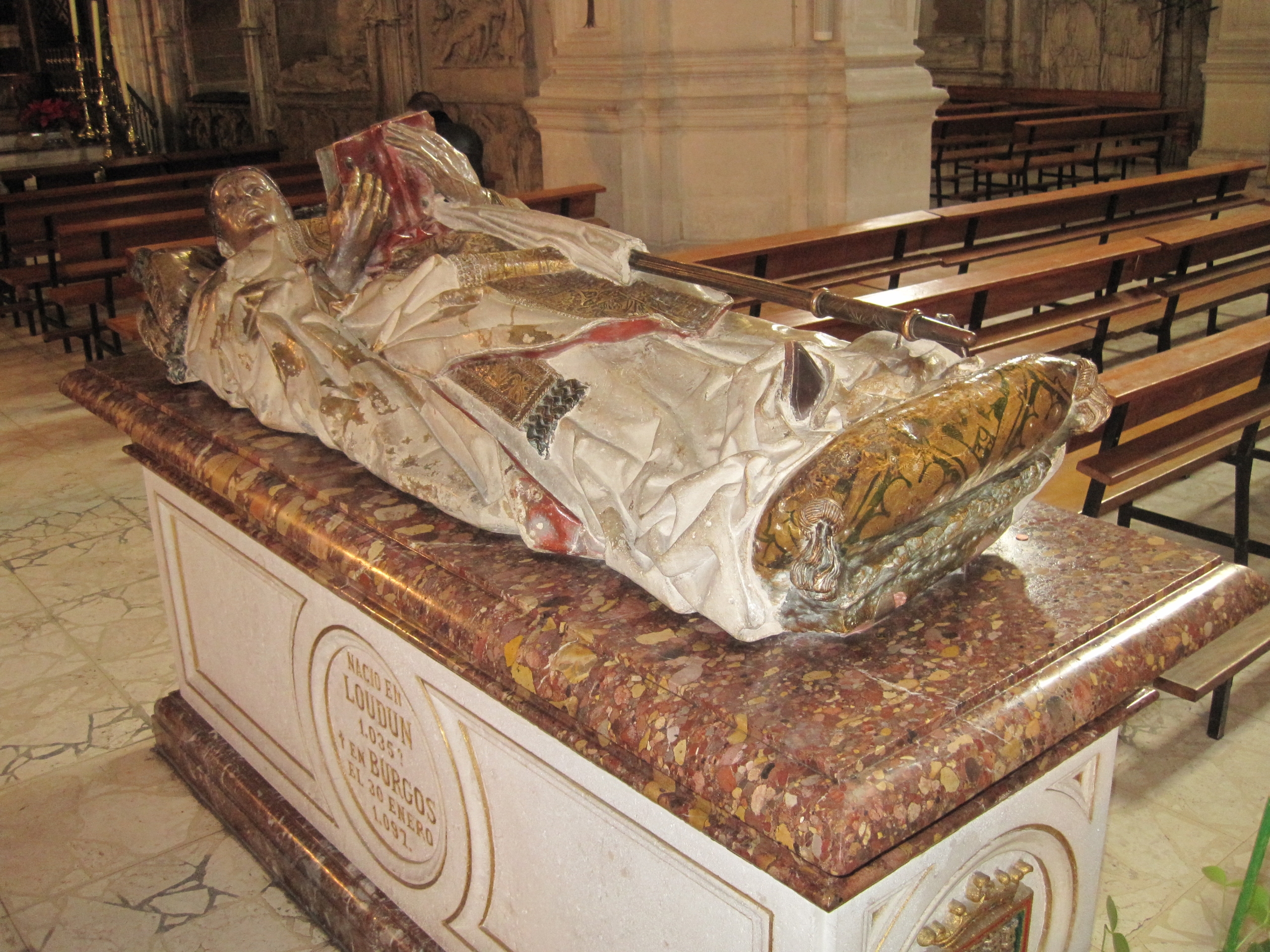
Pilgrims arriving in Burgos today along the Camino Francés have the chance to visit the tomb of San Lesmes without any significant detour from their route. After crossing the Gamonal district and advancing toward the historic centre, the Camino reaches the Plaza de San Juan, where the Gothic church dedicated to the city’s patron stands.
Inside is the tomb of San Lesmes, in the central nave, presided over by a recumbent sculpture representing the monk with his abbatial attributes. The figure belongs to a period long after his death, but it attests to the importance his cult had attained.
The visit recovers a tradition with centuries of history behind it. As early as the twelfth century the arrival of pilgrims at his tomb was being recorded, and in the modern period the site was adapted to facilitate veneration.
The church stands in the Plaza de San Juan, Burgos, beside the Jacobean route that continues toward the historic centre and the cathedral. To visit the interior, it is advisable to check the parish’s worship and opening hours in advance.
To pause a few minutes before his tomb is to discover a singular chapter in the history of the Camino: that of the religious and the communities whose hospitality turned a long pilgrimage route into a network of welcome extending across much of Europe.
Between legend and the Camino
The story of San Lesmes begins with an extraordinary image: a monk on a donkey crossing the raging waters of the Tagus. It is an account with epic resonances, enriched by centuries of tradition and later connected to the conquest of Toledo.
But behind the prodigy we find a historical trajectory that helps us understand eleventh-century Europe better, when monasteries, courts and pilgrimage routes were connecting territories far distant from one another.
The Camino de Santiago was one of the great settings of that exchange. Along it travelled people, languages, knowledge and experience, while communities arose dedicated to receiving and assisting those who undertook the long journey to Compostela.
San Lesmes was part of that world. His memory remained bound to Burgos, to hospitality and to the passage of pilgrims. Almost a thousand years later, those walking the Camino de Levante can call his legend to mind before the waters of the Tagus in Toledo. And those following the Camino Francés can still pause at his tomb in Burgos.
Two roads and two cities that allow us to discover how a single story has travelled across the centuries, between tradition, memory and historical reality.
AI Transparency Notice
PilgriMaps uses artificial intelligence tools to assist in the research, drafting and translation of editorial content. All AI-assisted content is reviewed, edited and verified by our editorial team before publication. We contrast information against primary sources, specialist literature and on-the-ground knowledge to ensure accuracy, cultural sensitivity and editorial integrity.
AI is one tool among many in our workflow. The judgement, curation and responsibility for everything published on this platform remain entirely human.
Viator Media S.L. — in compliance with the EU Artificial Intelligence Act (Regulation EU 2024/1689).
This post is also available in: