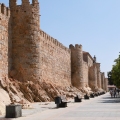
Today, amid the dense traffic and crowded neighborhoods of northeast Cairo, in Matariya, a tree survives that seems to belong to another time. Visitors pass through streets saturated with cars and modern buildings until they reach a small enclosure where the gnarled branches of an old sycamore continue drawing pilgrims, scholars, and travelers. Some arrive out of Christian devotion. Others out of historical curiosity. Many simply because they have heard of the place where, according to tradition, the Holy Family rested during the flight into Egypt.
Even an empress wanted to see it.
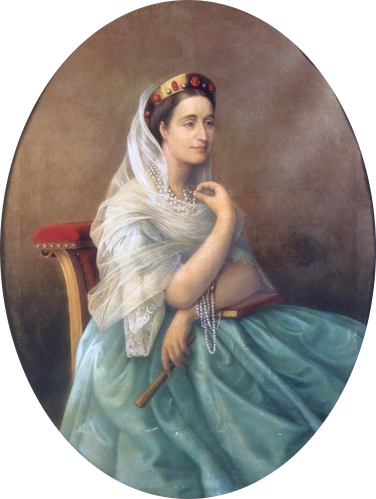
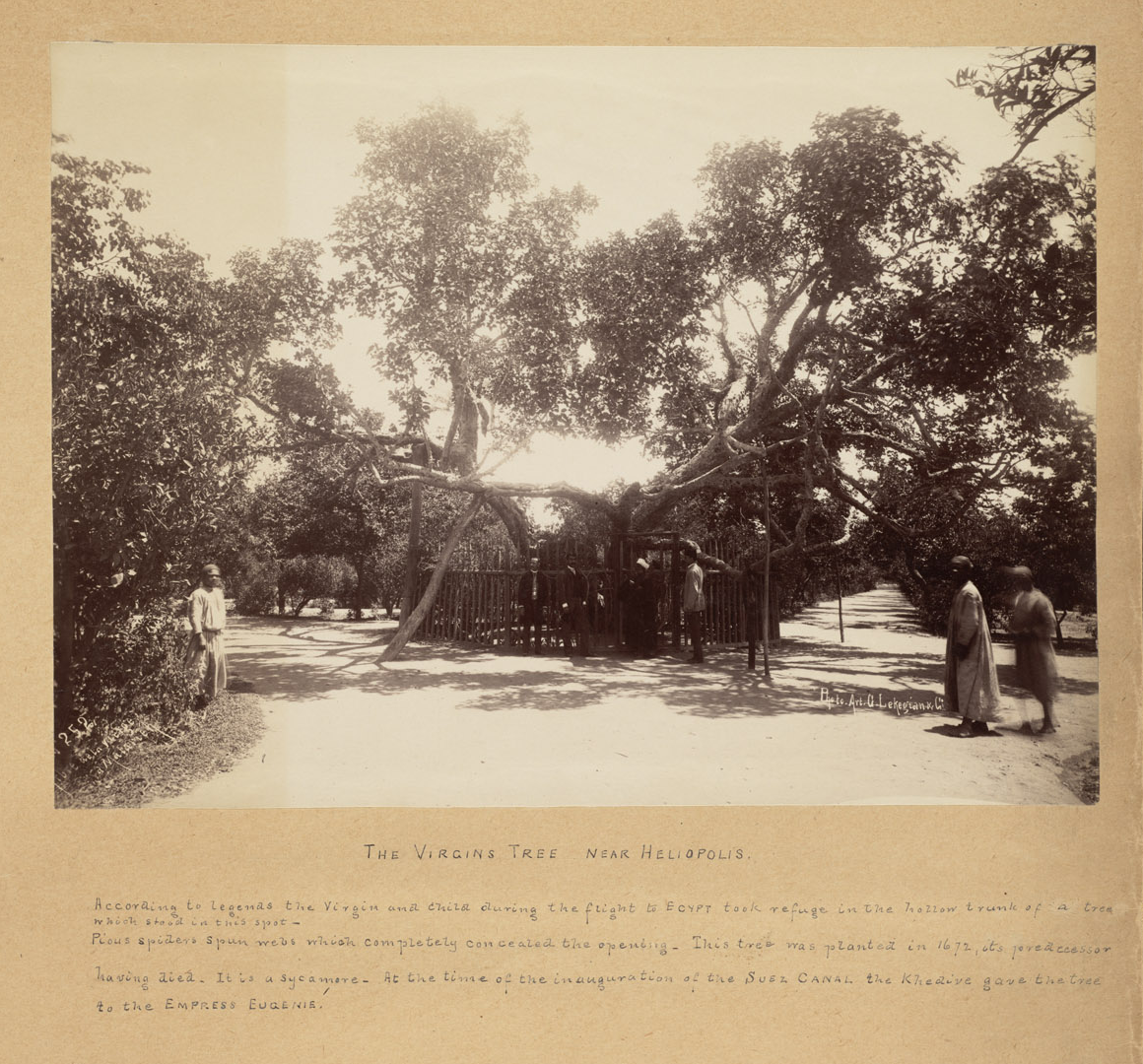
In October 1869, while attending the lavish celebrations marking the inauguration of the Suez Canal, Eugénie de Montijo — Empress of the French — asked to visit what was known as the Virgin’s Tree, in the Cairo district of Matariya. The scene carried a certain historical contrast: the great figure of the Second French Empire slipping away for a few hours from the diplomatic spectacle of the canal to stand before a tree venerated for centuries by Egyptian Christians.
But what fascinated nineteenth-century visitors was not only the Holy Family tradition. The true protagonist of Matariya was the sycamore itself — one of the most symbolically weighted trees in all of Egyptian civilization.
A sacred tree
The tree of Matariya belongs to the species Ficus sycomorus, the sycamore fig characteristic of the Nile valley and broad regions of Africa. Unlike the European sycamore — an entirely different tree — the Egyptian sycamore has a wide canopy, powerful roots, and fruits that grow directly from the trunk and thick branches. For millennia it provided shade, food, and timber in an environment where survival depended profoundly on one’s relationship with the landscape.
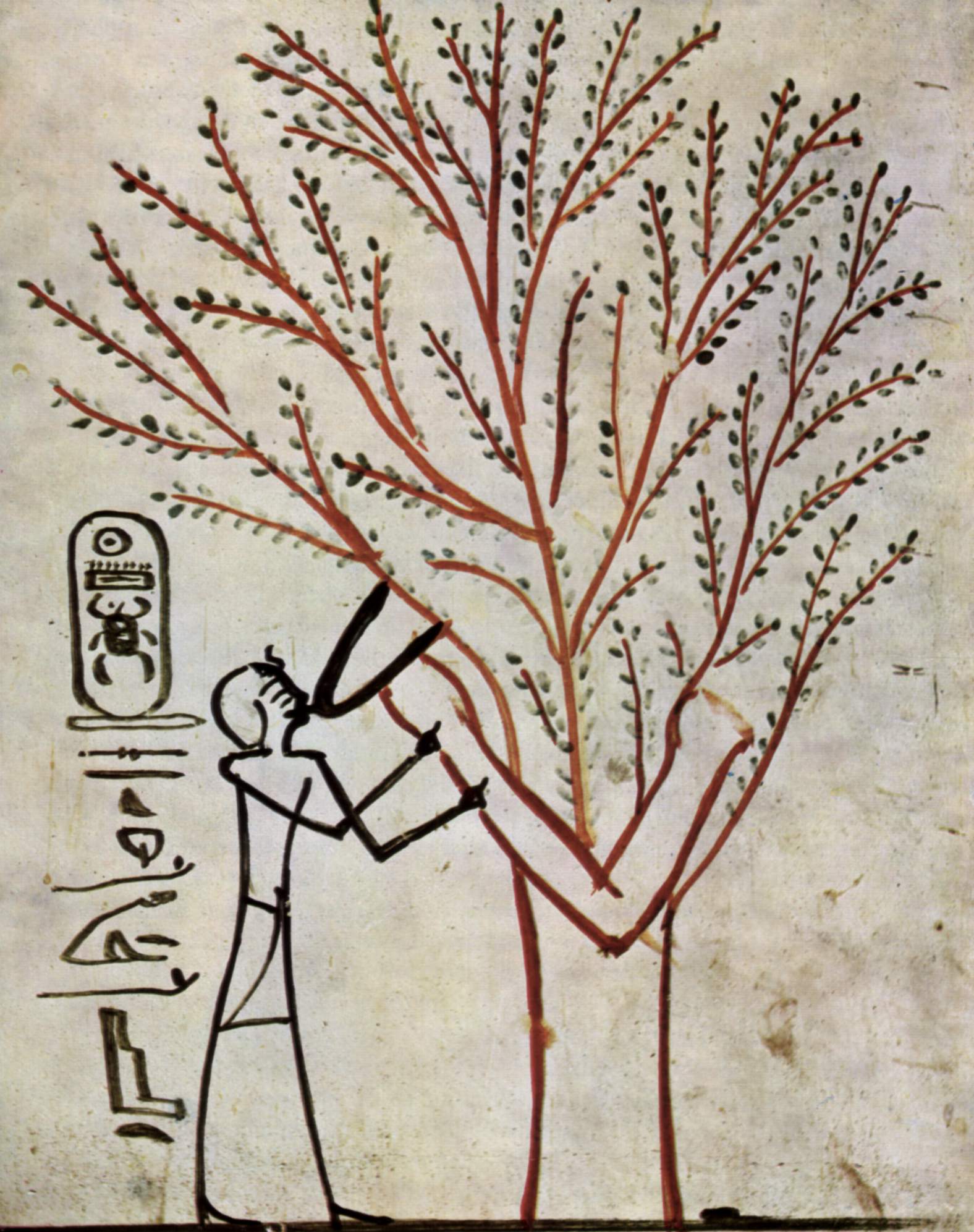
In Egypt, that everyday utility eventually became religious symbol. The ancient Egyptians drew no sharp line between the practical and the sacred. The same tree that gave fruit and wood could also be a representation of divine protection. The sycamore thus became one of the great symbolic trees of pharaonic culture. Funerary texts described it as a source of water, shelter, and renewal for the dead.
In the Pyramid Texts — among the oldest religious collections in the world — the sycamore appears associated with the protection of the deceased king. Later, in the Coffin Texts and the Book of the Dead, the tree became a kind of threshold between the human world and the afterlife. Some funerary formulas invoked the “sycamore of Nut” — the sky goddess — asking her for water and air for the soul of the dead.
The most powerful image developed by Egyptian art was probably that of the “goddess of the tree.” In numerous New Kingdom tombs, a female figure emerges from the trunk or branches of a sycamore to offer drink and food to the deceased. Sometimes she was identified with Hathor, goddess of maternity, music, and love. Sometimes with Nut, goddess of the sky. In either case, the tree functioned as a manifestation of care and protection.
Christian continuity
Centuries later, the sycamore of Matariya would be remembered as the tree that sheltered Mary and the child Jesus. Tradition holds that the Holy Family rested beneath its branches during the flight into Egypt, and that a spring emerged nearby that Mary used. Some later versions of the tradition added that from the water spilled beside the well there grew a plant of miraculous balsam.
No historically verifiable evidence exists for that episode. But the continuity of religious memory is extensively documented. Coptic references to the site appear from the early Middle Ages, and at least from the fifth century a church known as the “Church of Gold” stood beside the tree. The sanctuary was rebuilt several times and remained an important center of Christian pilgrimage even during periods of Islamic rule.
What is most striking is that Egyptian Christianity did not dismantle the ancient symbolism of the tree. It reinterpreted it. The sycamore had already been for millennia a symbol of shelter, maternity, and divine protection. The tradition of the Holy Family settled almost naturally into that symbolic landscape inherited from pharaonic Egypt. Beneath the Christian memory, a far older sensibility toward sacred trees continued to survive.
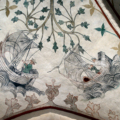
That continuity can be read even in the visual language of the place. Many Coptic Christian representations of the flight into Egypt show Mary resting beneath leafy trees that echo, however indirectly, the pharaonic iconography of the protective tree.
A tree that speaks of memory
The sycamore standing in Matariya today is not exactly the same tree venerated in antiquity. Coptic sources record that the original tree weakened and fell in 1656. Its branches and shoots were collected and replanted, allowing a new tree to grow from the previous roots. The tree survived by regenerating itself.
The metaphor is almost perfect for describing the religious history of Egypt. Civilizations changed. Gods, languages, and empires changed. But certain places retained their capacity to produce collective memory. Matariya is one of them.
Historical photographs show the tree gradually acquiring an almost sculptural presence. Nineteenth-century images reveal a great sycamore surrounded by gardens and dusty paths. Later photographs, taken in the 1930s, show vast deformed roots and branches covered in votive cloths left by pilgrims.
Visiting Matariya today
In recent years Egyptian authorities have restored the enclosure and integrated it into what is called the Route of the Holy Family — a tourist and religious itinerary connecting various sites associated with Egyptian Christian tradition. Supports have been installed to hold the heaviest branches; pedestrian areas and protective elements have been added to prevent further deterioration.
Yet despite these interventions, the experience of visiting retains something unexpectedly intimate. One stands before an irregular tree, partially supported by modern structures, surrounded by the distant noise of the city. There is no monumentality comparable to the pyramids or the pharaonic temples.
Perhaps precisely for that reason the place produces a different kind of impression. Everything there seems to speak of continuity rather than grandeur. The tree continues to give shade. Pilgrims still approach the well. In the midst of a vast metropolis, Matariya preserves the atmosphere of a refuge.
That may explain why the visit of Eugénie de Montijo came to occupy such a persistent place in local memory. In 1869, the Empress had traveled to Egypt to witness the technical and political triumph of the Suez Canal — one of the great symbols of industrial modernity. Yet one of the most remembered episodes of her stay was precisely her passage through this ancient sanctuary.
Because the sycamore of Matariya represents another way of understanding history. Not the history of monumental works or empires, but the history of places where different civilizations end up depositing their memories.
Some monuments survive through stone. Others remain alive — like this one, which still produces berries and shade. And perhaps that is why, after so many centuries, people still cross Cairo to stand for a few minutes beneath the branches of a sycamore.
This content is brought to you in partnership with Synergy and the Egyptian Tourism Authority (ETA)
The Holy Family Route today: A living itinerary across Egypt
AI Transparency Notice
PilgriMaps uses artificial intelligence tools to assist in the research, drafting and translation of editorial content. All AI-assisted content is reviewed, edited and verified by our editorial team before publication. We contrast information against primary sources, specialist literature and on-the-ground knowledge to ensure accuracy, cultural sensitivity and editorial integrity.
AI is one tool among many in our workflow. The judgement, curation and responsibility for everything published on this platform remain entirely human.
Viator Media S.L. — in compliance with the EU Artificial Intelligence Act (Regulation EU 2024/1689).
This post is also available in: