From the Cathedral of Dalt Vila to the villages of the north, a multi-day itinerary through fortress churches, ancient paths, rural shrines and Mediterranean landscapes. To discover Ibiza not as the capital of the night, but as an island of silence, memory and walking.
There is a way of crossing Ibiza that requires a complete change of perspective. Instead of chasing the most famous beaches, the clubs or the next sunset, you must follow the bell towers. Climb the hills where the fortress churches stand. Enter the squares of small villages. Stop before a sun-whitened façade and ask yourself why, precisely there, in the middle of the countryside or on a hilltop, someone decided to build a place of worship.
From this comes the idea of a contemporary pilgrimage through Ibiza: a Camino of the White Churches — not a devotional route historically codified like the Camino de Santiago, but a cultural and spiritual itinerary built around the island’s extraordinary religious geography.
This distinction is important. There is no single official pilgrimage — at least in the tourist and institutional sources consulted — connecting all of Ibiza’s churches along one unified historic route. But there is something equally interesting: a network of sacred places that for centuries contributed to organising the territory and the life of communities. The rural churches were points of religious reference, naturally, but also places of gathering and, in some cases, buildings designed with defensive characteristics against raids from the sea.
Ibiza Tourism proposes a genuine “mystic route of the white churches” crossing numerous villages on the island. It is from this geography that a pilgrimage experience can arise: a slow journey, organised in stages, in which the road does not necessarily have a miraculous destination but becomes itself an instrument of knowledge.
The result is another Ibiza.
An island traversed from the fortified heart of Eivissa toward the countryside, from the Cathedral walls to the valleys of the north, from places overlooking the sea to the squares where patron saint festivals still bring the inhabitants together today.
First stage: Dalt Vila, the point of departure
Every pilgrimage needs a threshold.
In Ibiza, that threshold can be the Cathedral of Santa María de las Nieves, at the highest point of Dalt Vila. Its position is not only spectacular: it tells the history of the island itself. The building rises on the site of the ancient mosque of Yebisah, and its Christian construction is linked to the Catalan conquest of 1235. The medieval church, initially Gothic, was later profoundly transformed in the 18th century according to Baroque taste.
It is here that the journey can begin.
Before leaving the city, the contemporary pilgrim should walk slowly through Dalt Vila. Not to “see everything,” but to understand how the sacred occupied and organised a fortified urban space. The Cathedral is not isolated: along the way one encounters the church of Santo Domingo, the chapel of Sant Ciriac, the Capella del Salvador, L’Hospitalet and other religious buildings that tell of a city in which power, faith and defence were closely intertwined.
A possible first ritual gesture might be precisely this: to climb to the Cathedral without haste.
Dalt Vila demands vertical movement. You pass through gates, stairways and rising streets before reaching the Plaça de la Catedral. It is a topography that lends itself naturally to the idea of pilgrimage: the destination does not appear immediately — it must be earned, step by step.
During Holy Week, this dimension becomes even more evident. The processions and the Via Crucis cross the city’s streets and connect different churches to the Cathedral, physically transforming the movement through Eivissa into a collective religious gesture.
Second stage: Jesús and Santa Eulària, the road to the East
From the heart of Eivissa the route can head eastward, making a first stop at the church of Jesús and continuing toward Santa Eulària des Riu.
Here the religious landscape changes. You leave the fortified city to enter a geography of villages and rural settlements. The great landmark is the Puig de Missa, the church of Santa Eulària built on elevated ground, commanding the territory and the sea.
Here too the choice of height is significant. The Ibizan churches were not simply places destined for liturgy: their position, their solid walls and, in some cases, their defensive elements recall an era when the safety of the population was a concrete concern. The official Balearic sources describe many of these buildings as churches linked to functions of protection against pirates.
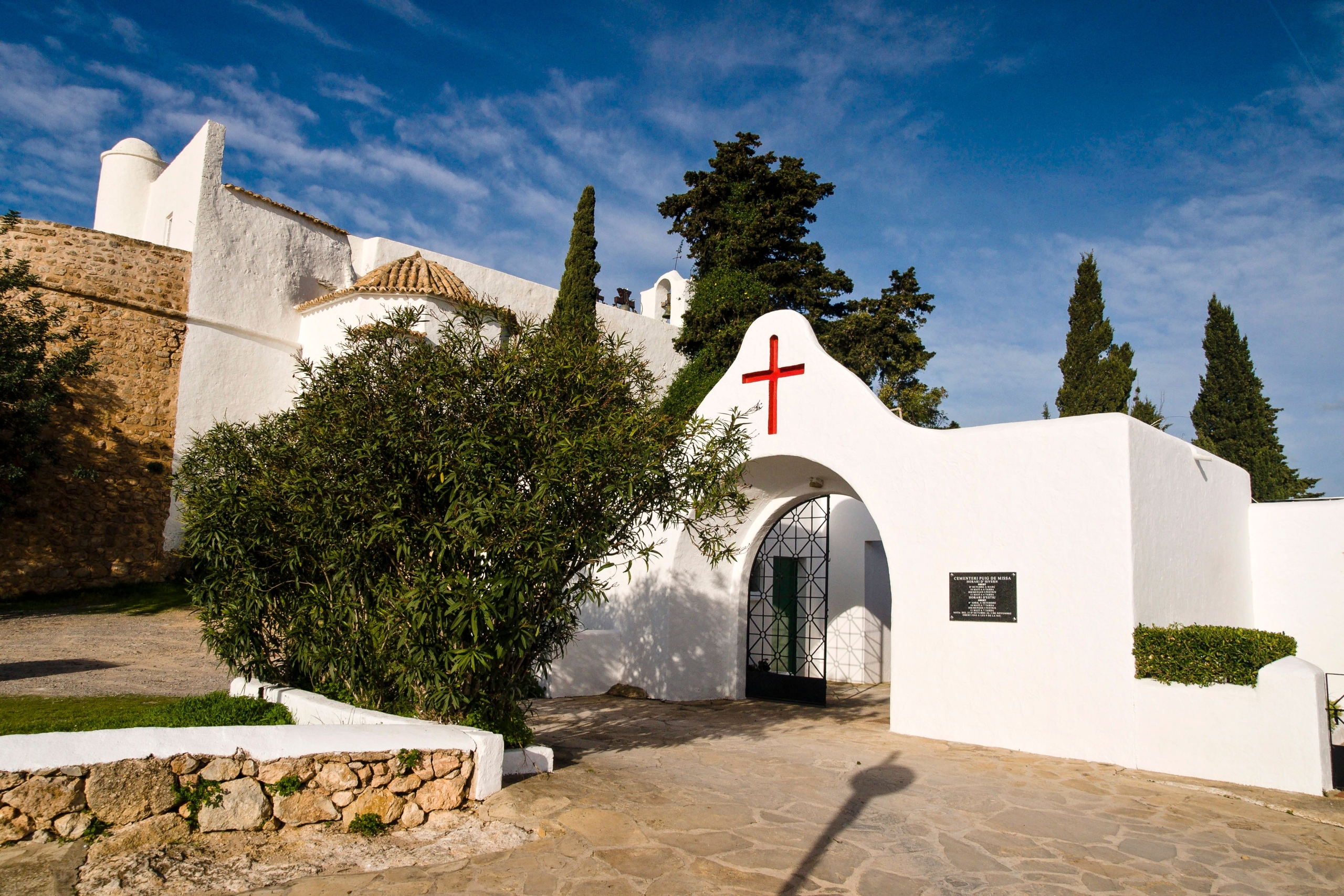
At this point the pilgrimage acquires a second dimension: to climb in order to see. Faith is often associated with interiority. In Ibiza, the churches frequently compel you to look at the territory. From above you understand the distances, the relationship between village and countryside, between scattered houses and communal centre.
The sacred becomes also a form of orientation.
Third stage: Sant Carles and Sant Vicent, toward the edge of the Island
From Santa Eulària the path can continue toward Sant Carles de Peralta, then toward the north-eastern coast and Sant Vicent de sa Cala.
Sant Carles is one of the churches that best embodies the image of rural Ibiza: white, essential, with defensive characteristics. Sant Vicent, by contrast, brings the pilgrim into a green valley, not far from one of the great coves of the northern coast. Both form part of the network of churches that the island’s cultural promotion presents as an expression of Ibizan historical and religious heritage.
This might be one of the most contemplative stages of the route.
A pilgrimage must not be a succession of monuments. If the journey is reduced to a list of churches, it loses its deeper purpose. The distance between one building and the next is part of the experience.
To walk — or, where distances require it, to move by bicycle or other means — means to understand what it is to be on an island. In Ibiza the parishes do not arise in a uniform territory. They are set into valleys, hilltops, plains and villages that have produced very marked local identities.
The pilgrim should therefore allow themselves one rule: one church, one pause, one moment of silence.
Not necessarily a prayer, if the experience is not confessional. It might be reading the history of the place. Listening to the sounds. Observing the architecture. Trying to imagine how people lived here before modern roads and mass tourism.
Fourth stage: Sant Joan, the North, and the church as community
The north of Ibiza is perhaps the territory that best preserves the image of a slower island.
The church of Sant Joan de Labritja stands at the heart of the village that bears the same name. Completed in 1770, it has a rectangular nave with a vault and side chapels; before it, the square continues to serve a social function, becoming also a gathering point for the Sunday market.
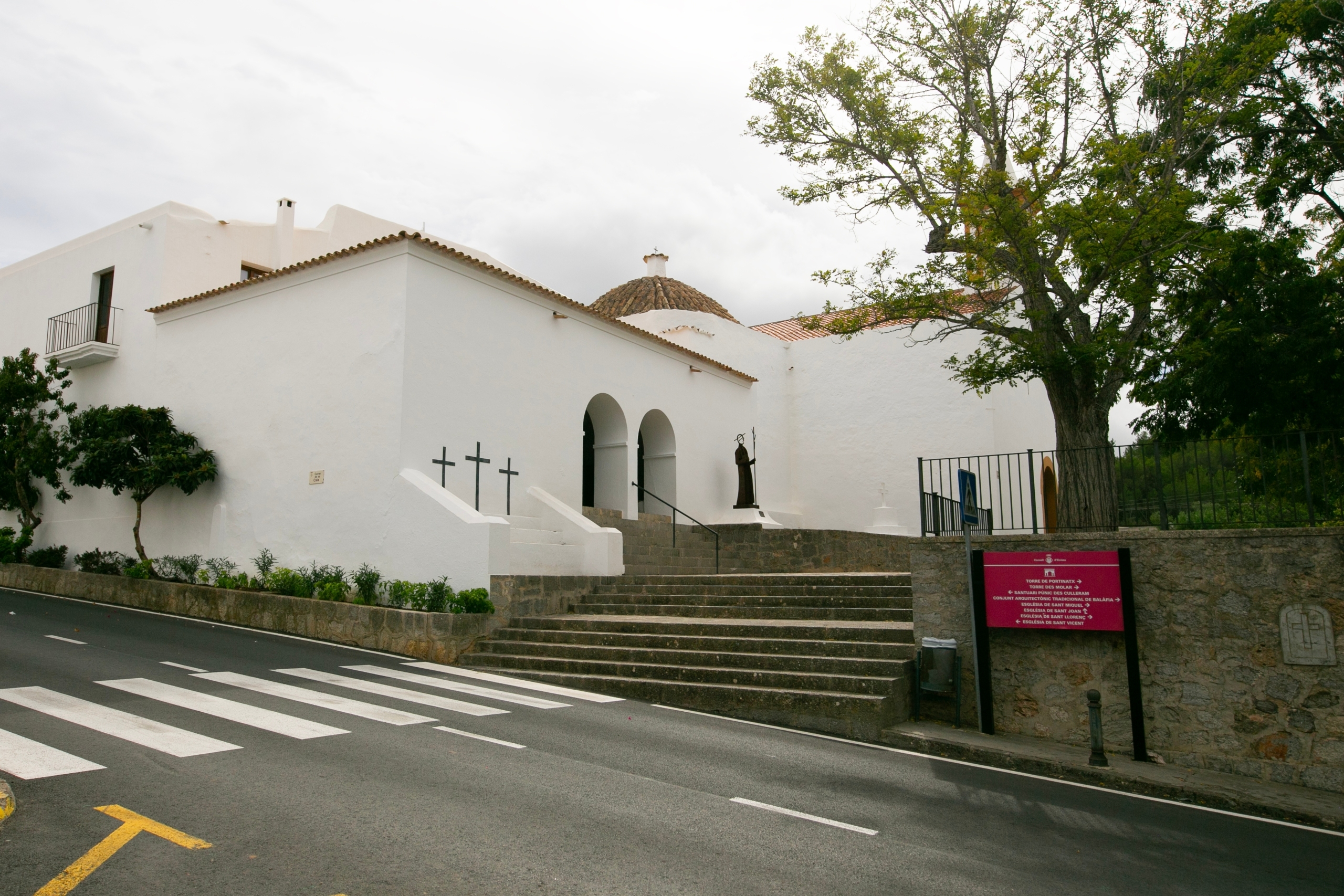
This is an important detail. In many locations on the island, church and square form a single symbolic system. Inside, the religious rite is celebrated. Outside, community is built. The passage between sacred and everyday is brief, almost physical: you need only cross a door.
For a pilgrimage itinerary, Sant Joan can represent the stage of community. Here the journey is no longer only about the individual’s relationship with spirituality or history, but about the collective meaning of the sacred place.
Every rural church contributed, for centuries, to defining a centre. And the pilgrimage also serves to reconstruct those centres.
Fifth stage: Sant Miquel de Balansat, the Fortress Church
From Sant Joan the route leads to one of the most emblematic places of the entire experience: the church of Sant Miquel de Balansat, on the Puig de Sant Miquel.
Here the idea of Ibiza as a vulnerable and defensive island becomes architecture. The complex commands the landscape from above, and its structure preserves the robust character of churches built also in response to the security needs of the period. The central body was constructed at the end of the 16th century according to defensive criteria; among the features to observe are the bell tower and the restored frescoes in two chapels.
Sant Miquel might be the symbolic stage of protection. In a modern pilgrimage we are accustomed to thinking of the sanctuary as a place of inner refuge. Here the concept of refuge was also literal. Thick walls. A commanding position. A community that knew it could find protection in a consecrated building.
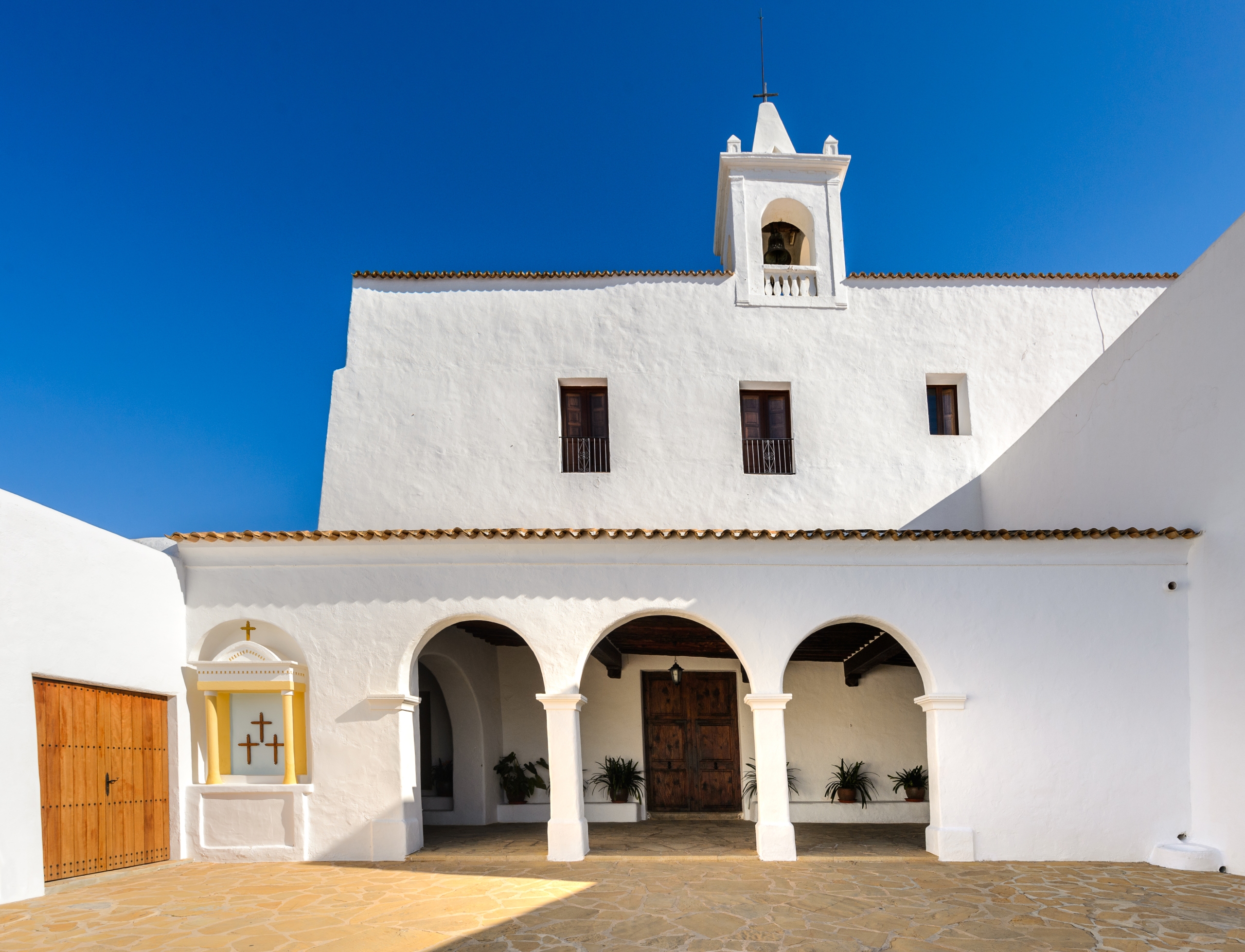
The fortress church tells of a deeply Mediterranean Christianity, born in a region where the sea could be at once a commercial route, a spiritual horizon and a threat.
Sixth stage: Sant Llorenç and the landscape of memory
The descent from Sant Miquel can continue toward Sant Llorenç de Balàfia. This stage allows the concept of pilgrimage to expand from the single building to the entire landscape. Not far from the church lies the historic nucleus of Balàfia, considered one of the most significant examples of traditional architecture on the island, characterised by rural houses with defensive towers.
The church, then, must not be observed separately from the dwellings. It is part of a system. A pilgrimage through the other Ibiza should continually recall this principle: sacred places did not appear in a vacuum. They were built for communities that farmed, raised livestock, traded, protected themselves and lived in a territory that was difficult to control.
At Sant Llorenç the theme of the stage might be memory. To look at what remains — not to transform it into nostalgia, but to understand how a territory produced its own architecture.
Seventh stage: Sant Mateu, the Camino as slowness
In the heart of a rural valley stands Sant Mateu d’Albarca, one of the churches best suited to the idea of slow pilgrimage. The present church dates to the 18th century and was built to provide spiritual assistance to the faithful of the area. It has a single nave, a barrel vault, eight chapels and the traditional portico with three arches. Its parish festival falls on 21 September.
But Sant Mateu matters for another reason too: here the camino can return to being truly a camino. The area is connected to official walking routes. One of the island’s proposed itineraries departs from the church of Sant Mateu itself and crosses the rural territory for approximately 11.3 kilometres. It is a concrete opportunity to include a day on foot within an itinerary that, given the overall size of Ibiza, cannot be walked entirely along a single continuous route.
This is a practically important clarification: the Camino of the White Churches can be designed as a staged pilgrimage, alternating transfers between different areas of the island and on-foot sections in territories where paths and adequate conditions exist.
That would not be a betrayal of the spirit of pilgrimage. The great European caminos too are made of adaptations, detours, rests and different modes of travel. What matters, in this case, is to maintain the continuity of intention.
Eighth stage: Santa Agnès, Sant Antoni and Sant Rafel
Heading west, the route can take in Santa Agnès de Corona, cross the territory of Sant Antoni de Portmany and conclude this central section of the island at Sant Rafel de sa Creu.
These are places that differ from one another, but are connected by a common characteristic: they show how the church has been the visible pivot of communities scattered across very different landscapes.
The church of Sant Antoni is among the historically most important on the island; Sant Rafel sits in a village also known for its craft tradition; Santa Agnès is set in its celebrated rural valley. All three are included in the cultural proposals and the network of historic churches promoted by the island’s tourism bodies.
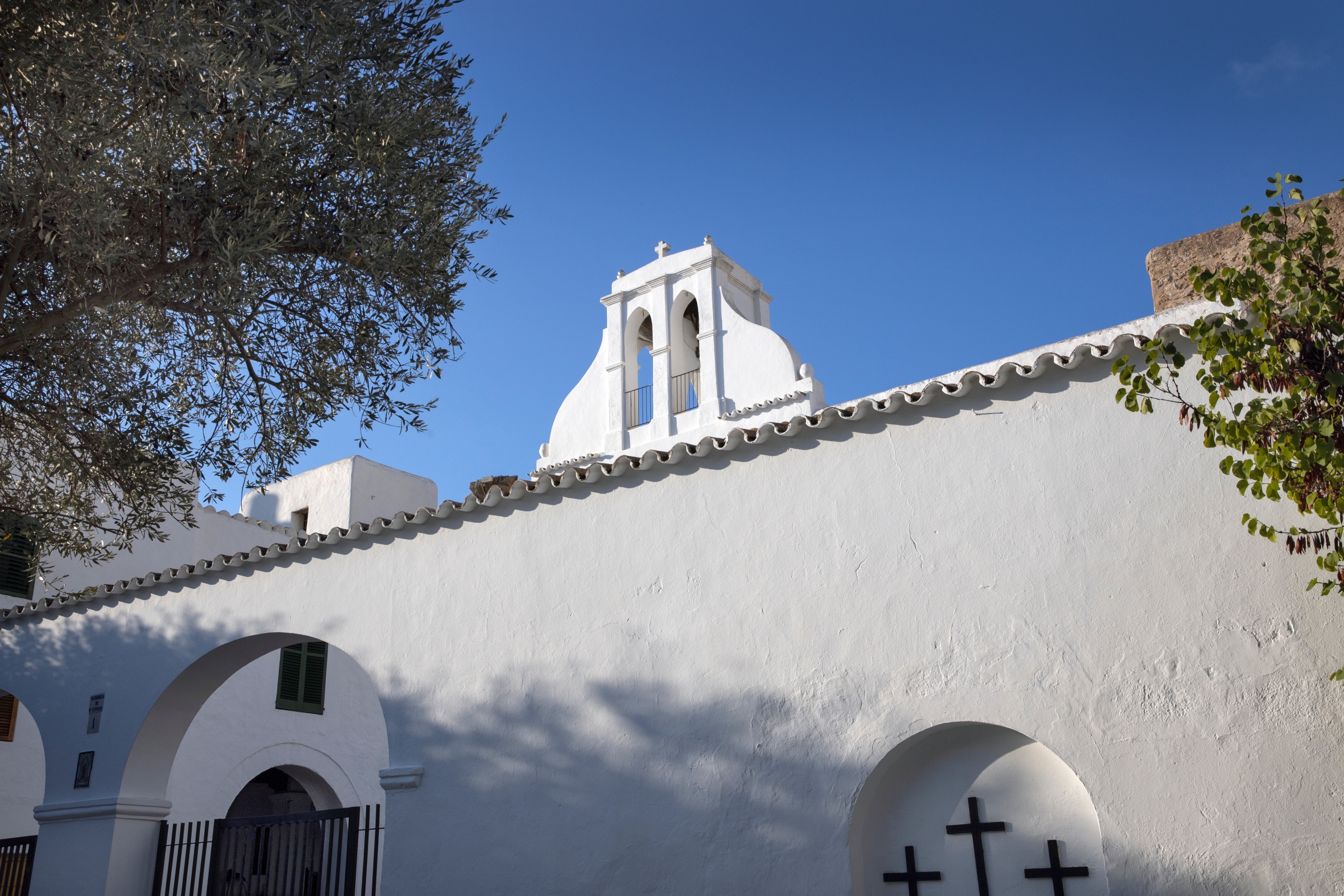
This might be the stage of dwelling. After days spent observing the sacred as defence, memory, community and silence, here another function emerges: the church as a constant presence in everyday life.
The pilgrim does not arrive at a grand concluding “sanctuary.” They discover, rather, a constellation of small centres. And this is perhaps the true particularity of the Ibizan route.
Ninth stage: Sant Josep, Sant Agustí and Es Cubells, toward the sea
The final great section of the pilgrimage can cross the south-west of the island: Sant Josep de sa Talaia, Sant Agustí des Vedrà and Es Cubells.
The church of Sant Josep, completed in 1731, preserves many of the distinguishing features of local religious architecture: decorative simplicity, wide whitewashed walls, an almost fortified appearance. It is also the only church on the island equipped with a sundial on its façade. The sundial is a perfect detail for a pilgrimage.
After crossing the island following the bell towers, here you encounter a building that speaks explicitly also of time. And time is, in the end, the great theme of this journey. The liturgical time of the festivals. The agricultural time of the countryside. The historical time of the raids and the fortifications. The slow time of walking.
From Sant Josep the route can continue toward Sant Agustí and finally reach Es Cubells, where the church dedicated to Nuestra Señora del Carmen stands in one of the most spectacular areas of the southern coast. Here the pilgrimage meets the sea again, ideally closing the circle that began on the walls of Dalt Vila.
If the Cathedral represented the city and the conquest, Es Cubells can represent the horizon. The point where nothing remains to cross but the sea.
A pilgrimage for those who seek the invisible
An itinerary among the churches of Ibiza should not be marketed as an “exotic” alternative to the nightlife. That would be a mistake of perspective. It is something deeper. It allows one to understand that Ibiza possesses a symbolic density far greater than the dominant narrative constructed over recent decades. Behind the international myth of the island of freedom there exists an ancient fabric of parishes, villages, patron saint festivals, processions and rural routes.
A possible Camino of the White Churches might be organised over six or seven days, or extended according to available time:
- Day 1: Dalt Vila, Cathedral and historic churches of Eivissa.
- Day 2: Jesús and Puig de Missa at Santa Eulària.
- Day 3: Sant Carles and Sant Vicent.
- Day 4: Sant Joan and Sant Miquel de Balansat.
- Day 5: Sant Llorenç and Sant Mateu, with a section to be walked on foot.
- Day 6: Santa Agnès, Sant Antoni and Sant Rafel.
- Day 7: Sant Josep, Sant Agustí and Es Cubells.
The route can naturally be adapted. Church opening hours, Mass times and visiting arrangements change throughout the year and should be verified before departure. Those wishing to give the experience a properly religious dimension might also build the journey to coincide with the principal local celebrations or with Holy Week, when many churches become part of a physical network of processions and walks.
But even outside the great feast days, this itinerary retains its meaning. Because to make a pilgrimage does not necessarily mean to seek a miracle. Sometimes it simply means learning to see. And in Ibiza, following the invisible line that connects one white church to the next, you discover that the most famous island in the Mediterranean still has vast areas of shadow, of silence and of memory. You only need to have the time to walk them.
AI Transparency Notice
PilgriMaps uses artificial intelligence tools to assist in the research, drafting and translation of editorial content. All AI-assisted content is reviewed, edited and verified by our editorial team before publication. We contrast information against primary sources, specialist literature and on-the-ground knowledge to ensure accuracy, cultural sensitivity and editorial integrity.
AI is one tool among many in our workflow. The judgement, curation and responsibility for everything published on this platform remain entirely human.
Viator Media S.L. — in compliance with the EU Artificial Intelligence Act (Regulation EU 2024/1689).
This post is also available in: