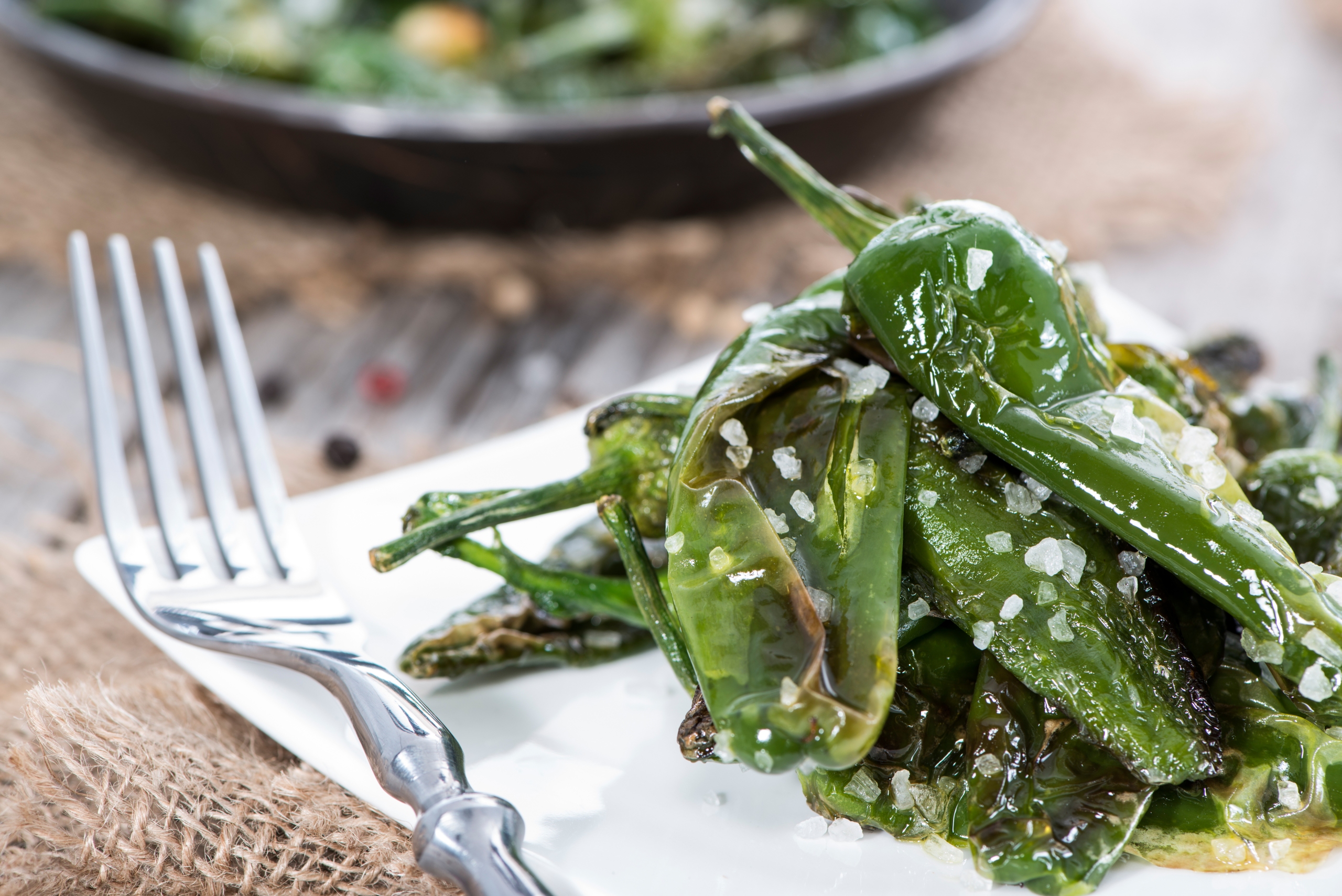
Before they are a delicacy, pimientos de Padrón are a small test of courage. They arrive at the table looking identical — green, glossy, barely wrinkled from the heat of the oil, scattered with coarse salt. They seem harmless, almost gentle. Then someone bites into one and the table holds its breath for just a moment: sweet or hot? In that brief suspension, more than in any recipe, lives the fame of these celebrated Galician peppers. They are a kind of collective ritual, a shared surprise that has accompanied Galician food culture for centuries.
Behind this apparent simplicity lies a history that crosses oceans, monasteries, and generations of farmers. The pimientos de Padrón are the result of a long journey that began on the other side of the Atlantic and ended in the green, humid valleys of Galicia, where they found their permanent home.
From the Americas to Galicia
To understand their origin, you have to go back to the period following the discovery of the New World. Between the sixteenth and seventeenth centuries, Spanish ships were carrying increasing quantities of products unknown to Europeans back across the Atlantic: tomatoes, potatoes, maize, cacao, and various varieties of chili pepper belonging to the genus Capsicum.
According to local tradition and the sources of the Consejo Regulador of the Protected Designation of Origin, it was the Franciscan friars of the convent of San Antonio de Herbón, near Padrón, who introduced pepper seeds into Galicia. The friars, who maintained connections with Spanish missions in the Americas, are said to have received seeds from the Mexican region of Tabasco, one of the areas historically associated with chili cultivation.
The convent of Herbón, founded in the fifteenth century, became the place where an American plant began its transformation into a Galician product. Over the following centuries, local farmers selected the varieties that best adapted to the regional climate, favoring small, tender fruits with a delicate flavor. What we know today as the pimiento de Padrón is not a simple import from Mexico but the result of a long process of agricultural and cultural adaptation.
The land that shaped them
Galicia is one of Spain’s greenest regions. Its Atlantic climate — abundant rainfall, moderate temperatures, high humidity — creates particularly favorable conditions for many horticultural crops. The historic production area for pimientos de Padrón is concentrated around the parish of Herbón, in a zone crossed by the rivers Sar and Ulla. The landscape here alternates cultivated fields, woodland, and small rural villages that still retain a strong agricultural identity.
The combination of fertile soil, constant moisture, and mild temperatures shapes the peppers’ flavor and texture. This is not simply a matter of geography: it is the relationship between environment and human labor that has produced a symbol of Galician gastronomy. That bond with the land has been formally recognized by the European Union through the Protected Designation of Origin Pemento de Herbón DOP, which applies exclusively to production from the authorized area.
Pimiento de Padrón or Pemento de Herbón?
Many consumers use the two names interchangeably, but the distinction matters. “Pimientos de Padrón” has entered everyday language as a generic term for this type of pepper. The officially protected designation is Pemento de Herbón, a name that refers to the place where cultivation originated. Not all peppers sold as “Padrón-type” belong to the certified designation: only those grown within the area defined by the specification and subject to its controls can carry the DOP mark.
The production zone covers the municipalities of Padrón, Dodro, and Rois in the province of A Coruña, and Pontecesures and Valga in the province of Pontevedra — the territory where an agricultural tradition has been passed down across generations.
The pepper itself
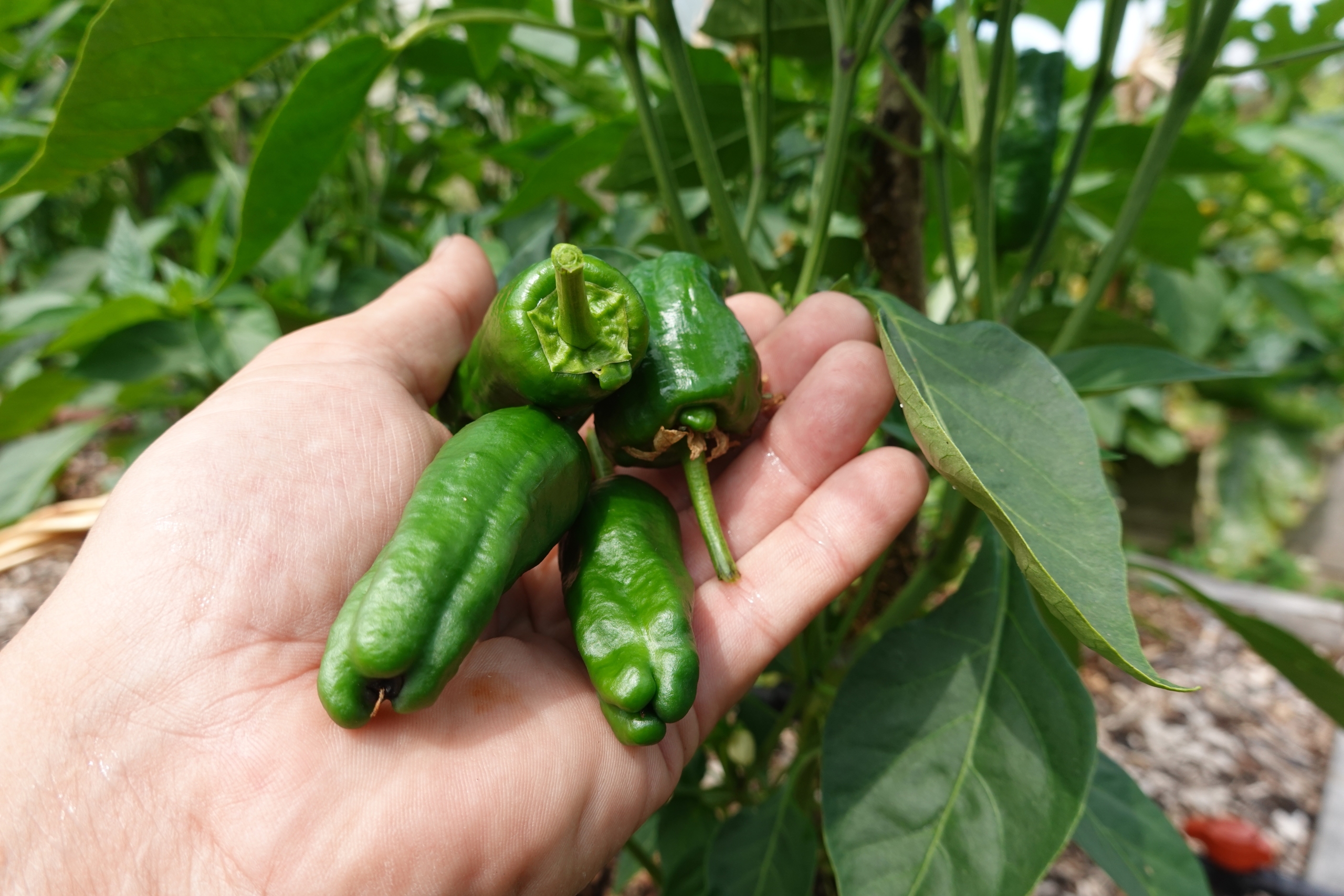
Botanically, the Pemento de Herbón belongs to the species Capsicum annuum. The fruits are harvested while still immature, before they develop the red color of full ripeness. They are relatively small — generally between 3.5 and 5.5 centimeters in length — with a slightly conical shape, a smooth, glossy surface, and an intense green color.
The flesh is thin and tender, the flavor predominantly sweet and vegetal, with fresh notes reminiscent of cut grass and young peppers. It is precisely the possibility of encountering a hotter one that has made the product famous worldwide. Harvesting remains largely done by hand, concentrated between May and October, as the delicacy of the fruits requires particular care at every stage.
The famous unpredictability
The most celebrated phrase associated with pimientos de Padrón is probably: Os pementos de Padrón, uns pican e outros non — Padrón peppers, some are hot and some are not. It reads like a tourist slogan, but it is also a surprisingly accurate description of reality.
The heat depends on capsaicin, the natural compound responsible for the burning sensation. In pimientos de Padrón, the quantity of capsaicin varies considerably from one fruit to the next. The reasons are not entirely predictable: agronomic studies point to factors including temperature, water availability, sun exposure, soil conditions, and degree of ripeness. Even within the same plant, peppers can develop markedly different heat levels.
It is this natural variability that has turned a simple vegetable into a minor gastronomic event. In certified traditional production, however, the heat should never be excessive — the goal is to maintain a balance that allows room for surprise without compromising the pleasure of the product.
From Galicia to every tapas bar in Spain
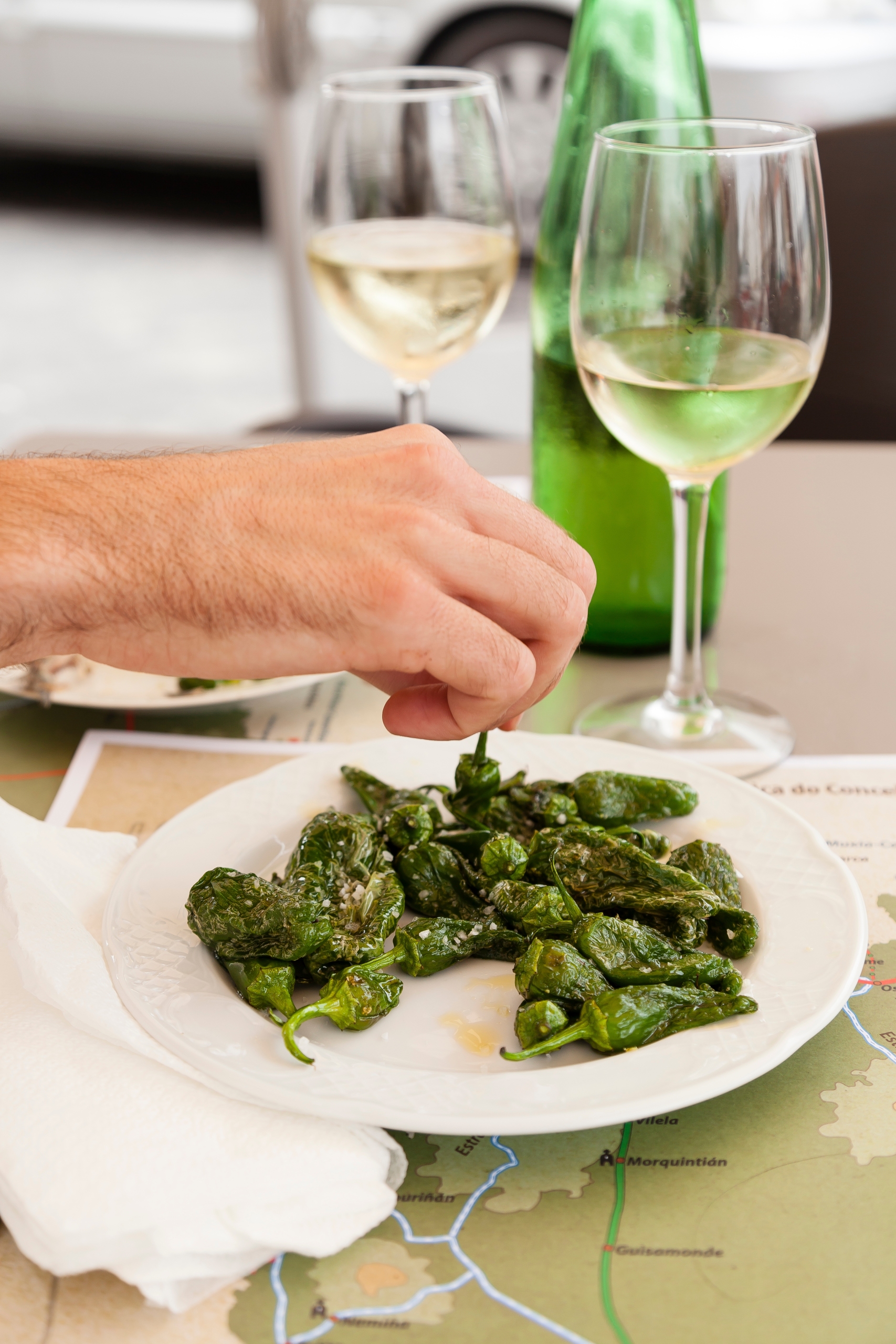
For much of the twentieth century, pimientos de Padrón were known primarily within Galicia. With the rise of tourism and the spread of tapas culture, their popularity gradually extended across Spain. Today it is difficult to find a tapas bar that does not feature them. The traditional preparation is extremely simple: the peppers are fried quickly in very hot olive oil, drained, and served with a generous scattering of coarse salt. No sauces, no additional ingredients. The recipe honors the product in its essentials, letting texture, aroma, and unpredictability do the work.
Their versatility has also encouraged more contemporary interpretations. Chefs use them in tempura, alongside fish dishes, paired with artisan cheeses, or as an ingredient in creative preparations that combine tradition with innovation.
A pepper that carries a place
Few products represent a territory as effectively as pimientos de Padrón. In a small green pepper coexist many of the qualities that define Galicia: the Atlantic climate, the farming culture, the relationship with the sea, the memory of transoceanic routes, and the capacity to transform simple ingredients into markers of identity.
Their international fame has inevitably encouraged imitation, with “Padrón-type” varieties now grown across several European countries and even in North America. For enthusiasts and connoisseurs, however, the reference remains the certified product from the historic area of Herbón.
To eat an authentic Pemento de Herbón is to taste not merely a vegetable but a fragment of European agricultural history — the journey of a seed from the Americas, the patient work of generations of growers, and the identity of a region that turned a simple crop into cultural heritage.
Perhaps that is the real reason for their success. In an age when almost everything tends toward standardization and predictability, pimientos de Padrón continue to remind us that nature still retains a measure of unpredictability. And that sometimes, the pleasure of the table is born from a small surprise.
AI Transparency Notice
PilgriMaps uses artificial intelligence tools to assist in the research, drafting and translation of editorial content. All AI-assisted content is reviewed, edited and verified by our editorial team before publication. We contrast information against primary sources, specialist literature and on-the-ground knowledge to ensure accuracy, cultural sensitivity and editorial integrity.
AI is one tool among many in our workflow. The judgement, curation and responsibility for everything published on this platform remain entirely human.
Viator Media S.L. — in compliance with the EU Artificial Intelligence Act (Regulation EU 2024/1689).
This post is also available in: