I noticed her in Sarria, on the first morning. It was raining that fine Galician rain that gets into your bones without asking permission. She was sitting in a corner of the bar, a cap pulled down over her forehead, her green poncho still dripping, a cup of coffee held between her hands the way you hold a small fire.
Something about that face was familiar. It took me a few seconds to work it out. It was her — the actress I had seen for years on the big screen, on posters, on magazine covers at the newsstand. Perfect smiles, dream dresses, red carpets. And now there she was, with shadows under her eyes and short nails, stirring sugar into her coffee in silence.
I did what I would have wanted someone to do for me: I pretended not to have recognised her. I only asked her whether she knew what time the bakery opened in the next village. She looked up, surprised, and smiled at me. That was how it began.
The First Kilometres, on Tiptoe
We set out together almost by accident, because we walked at the same pace. All morning we talked about light things: the weight of the rucksack, the new shoes that were hurting, the cows that watched us from the fields like curious old ladies. She laughed often — a low, real laugh, very different from the one I knew from the films.
Every so often someone would recognise her. A Spanish couple stopped, whispered her name, pulled out a phone. She smiled, posed for the photo, thanked them. Then, as soon as we set off again, I saw her pull the cap down once more and draw her shoulders in, like someone trying to make herself smaller. In that gesture I understood that the camino, for her, was also an attempt to disappear.
The Evening She Took Off the Mask
In Portomarín, that evening, we sat on a low wall watching the river. The sun was going down slowly, the water was turning gold, and for long minutes neither of us said anything. Then, suddenly, she spoke.
She told me it had been years since she had walked down a street without someone beside her. A driver, an assistant, a press officer. That she could not remember the last time she had eaten in a restaurant without feeling watched. That sometimes, in the most beautiful hotel rooms in the world, she felt so alone that she switched on the television just to have a voice in the room.
She confessed her fear of growing old in a trade that forgives wrinkles very little. The exhaustion of always living up to an image constructed by other people. The fear that people loved the character and not her. And then the real reason she had set out: a recent bereavement, a mother who had died while she was on a set on the other side of the world. She had not got there in time to say goodbye.
She wept quietly, without hiding it. I took her hand. In that moment there was no star sitting beside me. There was a daughter asking her mother’s forgiveness, under the Galician sky.
Equals Before the Climb
The next day we tackled the hardest stage. Long, with ascents that seemed never to end. By mid-morning she stopped, pale, hands on her knees. A blister had opened on her heel and every step was a stab of pain.
We sat down at the side of the road. I got out needle, thread and plasters, as an old hospitalero had taught me to do years before. She watched me tending to her foot with an expression I will not forget: astonishment, gratitude, and a kind of childlike relief. She told me nobody had looked after her without wanting something in return for a long, long time.
The camino has that power. Facing a climb, we are all equal. Fame, the bank balance, the prizes won, the magazine covers — all of it stays behind, along with the dust. What remains is two tired legs, a heart beating hard, and the same yellow arrow to follow.
Her Fragilities, and Mine
Over the following days we walked a great deal, sometimes talking, sometimes in silence. And I discovered that her fragilities closely resembled my own. The fear of not being enough. The need to be seen for who you really are. The difficulty of stopping, of asking for help, of accepting that pain too is part of life.
She lived it under the spotlights, I in my everyday life as a journalist always in a hurry. But the substance was the same. I understood that behind every famous face there is a person who sometimes cannot sleep at night, who is afraid, who feels alone, who loves and suffers exactly as the rest of us do.
And I understood something else too, perhaps the most important thing. We often look at famous people as though they lived in another world, brighter and easier than ours. The camino showed me that the light of the spotlights can be blinding, and that whoever lives inside it needs, like anyone else, a little cool shade and a hand held out.
The Embrace in Front of the Cathedral
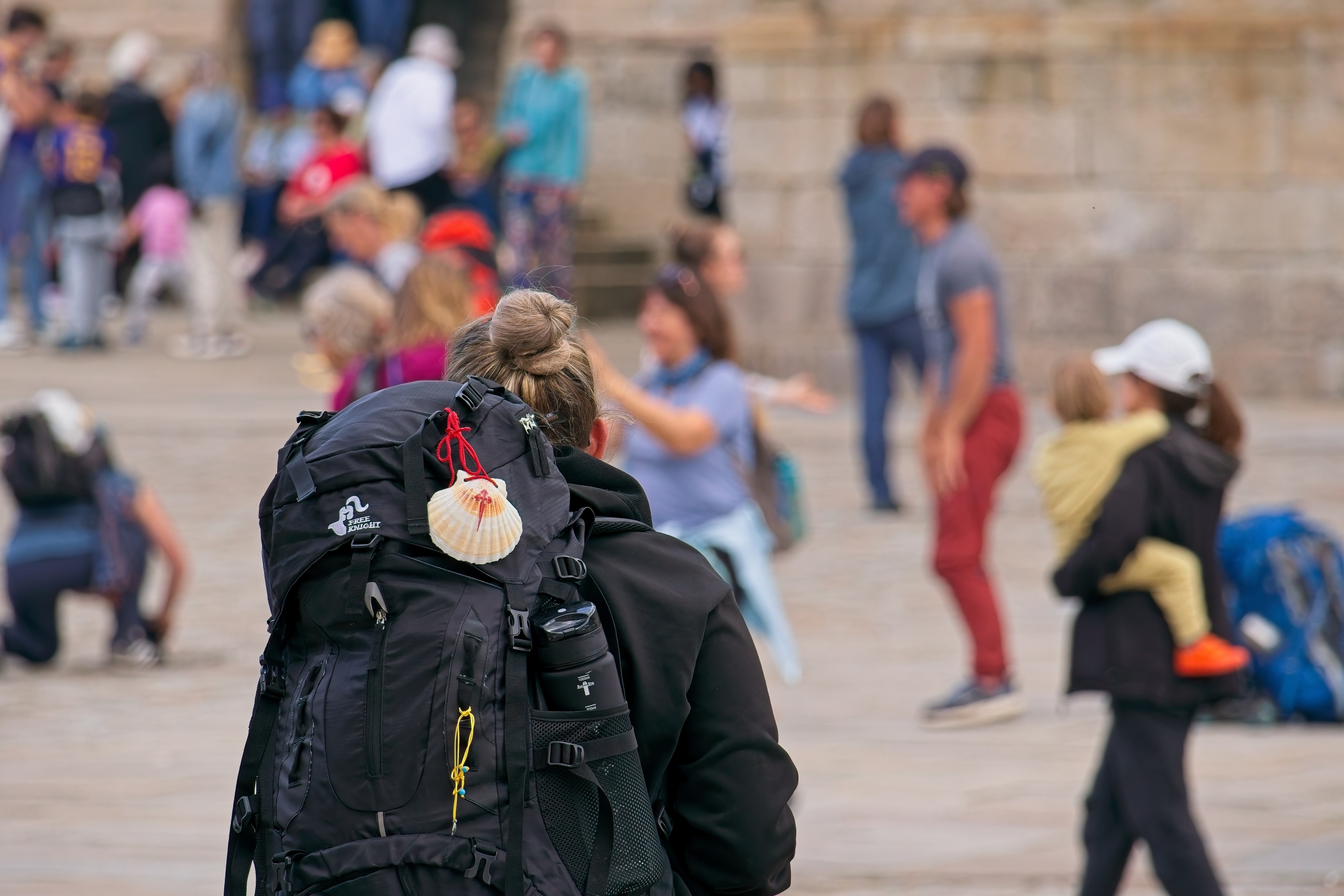
We arrived in Santiago together, on a sunny morning. In the Plaza del Obradoiro she took off her cap for the first time since we had met. Someone recognised her, a few phones went up. This time she did not mind. She lay down on the stones, arms open, and laughed looking up at the cathedral towers.
Then she held me in a long embrace. She told me that in those days she had found again a part of herself she thought she had lost: the provincial girl who had dreamed of being an actress, before the dream became a trade and the trade a gilded cage. She told me she would carry the story of that journey to her mother, somehow.
What She Gave Me
We exchanged phone numbers, as all pilgrims do. A few messages came in the weeks that followed. Then life resumed its course, she on set, I in newsrooms. Every now and then I see her again on a poster, made up and smiling, and I think of the woman in the green poncho who wept on the low wall at Portomarín.
I have decided not to reveal the name of the person I met. It belongs to her, and to those suspended days in which she could simply be a pilgrim among pilgrims.
The camino has given me many lessons, but I carry this one in my heart above all the others. Behind every perfect image there is a fragile and precious person. And sometimes it is enough to walk beside them, with respect and in silence, to let them breathe again.
AI Transparency Notice
PilgriMaps uses artificial intelligence tools to assist in the research, drafting and translation of editorial content. All AI-assisted content is reviewed, edited and verified by our editorial team before publication. We contrast information against primary sources, specialist literature and on-the-ground knowledge to ensure accuracy, cultural sensitivity and editorial integrity.
AI is one tool among many in our workflow. The judgement, curation and responsibility for everything published on this platform remain entirely human.
Viator Media S.L. — in compliance with the EU Artificial Intelligence Act (Regulation EU 2024/1689).
This post is also available in: