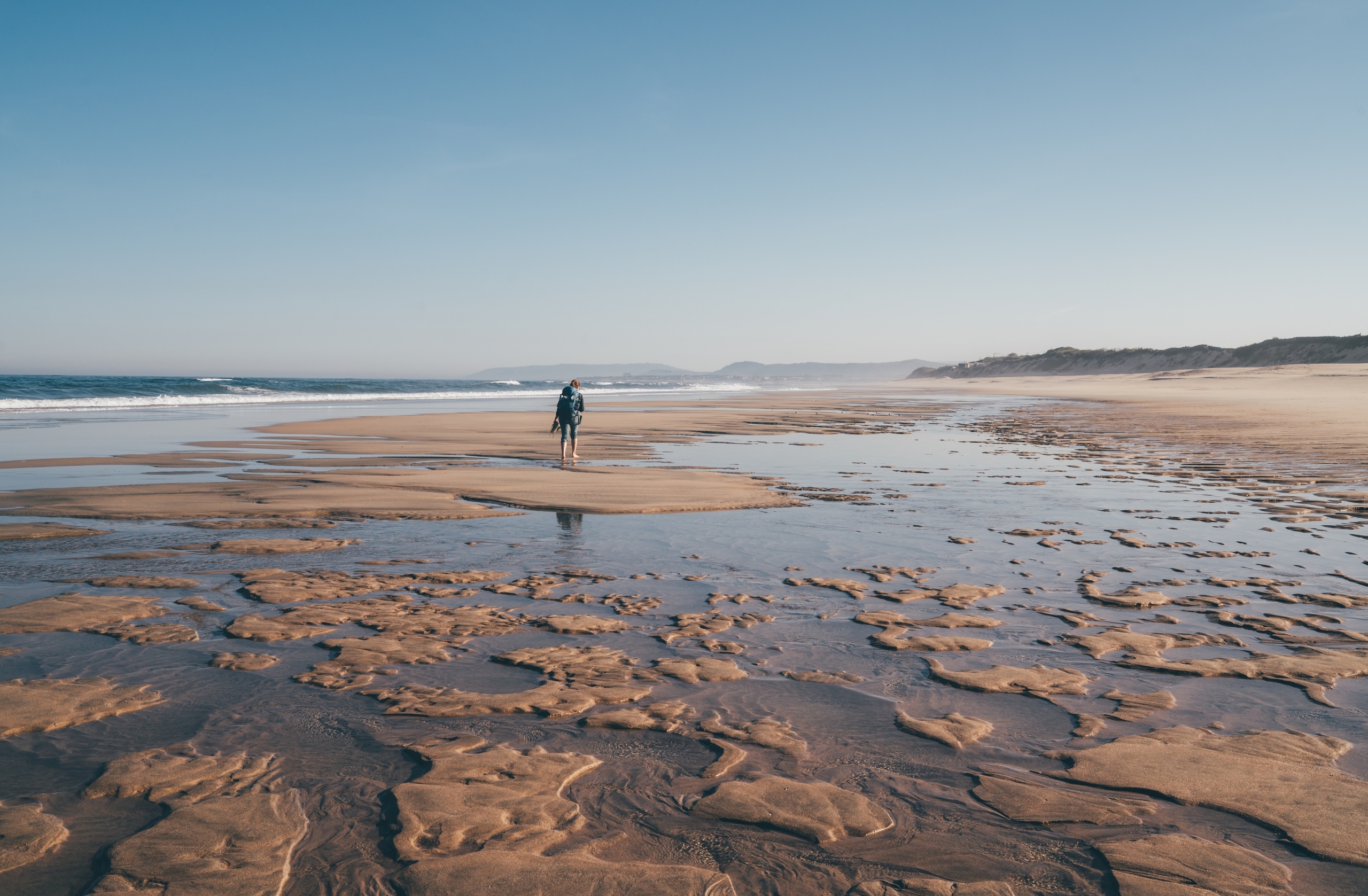
Not all horizons are equal. Some expand our breathing; others tighten our chest. And it is not simply a matter of personal taste.
There is a kind of light that falls on the Camino Primitivo, in Galicia, around five o’clock on October afternoons, that is difficult to describe without sounding exaggerated. It is a green-gold light, filtered through centuries-old oaks and chestnut trees, transforming paths still wet from the morning rain into something resembling a Flemish painting — that luminous, almost unreal quality Vermeer pursued in a studio and that here is simply the world as it is. People walking through it almost always stop talking. Not by agreement, not by protocol, not because anyone has asked them to. Because that light does something words suddenly seem too noisy to approach. As though opening one’s mouth might spoil something precious.
What is it? Poetry?
In 1984, a researcher named Roger Ulrich published a study in the journal Science that would permanently change the way hospitals — and gradually many other public spaces — were designed. Ulrich analyzed the medical records of gallbladder surgery patients in a Pennsylvania hospital, divided into two groups differing in only one variable: the room’s window view. One group looked out onto a small stand of trees. The other faced a brick wall. Everything else — diagnosis, surgeon, post-operative protocol, medication — was identical.
The results were unequivocal: patients with views of trees left the hospital almost a day earlier, requested fewer painkillers, received fewer negative notes from nursing staff, and experienced fewer post-operative complications. A brick wall or a grove of trees: same room, same treatment, significantly different outcomes. It was the first rigorous experimental evidence of something humanity had always understood intuitively: the environment around us is not neutral scenery. It is an active ingredient in our physiology.
Since then, research into how landscapes affect the mind and body has expanded dramatically. We know that natural environments with visible water, varied vegetation, and open horizons tend to reduce cortisol levels, blood pressure, and heart rate in stressed individuals. We know that chaotic landscapes dense with artificial stimuli tend to produce the opposite effect. Yet the most interesting aspect — the one that goes beyond the simplistic distinction between “good nature” and “bad city” — lies in the nuance. Not all natural landscapes produce the same response. Not all “beautiful” landscapes do the same thing.
Immense plains — the Bolivian Altiplano at 3,800 meters, the steppes of Kazakhstan, the vast Argentine pampas — often produce in travelers something that is neither exactly calm nor exactly anxiety. It resembles a peaceful form of existential vertigo: the sensation of being absolutely small, not relatively small. Not small in comparison to a mountain or a building — small in relation to the horizon itself, widening in every direction until the curvature of the earth becomes perceptible. The peoples who have lived on these plains for millennia often describe them as sacred: not because there is a temple there, not because a deity inhabits them, but because they dissolve the ego in a way no human architecture can achieve.
Very high mountains, sea cliffs, active volcanoes, ancient forests where light barely penetrates: these landscapes evoke what eighteenth-century philosophers called the sublime, and what contemporary psychological research studies under the term awe. It is a distinct psychological state, different from simple admiration. It involves the feeling of being in the presence of something exceeding one’s ordinary capacity for comprehension. The scholar Dacher Keltner of the University of California, Berkeley, who has devoted years to studying this emotion, has documented how people who experience awe become, even temporarily, more generous, more willing to collaborate, less focused on themselves, and more capable of seeing their lives in perspective. Landscapes that tower above us, in the right measure, have measurable effects on social behavior and on our perception of time.
The great pilgrimage routes of the world seem to be structured — though “structured” is probably the wrong word for something formed through centuries of collective walking — around sequences of landscapes that generate different emotional states, like movements within a symphony. The Camino Francés toward Santiago de Compostela first crosses the open, windswept plains of the Castilian Meseta — hundreds of kilometers of wheat and sky, with no shelter, where there is little to do except remain with oneself — before entering the more intimate and variable landscapes of Galicia, with its sudden rains and eucalyptus and oak forests. These are two entirely different landscapes requiring two different forms of attention. The Meseta opens. Galicia envelops. Pilgrims who have crossed both — and allowed each sufficient time to work upon them — arrive in Santiago carrying something different from those who flew directly to the city and walked only the final hundred kilometers.
The geographer Yi-Fu Tuan introduced, in the 1970s, the concept of topophilia — the affective attachment human beings develop toward specific places. It is not merely sentimentalism. The phenomenon has deep evolutionary foundations: our ancestors needed to assess quickly whether an environment was safe or dangerous, rich in resources or poor, familiar or hostile. These evaluations — encoded in the amygdala, the limbic system, the brain’s most ancient regions — still occur before the rational mind has time to intervene. The landscape judges us before we judge it.
The next time you feel strangely at peace in a place you have never seen before, or strangely unsettled in a place that should, on paper, appear beautiful to you, consider the possibility that your nervous system is processing something real — something your eyes do not consciously perceive but your receptors detect. The territory speaks. We have simply become unaccustomed to listening.
Forest bathing and pilgrimage: When the forest becomes a sanctuary
References
Ulrich, R.S. (1984). View through a window may influence recovery from surgery. Science, 224. Science article
Keltner, D. & Haidt, J. (2003). Approaching awe, a moral, spiritual, and aesthetic emotion. Cognition & Emotion. PubMed reference
AI Transparency Notice
PilgriMaps uses artificial intelligence tools to assist in the research, drafting and translation of editorial content. All AI-assisted content is reviewed, edited and verified by our editorial team before publication. We contrast information against primary sources, specialist literature and on-the-ground knowledge to ensure accuracy, cultural sensitivity and editorial integrity.
AI is one tool among many in our workflow. The judgement, curation and responsibility for everything published on this platform remain entirely human.
Viator Media S.L. — in compliance with the EU Artificial Intelligence Act (Regulation EU 2024/1689).
This post is also available in: