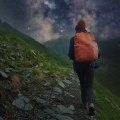
The difference between a pilgrim who arrives at the destination radiant and one who arrives destroyed often has nothing to do with the distance covered. It has everything to do with what they did each evening before going to sleep.
There is a scene that repeats itself every evening in every hostel along every pilgrimage route, and there is something strangely moving about its ordinariness. Pilgrims arrive — expressions ranging from satisfied to spent, sometimes on the same face — sit on the edge of a bunk bed in the shared dormitory, and remove their shoes with that particular grimace that only those who have walked long distances in not-quite-broken-in footwear fully understand. Then, with a methodical consistency that feels almost mechanical in the first days and nearly ritual by the final weeks, they begin. Feet up, socks rinsed in the sink, a careful inspection of the pressure points, petroleum jelly where needed, a calf massage with their hands or a ball carried for that purpose, stretches against the doorframe, the quiet preparation of the pack for the following morning. All of this, in the last hours of an already physically demanding day, with the light fading and someone already snoring in the next bunk.
These small gestures — invisible, repetitive, devoid of any photographic appeal — are, in reality, the load-bearing structure of any long walk. Without them, the body begins to give way not suddenly or dramatically but insidiously, progressively, almost imperceptibly until it is too late: a blister ignored for too many days becomes an infection. An Achilles tendon pain dismissed becomes tendinitis that forces a three-day stop. A shoulder held at the wrong angle for weeks under a poorly loaded pack becomes back pain carried home as an unwanted souvenir. The camino has no mercy for major negligence — but above all, it has no mercy for the small kind, repeated and accumulated.
Training your feet at home: The key to walking long distances without pain
The pack is the most important issue of all and the most underestimated. That it should be light has become almost a contemporary pilgrim’s mantra, repeated to newcomers with the air of someone announcing a cosmic principle. But weight is only half the problem — perhaps less than half. The other half, rarely explained in practical guides, is how weight is distributed inside. The rules are simple and routinely ignored: the heaviest items should sit against the back, in the upper portion of the pack, as close as possible to the body’s center of gravity. Light items can go in the outer pockets and lower sections. A ten-kilogram pack loaded correctly carries in a meaningfully different way — with less effort, less muscular compensation, less spinal tension — than an eight-kilogram pack loaded haphazardly. Multiply that difference by thirty days and forty thousand steps a day, and you understand why someone’s tendinitis always starts in the same spot.
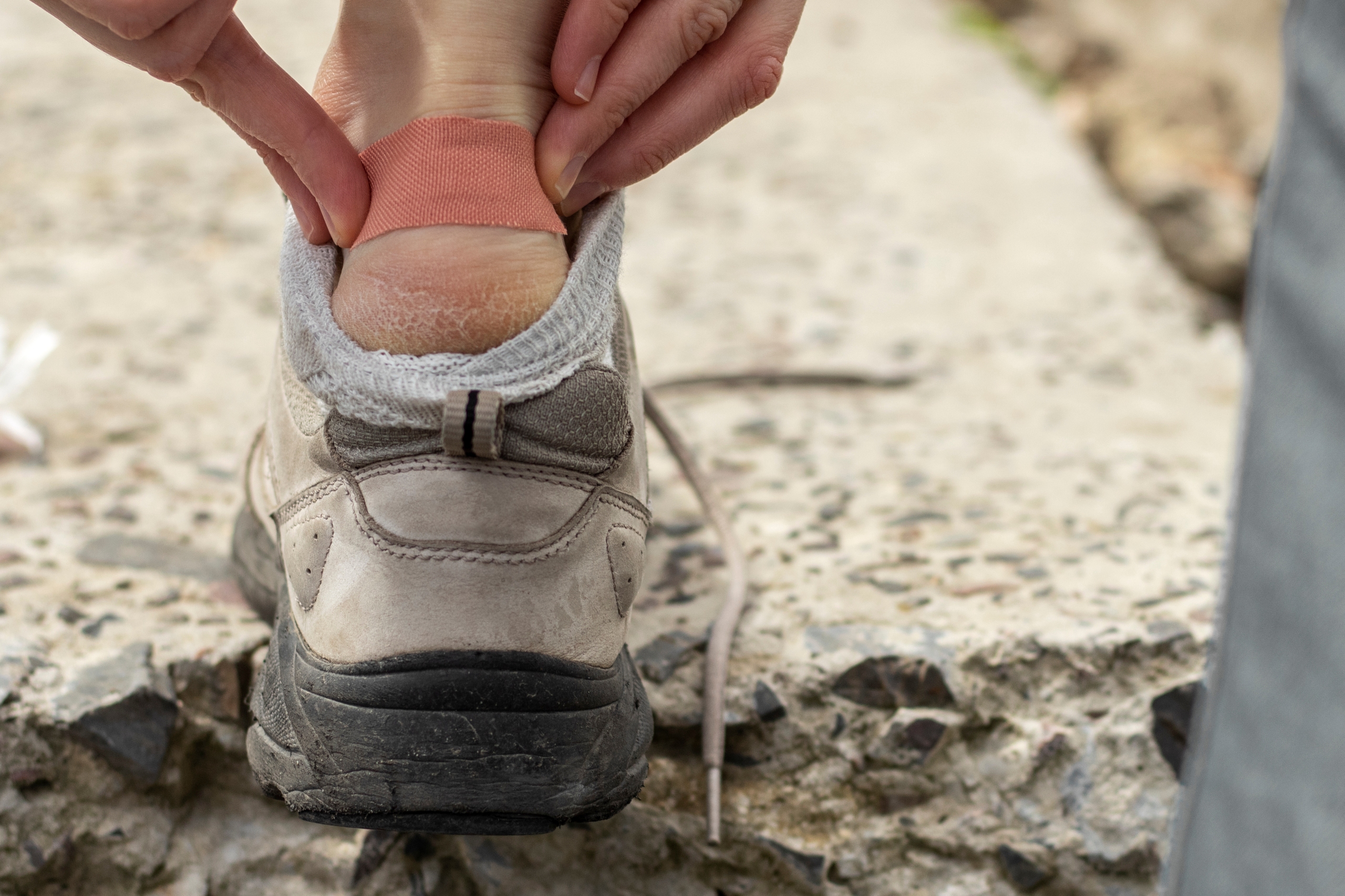
Blisters are the most frequent cause of abandoning a pilgrimage, and also the most preventable. The logic of prevention is straightforward: blisters form through friction between skin and sock or shoe upper, in the presence of moisture. They can be prevented — effectively — with three measures that no one takes because they seem excessive until they become necessary. First: change socks at midday, putting on a dry pair. Second: apply petroleum jelly or protective cream to the highest-friction points — heels, big toes, little toes — before putting on shoes in the morning, not once the pain has already started. Third: dry the feet thoroughly each evening and inspect them systematically, because a small area of redness treated promptly is a blister that never forms.
No more blisters: Caring for your feet before and after a pilgrimage
But the micro-gestures of care that make a long journey sustainable are both physical and mental, and deserve equal attention. The evening journal ritual — even just three lines scrawled before the eyelids give out — fixes the experience in memory before sleep softens it. The morning coffee moment, arriving ten minutes before anyone else, sitting outside the albergue in the pre-dawn cold, watching the light shift slowly across the bell tower or the hills, no phone, no music, no one to talk to: that is not wasted time. It is time invested in the capacity to remain present through the hours that follow. The deliberate decision not to check your phone during the first two hours of walking — which looks like a negligible sacrifice on paper and in practice completely transforms the quality of attention during the crucial morning hours — is a micro-gesture of mental hygiene that costs nothing and pays considerably.
Japanese pilgrims on the Shikoku trail — the 1,200-kilometer route touching 88 Buddhist temples on the island, walkable in roughly sixty days — have a term for the approach that describes this way of relating to every act of the journey: shokunin kishitsu, roughly translatable as “the craftsman’s spirit.” It is the attitude of someone who brings attention and care even to the smallest and most repetitive gestures, not because the final outcome explicitly demands it but because every gesture deserves to be done well, in itself, regardless of who sees it or how important it appears. Doing small things as though they were large. On the camino, you come to understand that there is no such thing as a small thing. Every gesture accumulates in the body and the mind the way kilometers accumulate in the journal: one at a time, invisibly, until they produce something none of the individual steps seemed to promise.
Those who arrive at the destination still standing — in the physical sense but also in the broader one — are almost always those who learned, over the weeks, to pay attention to what seemed not to matter.
References
Knapik, J. et al. (1996). Soldier performance and strenuous road marching: Influence of load mass and load distribution. Military Medicine, 162(1).
Csikszentmihalyi, M. (1990). Flow: The Psychology of Optimal Experience. Harper & Row.
AI Transparency Notice
PilgriMaps uses artificial intelligence tools to assist in the research, drafting and translation of editorial content. All AI-assisted content is reviewed, edited and verified by our editorial team before publication. We contrast information against primary sources, specialist literature and on-the-ground knowledge to ensure accuracy, cultural sensitivity and editorial integrity.
AI is one tool among many in our workflow. The judgement, curation and responsibility for everything published on this platform remain entirely human.
Viator Media S.L. — in compliance with the EU Artificial Intelligence Act (Regulation EU 2024/1689).
This post is also available in: