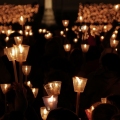
Dawn breaks over Bayaguana, and the air is already filled with sounds that do not belong to an ordinary day. From early morning, horses’ hooves strike the pavement, atabales drums establish an ancient rhythm, and chants — somewhere between improvisation and prayer — rise above the crowd. There is no single direction of arrival: people come from many places, some on foot, others on horseback, many accompanying cattle moving calmly through the streets.
At first glance, someone might assume this is a bullfight. Yet only a few minutes are needed to understand that something entirely different is taking place here. There is no arena, no matadors, no ritual tension of confrontation. The bulls are neither enemies nor performers in a spectacle: they are fulfilled promises, living offerings that move through the town before being blessed. The scene carries elements of pilgrimage, fairground gathering, and collective memory all at once.
At the center of everything stands the Sanctuary of the Holy Christ of Miracles, the final destination of this human and animal procession that transforms the town into a ritual landscape. What is celebrated here every December 28 is not merely a festival, but a way of understanding the relationship between faith, community, and tradition.
Not a bullfight
The so-called “festival of the bulls of Bayaguana” can be misleading if interpreted through the framework of Spanish bullfighting. In reality, it is a complex system where popular religion, symbolic economy, and cattle-raising traditions converge. The bulls arriving in town were not bred for spectacle, but offered as acts of devotion to the Christ of Miracles in fulfillment of vows.
The process follows a clear structure: the animals are gathered by comisarios — key figures in the organization of the event — brought into town, blessed, and ultimately auctioned on January 1. The proceeds support community, religious, or educational purposes. Through this process, the bull changes meaning: from private property to a collective asset charged with symbolic value.
This distinction is essential. Unlike the classical corrida, there is no formal combat and no ritualized death in an arena. What exists instead is a transition: from countryside to town, from individual to community, from promise to fulfillment.
Between Empire, cattle, and devotion
To understand the celebration, it is necessary to go back several centuries, to the period when Bayaguana itself was taking shape. Its foundation is tied to the colonial transformations of the Spanish Caribbean, particularly the devastations ordered by Philip III at the beginning of the 17th century. These policies reorganized populations and economies, creating new settlements in which cattle raising became central.
Within that context, cattle represented more than economic wealth; they also became integrated into religious and social practices. Colonial records show that as early as the 16th and 17th centuries, festivals involving bulls already existed on the island, along with vows promising animals to religious institutions. The offering of a bull as an act of devotion is therefore not a recent invention, but a practice with deep historical roots.
To this Hispanic foundation was added another decisive element: Afro-Caribbean culture. In the cattle-raising regions of eastern Dominican Republic, Afro-descendant communities developed musical and ritual forms that gradually became integrated into the Catholic calendar. The atabales drums, salves, and responsorial chants that characterize the festival today emerged from this process of cultural blending.
The festival of Bayaguana cannot therefore be understood as a simple European inheritance. It is instead a historical creation shaped by three major forces: colonial organization, cattle economy, and forms of popular religiosity rooted in diverse traditions.
A collective choreography
December 28 marks the culmination of the festival, but preparations begin long beforehand. For months, the comisarios travel through surrounding communities, organize gatherings, and collect offerings. This quiet labor sustains the visible celebration, creating a network that links countryside and town.
The central day follows a recognizable sequence. Bulls arrive from different directions and converge at symbolic locations such as Las Tres Cruces, where the so-called crossing of flags takes place — a moment of encounter between groups that dramatizes entry into sacred space. From there, the procession advances toward the sanctuary accompanied by music, chants, and a crowd that participates actively throughout the route.
Within this context, the bull is not a passive object. Its presence structures the procession, sets the rhythm of the day, and embodies the fulfilled vow. After the blessing, the animals are taken to corrals where they remain until the auction.
The festival combines order and spontaneity. There is organization, but also improvisation; structure, but also room for the unexpected. That tension forms part of its vitality.
Resonances with Spain
Although the festival of Bayaguana is singular, it did not emerge in isolation. Clear connections exist with Spanish traditions, particularly in the use of bulls within communal celebrations.
Events such as the Running of the Bulls in Pamplona, the Toro Enmaromado of Benavente, or the Entrada de Toros y Caballos of Segorbe display comparable elements: streets transformed into ceremonial spaces, bulls guided by horse riders, and integration into patronal festivities.
These traditions share a festive language in which animal, movement, and community become intertwined. In each case, the bull leaves the enclosed arena and becomes part of the urban landscape, generating a collective experience.
Yet these similarities should not obscure the differences. What in Spain often culminates in spectacle or festive entertainment is directed in Bayaguana toward devotional and communal purposes.
Another logic, another meaning
The comparison reveals profound contrasts that define the identity of the Dominican celebration. First is the question of purpose. While many Spanish traditions emphasize recreation or bull spectacle, Bayaguana centers on religious vows. The bull is not a vehicle for entertainment, but a means of relationship with the sacred.
Second is the relationship with the animal itself. In classical bullfighting, confrontation between man and bull is central. Here, there is no struggle and no dramatization of death. The animal is respected as an offering, and its final destination is auction rather than combat.
The soundscape also differs significantly. Spanish festivals are often accompanied by brass bands and European festive music. In Bayaguana, the presence of atabales drums and improvised chants creates a different sonic atmosphere shaped by Afro-Dominican heritage.
Finally, there is the bull’s ultimate role. In Spain, the procession generally leads toward an arena or bull-related spectacle. In Bayaguana, the process culminates in an economic and symbolic act: the transformation of the animal into resources for the community. These differences demonstrate that, despite a shared historical origin, the cultural trajectories evolved in distinct directions.
A living cultural synthesis
The festival of the bulls of Bayaguana is, at its core, a synthesis. It belongs entirely neither to one tradition nor another, but combines diverse elements into a coherent and dynamic form. On one hand, it preserves the structure of the Catholic calendar and the logic of the vow. On the other, it incorporates musical and expressive practices without direct European equivalents. Added to this is the cattle-raising dimension, linking the celebration to rural life and the economic history of the region.
The result is a festival that resists simple categorization. It is not solely religious, purely festive, or exclusively cultural. It exists simultaneously across all these dimensions.
By the end of the day, the lasting image is that of the bull advancing through the crowd. Not as a symbol of danger or domination, but as a bridge between worlds: countryside and town, individual and community, promise and fulfillment.
That image captures the deeper meaning of the festival. In Bayaguana, the bull does not die in the arena; it circulates, connects, and transforms. It is a symbol in motion, charged with history and meaning.
Relics of the Cross in the Dominican Republic: Circulation, devotion, and colonial memory
AI Transparency Notice
PilgriMaps uses artificial intelligence tools to assist in the research, drafting and translation of editorial content. All AI-assisted content is reviewed, edited and verified by our editorial team before publication. We contrast information against primary sources, specialist literature and on-the-ground knowledge to ensure accuracy, cultural sensitivity and editorial integrity.
AI is one tool among many in our workflow. The judgement, curation and responsibility for everything published on this platform remain entirely human.
Viator Media S.L. — in compliance with the EU Artificial Intelligence Act (Regulation EU 2024/1689).
This post is also available in: