The sun had barely risen when Egeria reached the summit of Mount Nebo. The clerics accompanying her pointed toward the horizon: there lay the Jordan Valley, there Jericho, there the hills of the land the Bible called Promised. For years she had read those names in the Scriptures; now she stood there, looking out over the same landscape.
In the fourth century, when the Roman Empire still united the Mediterranean world, a woman born on the far western edge of that world decided to undertake an extraordinary journey. Her name was Egeria, and driven by deep faith and tireless curiosity, she traveled thousands of kilometers to see with her own eyes the places she had previously known only through the Bible.
For several years she crossed the Empire from west to east. She visited Jerusalem, Egypt, Syria, and Mesopotamia, climbed Mount Sinai, and walked through landscapes associated with patriarchs and prophets.
Along the way she wrote letters to a group of women from her community, whom she affectionately addressed as dominae sorores—“lady sisters.” In them she described what she saw, what she heard from the monks and priests who cared for those places, and the emotions she experienced while praying in settings she had previously imagined only through sacred texts.
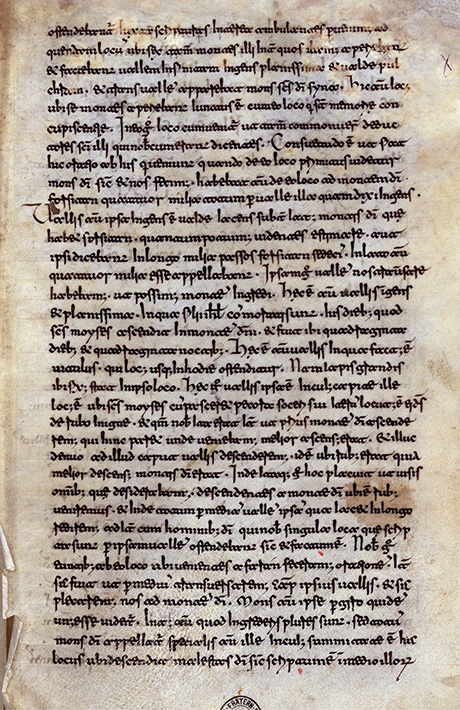
These letters, partially preserved in a medieval manuscript, form what is now known as the Itinerarium Egeriae, the earliest substantial diary of Christian pilgrimage that has come down to us. More than a simple travel narrative, the text offers a vivid testimony of how biblical landscapes were experienced in Late Antiquity and how one Christian traveler crossed the known world in order to approach them.
A woman from the “edge” of the Roman Empire
Relatively little is known about Egeria’s life, but clues in her own narrative and in later references allow historians to reconstruct part of her story. A seventh-century monk, Valerius of Bierzo, described her as a woman from “the far shore of the western Ocean Sea,” a phrase that has led historians to place her origin in the ancient Roman province of Gallaecia, in the northwest of Hispania – probably in what is today Galicia or León.
Everything suggests that she belonged to a cultivated and relatively privileged environment. In the fourth century, undertaking such an extensive journey required financial resources, connections, and protection – particularly for a woman. Egeria does not appear to have been a nun in the institutional sense the term would acquire centuries later, yet she was clearly a Christian deeply committed to her faith, perhaps associated with a female religious community.
Her writing also reveals a distinctive personality. She uses a straightforward Latin, close to spoken language, filled with colloquial turns that make her voice surprisingly lively and accessible. She was not writing for posterity or for scholars; she wrote to share her discoveries with friends.
Her narrative does not attempt to impress through elaborate descriptions. Instead, it conveys the astonishment of someone arriving for the first time at places long imagined.
A journey through the Biblical world
Between 381 and 384 CE, Egeria undertook one of the most ambitious pilgrimages known from Late Antiquity. From Hispania she traveled toward the eastern Mediterranean and entered the regions that had formed the setting of biblical history. Her itinerary brought her to Constantinople, Jerusalem, Egypt, Mount Sinai, Syria, and the territories near the Euphrates.
Each stage of the journey followed a similar pattern: visiting places mentioned in the Scriptures, reading the relevant passages on site, and praying within the same landscape where tradition located those events. Pilgrimage thus became an experience in which text, memory, and geography intertwined.
When she reached the Euphrates River, she wrote with emotion that they had given thanks to God for reaching that river “mentioned so many times in the Scripture.” For her, arriving there meant more than reaching a geographic destination; it meant physically entering the sacred history that had shaped her faith. For pilgrims of the fourth century, travel meant reading the Bible with their feet.
At other points she climbed Mount Sinai, visited places connected with the patriarch Abraham, and crossed deserts where early Christian hermits had lived. Throughout the journey she encountered monasteries, churches, and small communities that cared for these sites and welcomed pilgrims by explaining the traditions associated with each landscape.
Many of the places she visited were marked by churches or sanctuaries built to commemorate episodes from Scripture believed to have occurred there. For that reason, numerous passages of the Itinerarium Egeriae have proven essential for historians and archaeologists attempting to identify locations and traditions that disappeared after the Persian and later Muslim invasions.
Sylvester Saller: A Franciscan Excavating Memory on Mount Nebo
Through the lands of the Jordan
Among the many regions she explored, Egeria also traveled through the territory east of the Jordan River, in what is now known as Jordan. For Christians of her time, this land formed an essential part of the biblical landscape.
According to biblical tradition, Moses viewed the Promised Land from Mount Nebo, the prophet Elijah lived in retreat in the Wadi Cherith, and the Jordan River itself served as the setting for key episodes in both the Hebrew Bible and the New Testament.
Although Egeria’s narrative does not dwell extensively on these particular episodes, it makes clear that this region belonged to the broader sacred geography pilgrims traveled in order to deepen their understanding of the Scriptures.
A traveler who still walks with us
More than sixteen centuries after her journey, Egeria’s account continues to accompany those who travel through the eastern Mediterranean in search of spiritual roots. Her text demonstrates that Christian pilgrimage did not emerge in the Middle Ages; it has far earlier origins.
Reading her diary today opens an ancient map made of roads, mountains, and stories.
Following its pages, we discover that long before Europe’s major pilgrimage routes existed, a traveler set out from the western edges of the Roman Empire and crossed thousands of kilometers with a clear intention: to walk within the Scriptures.
AI Transparency Notice
PilgriMaps uses artificial intelligence tools to assist in the research, drafting and translation of editorial content. All AI-assisted content is reviewed, edited and verified by our editorial team before publication. We contrast information against primary sources, specialist literature and on-the-ground knowledge to ensure accuracy, cultural sensitivity and editorial integrity.
AI is one tool among many in our workflow. The judgement, curation and responsibility for everything published on this platform remain entirely human.
Viator Media S.L. — in compliance with the EU Artificial Intelligence Act (Regulation EU 2024/1689).
This post is also available in: