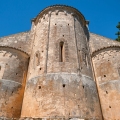
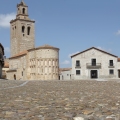
The Cathedral of Ivrea, dedicated to Saint Mary of the Assumption, rises above the old town on a hill long considered sacred. Built on the site of a 1st-century BC Roman temple, it became a Christian church in the 4th–5th centuries, when the Diocese of Ivrea was established. Under Bishop Warmondo (969–1005), the church was transformed into a grand Romanesque cathedral, parts of which still survive — the apse, twin bell towers, and crypt, which preserves a reused Roman sarcophagus holding the relics of Saint Besso. Warmondo’s era marked Ivrea’s rise as a cultural and religious hub, home to a renowned scriptorium and architecture influenced by imperial Ottonian models.
Through the centuries, the cathedral evolved in both structure and style. Between the 13th and 15th centuries, frescoes and sculpted capitals enriched its Romanesque soul. In the 18th century, under Bishop Ottavio Pocchettini, architect Giuseppe Martinez redesigned the interior in Late Baroque style, with stuccoes, Corinthian pilasters, and an elliptical dome, while the Chapel of the Blessed Sacrament (1761–63) added Claudio Beaumont’s refined painting. Later, Bishop Luigi Moreno commissioned Gaetano Bertolotti’s Neoclassical façade, inspired by Palladio and adorned with statues of Canavese saints. Today, Ivrea Cathedral stands as a living synthesis of two millennia of art, architecture, and faith, linking Roman origins with Baroque emotion and Neoclassical balance.
- Address
Piazza Castello, 16, Ivrea, Italy - Web
None - Visiting Hours
Unknown - What to see
Chapel of the Blessed Sacrament, crypt
AI Transparency Notice
PilgriMaps uses artificial intelligence tools to assist in the research, drafting and translation of editorial content. All AI-assisted content is reviewed, edited and verified by our editorial team before publication. We contrast information against primary sources, specialist literature and on-the-ground knowledge to ensure accuracy, cultural sensitivity and editorial integrity.
AI is one tool among many in our workflow. The judgement, curation and responsibility for everything published on this platform remain entirely human.
Viator Media S.L. — in compliance with the EU Artificial Intelligence Act (Regulation EU 2024/1689).
This post is also available in: