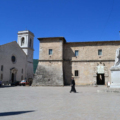
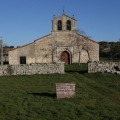
The Castello di Salle, in the province of Pescara, is a medieval fortress built with Maiella stone, originally linked to the Abbey of San Clemente a Casauria for defensive purposes. Over the centuries, it became a noble residence, housing families like the Colonna, Gonzaga, and D’Aquino, until 1646, when Giacinto de Genua (Di Genova) transformed it into a palace. Among the ruins of the ancient fortified village stands the Church of Blessed Roberto da Salle, a disciple of Saint Celestine V, whose spiritual legacy endures in the region. Part of the castle is now home to the Medieval Bourbon Museum, displaying ancient weapons, historical documents, and aristocratic artifacts.
The castle is steeped in legend, with tales of the ghost of “La Stecchina”, a 14th-century woman, and a hidden imperial treasure buried by Valentinian III. It is also said that Napoleon Bonaparte once slept in one of its rooms. With its battlemented towers, panoramic terraces, and an entrance framed by Italian gardens, the castle remains an important cultural and religious site in Abruzzo, deeply connected to Blessed Roberto da Salle.
- Address
Salle Vecchia, Via Str. Vecchia, 1, Caramanico Terme, Italy - Web
https://www.fondazionecastellodisalle.it/ - Visiting Hours
Info and Whatsapp +39 334 320 5050 - What to see
Church of Blessed Roberto, hall of Napoleon, Museum
AI Transparency Notice
PilgriMaps uses artificial intelligence tools to assist in the research, drafting and translation of editorial content. All AI-assisted content is reviewed, edited and verified by our editorial team before publication. We contrast information against primary sources, specialist literature and on-the-ground knowledge to ensure accuracy, cultural sensitivity and editorial integrity.
AI is one tool among many in our workflow. The judgement, curation and responsibility for everything published on this platform remain entirely human.
Viator Media S.L. — in compliance with the EU Artificial Intelligence Act (Regulation EU 2024/1689).
This post is also available in: