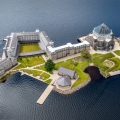
At dawn, the wrought-iron dragon of the Güell Pavilions still seems damp with Barcelona’s morning mist. Two hours away, in the mountains of Berguedà, an improbable garden channels water through rocks designed by the same man. Farther south, overlooking the Mediterranean, a stone winery leans toward the sea, reminding visitors that Antoni Gaudí did not only imagine temples. He also drew landscapes, roads, vineyards, and entire territories.
The most familiar image of Gaudí is still that of an architect almost exclusively associated with Barcelona: the soaring towers of the Sagrada Família, the skeletal balconies of Casa Batlló, and the sculptural chimneys of La Pedrera.
Yet leaving the city center and following certain routes across Catalonia reveals something more complex. Gaudí left behind more than buildings; he left behind a geography. His works form a scattered network linking industrial cities, mountains, workers’ colonies, monasteries, gardens, and wine-growing landscapes.
This Gaudían map has a clearly defined core—the internationally famous masterpieces—and a quieter periphery of related sites, partial projects, gardens, secondary buildings, and biographical places that help us understand the architect in a different light.
Barcelona: A city turned into a living organism
Barcelona was Gaudí’s great laboratory. Here he experimented with materials, symbols, structures, and new ways of connecting architecture with urban life. But it became something more: the place where he transformed the modern city into something almost biological.
The first signs appeared early. The streetlamps of Plaça Reial, designed in 1878, still feel like urban experiments. They are not simply pieces of street furniture. The iron twists like a metallic plant, while the illuminated crowns evoke marine and botanical forms. Even in these early works, a central idea emerges: architecture should not impose itself on nature but learn from it.
With Casa Vicens, in what was then the outlying neighborhood of Gràcia, Gaudí decisively broke with academic conventions. Ceramic tiles, ironwork, Oriental motifs, and plant-inspired designs combine in a burst of color that still feels radical today. Barcelona was becoming an industrial bourgeois city; Gaudí responded not with restraint, but with boundless imagination.
Palau Güell marked another decisive leap. Hidden behind a relatively restrained façade in the Raval district, the building unfolds into interiors designed to transform the experience of space itself: slanted columns, ceilings pierced by light, and chimneys elevated into sculpture. Here, one of the defining relationships of Gaudí’s career began to take shape: his partnership with Eusebi Güell.
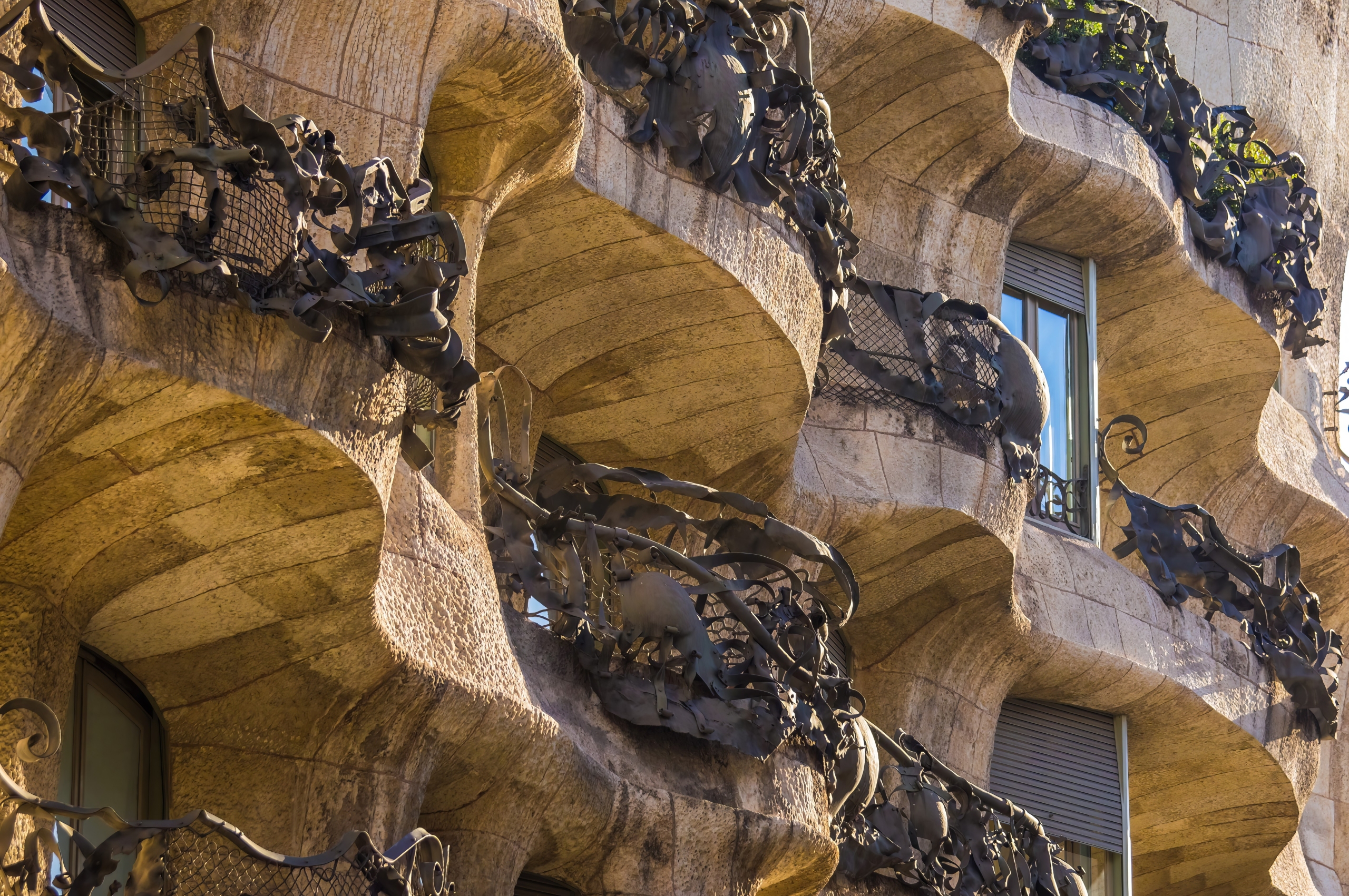
With Casa Batlló and La Pedrera, Barcelona ceased to be merely a city of buildings and became, through Gaudí’s eyes, a symbolic landscape. Facades ripple like waves, balconies resemble masks or skeletons, and rooftops appear as sleeping creatures. Stone stops behaving like stone. Iron stops behaving like iron.
And then there is the Sagrada Família, the project that consumed the final chapter of his life and ultimately reorganized his entire creative universe. More than a church, it feels like a complete synthesis of his obsessions: nature, geometry, religious symbolism, engineering, and landscape. Even today, amid traffic and tourism, its towers seem less built than slowly carved by time and wind.
The Güell territory: Where another Gaudí emerges
Without Eusebi Güell, the Gaudí we know today might never have existed. The industrialist and patron not only financed some of his most important works; he gave him the freedom to explore architectural ideas that would have found little room in conventional commissions. Together they created more than buildings. They created a territory.
The Güell Pavilions, with their famous wrought-iron dragon, function almost like a symbolic gateway into Gaudí’s universe. Mythology, handcrafted metalwork, and the notion that even a gate could become a living creature all appear here.
The real conceptual breakthrough came with Park Güell. Originally planned as a residential development, the project failed commercially and was eventually transformed into a public park. Ironically, that failure preserved one of the strangest urban visions in European Modernism: pathways supported by leaning columns like tree trunks, mosaic-covered serpentine benches, and plazas opening toward the Mediterranean horizon. The park feels designed less by an architect than by a geological force.
The Crypt of Colònia Güell marks another pivotal moment. Here, Gaudí experimented with catenary arches, inclined columns, and structural solutions that seemed to defy conventional building rules. The space feels almost subterranean, as though it had slowly emerged from the earth itself.
Yet perhaps the most unexpected site in the “Güell territory” lies far from Barcelona, overlooking the Mediterranean: Celler Güell in Garraf. The building rises along the coast as an ambiguous presence. From some angles it resembles a fortified chapel; from others, a mineral ship leaning toward the sea. Usually attributed jointly to Gaudí and his collaborator Francesc Berenguer, it reflects another side of Güell’s world: his agricultural and wine-making interests.
This small structure by the sea became a meeting point between two worlds that were emerging at the same time: Catalan Modernism and the sparkling wine industry that would eventually become one of Catalonia’s global symbols.
The unexpected Gaudí: Gardens, mountains, and remote landscapes
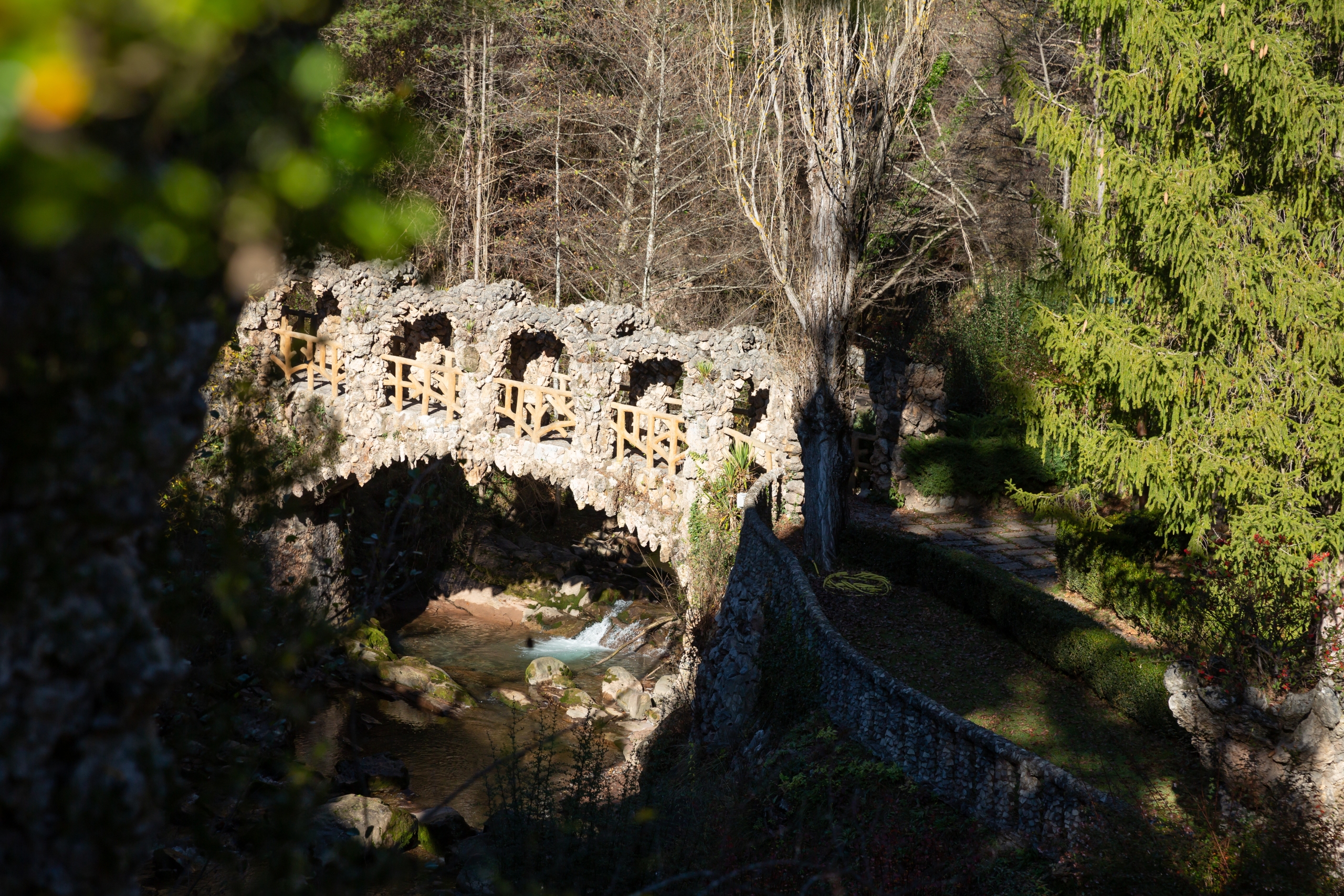
Beyond the city, a different Gaudí appears—less monumental and more attentive to landscape and nature. The Artigas Gardens in La Pobla de Lillet are perhaps the most surprising example. Designed beside a mountain river, they integrate bridges, stairways, vegetation, and water in a composition where it becomes difficult to distinguish what belongs to nature and what belongs to architecture. There is no desire to dominate the landscape, only to become part of it.
Nearby stands another remarkable site: the Xalet del Catllaràs. For years, its connection to Gaudí was debated by historians, until the attribution was officially confirmed by Catalan heritage authorities. Originally built to house technicians working in a mining operation, the chalet introduces an industrial and mountainous dimension rarely associated with the architect’s most famous works.
Catllaràs also demonstrates something important: the Gaudí catalog is not completely closed. More than a century after his death, new documents, interpretations, and discoveries continue to reshape our understanding of his work.
Montserrat offers yet another perspective. There, Gaudí contributed to the Monumental Rosary, bringing together architecture, spirituality, and sacred landscape. On Catalonia’s most emblematic mountain, the stone itself seems almost religious before it is ever carved.
The forgotten South: Reus, Riudoms, and emotional origins
Although most of his work is concentrated in and around Barcelona, southern Catalonia preserves something perhaps even more important: Gaudí’s emotional origins.
The debate over whether he was born in Reus or nearby Riudoms remains part of the architect’s mythology. Yet beyond that question, both places help explain the human and natural landscape that shaped his childhood.
Gaudí grew up among Mediterranean fields, farmhouses, trees, and workshops. The rheumatic illness he suffered as a child often forced him into solitude, where he learned to observe leaves, animal bones, branches, and clouds with unusual intensity.
Later, he would famously say that nature was the greatest book of architecture. The phrase is often quoted as poetic insight, but it was really a description of his method. The inclined columns of the Sagrada Família resemble tree trunks; its vaults behave like skeletons; its arches follow the same physical principles found in natural growth.
The Mediterranean light of Tarragona also left a lasting mark. The intense clarity of the Catalan landscape can be seen throughout his work, particularly in his use of ceramics, glass, and color.
The architect and the spiritual man
As he grew older, Gaudí gradually withdrew from Barcelona’s social circles and devoted himself almost entirely to the Sagrada Família. His austere appearance, deep religious faith, and obsessive dedication to the basilica transformed public perceptions of him.
In his final years, many contemporaries stopped seeing him solely as a brilliant creator and began describing him as a man of profound spiritual depth. That image survived his death. Decades later, the Catholic Church formally opened his cause for canonization, granting him the title “Servant of God,” the first step toward possible beatification.
The existence of that process helps explain why Gaudí continues to occupy such a singular place in European culture. Few modern architects have been viewed simultaneously as technical innovators, cultural icons, and spiritual figures.
Catalonia as a total work of art
Perhaps the most common mistake is to think of Gaudí simply as the creator of extraordinary buildings. His buildings matter, of course. But viewed together, they reveal something larger: a way of understanding territory itself.
In his work, dimensions that the modern world often separates come together: industry and spirituality, nature and technology, landscape and city, craftsmanship and modernity. That may be why Gaudí’s works seem inseparable from the Catalan landscape. They do not feel like monuments placed upon the land. They seem to have grown from within it, as though stone, iron, and sea had one day decided to learn architecture.
And perhaps that is where part of his mystery still resides. More than a century after his death, Gaudí continues to be read not only as an extraordinary architect, but as someone who tried to unite nature, technology, and spirituality into a single way of seeing the world.
AI Transparency Notice
PilgriMaps uses artificial intelligence tools to assist in the research, drafting and translation of editorial content. All AI-assisted content is reviewed, edited and verified by our editorial team before publication. We contrast information against primary sources, specialist literature and on-the-ground knowledge to ensure accuracy, cultural sensitivity and editorial integrity.
AI is one tool among many in our workflow. The judgement, curation and responsibility for everything published on this platform remain entirely human.
Viator Media S.L. — in compliance with the EU Artificial Intelligence Act (Regulation EU 2024/1689).
This post is also available in: