In the arid expanse of southern Iraq, the city of Najaf rises from the desert as one of the most enduring centers of Islamic scholarship and memory. At its heart stands the Mausoleum of ʿAlī ibn Abī Ṭālib—a monument of devotion, art, and history. For over a millennium, this sanctuary has drawn travelers, scholars, and pilgrims from across the Islamic world, shaping Najaf into a locus of spiritual and intellectual life.
Historical Context and Foundations
Najaf lies about 160 kilometers south of Baghdad, near the western edge of the Euphrates River basin. Tradition holds that ʿAlī, cousin and son-in-law of the Prophet Muḥammad, was buried here after his death in 661 CE. According to early sources, his burial site was kept hidden for fear of desecration during the turbulent years that followed his assassination in Kufa. It was not until the Abbasid period, around the 8th century CE, that the location was publicly identified and marked by a shrine.
The earliest known structure over the grave is attributed to the Abbasid caliph Hārūn al-Rashīd (r. 786–809 CE). Over time, successive dynasties—Buyids, Seljuks, Safavids, and Qajars—expanded and embellished the shrine. Each phase reflected the political and artistic sensibilities of its patrons, integrating Persian, Arab, and Central Asian design elements into a distinctive architectural synthesis.
Architecture and Symbolism
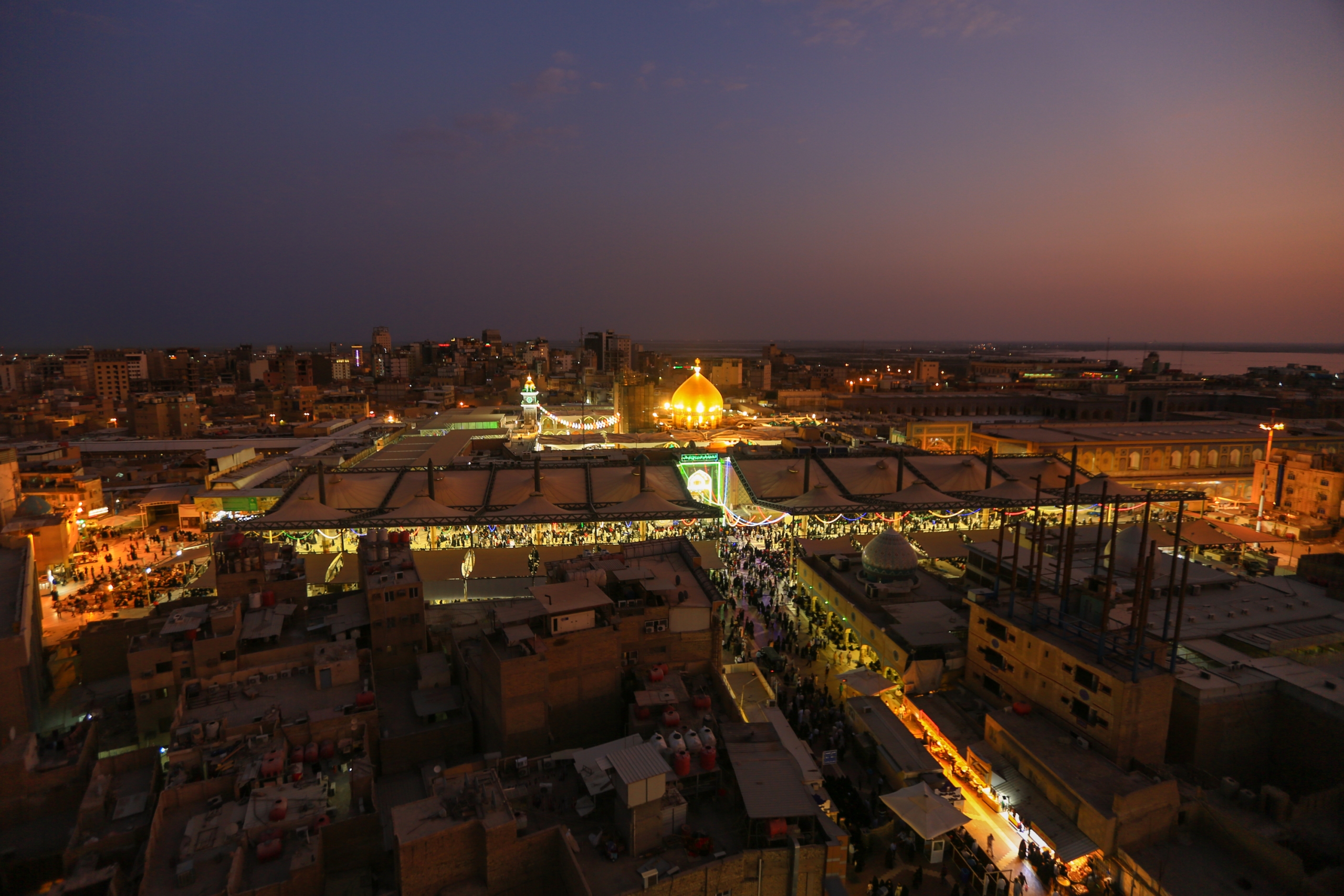
The Mausoleum of ʿAlī today dominates the Najaf skyline with its gilded dome and twin minarets, sheathed in gold tiles that shimmer under the desert light. The present form largely dates from the 17th century CE, when the Safavid rulers of Iran, particularly Shah Abbas I, undertook extensive restoration. Later additions and repairs, including work during the Qajar period and modern Iraqi restoration efforts, maintained the shrine’s grandeur while adapting to new materials and structural needs.
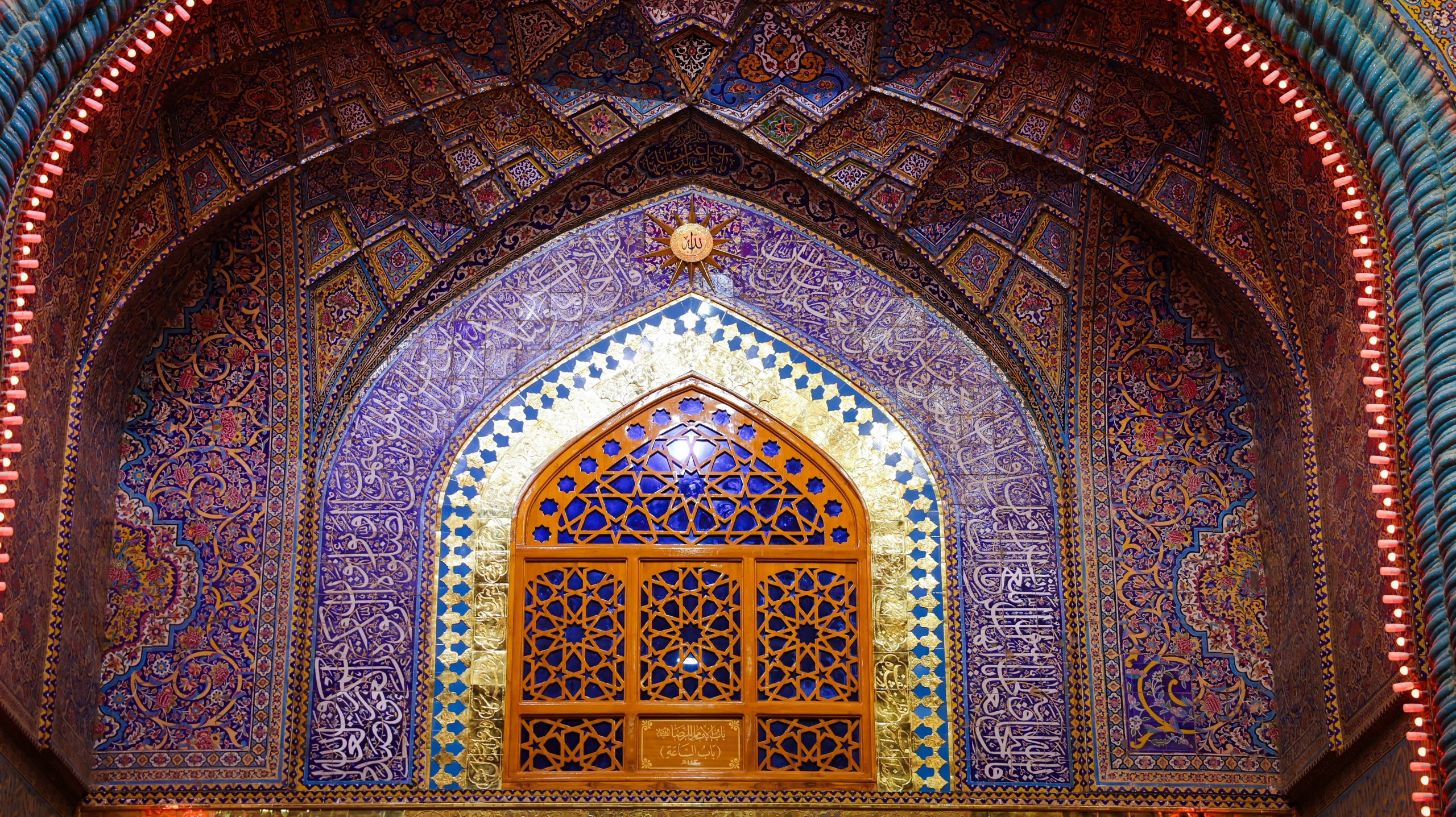
The main courtyard—entered through ornate gateways—opens into a vast rectangular enclosure surrounded by arcaded galleries. The interior of the shrine is rich with mirror mosaic work, calligraphy, and glazed tile panels. Within the sanctum stands the tomb chamber itself, enclosed by a silver zarih (lattice screen) adorned with intricate filigree and Qurʾanic inscriptions. The dome above is clad in more than 7,000 gold-plated bricks, and the surrounding iwans (vaulted halls) are faced with vivid blue and turquoise tiles, typical of Safavid aesthetic sensibilities.
The shrine complex also houses a large mosque, libraries, seminaries, and courtyards that serve the city’s extensive network of religious schools (hawza ʿilmiyya). The combination of devotional space and academic institution gives Najaf a unique dual identity—simultaneously a site of pilgrimage and a center of Islamic jurisprudence and philosophy.
The City of Najaf
Najaf developed around the shrine, evolving into one of the principal cities of Shiʿa scholarship alongside Karbala and Qom. Since the medieval period, it has served as the seat of leading theologians and jurists. Its hawza, founded around the 11th century CE, remains among the most respected in the Islamic world, attracting students from across the Middle East, South Asia, and beyond.
The city’s cemetery, Wādī al-Salām (“Valley of Peace”), extends northward from the shrine and is often described as the largest graveyard in the world. For centuries, believers have sought burial there, believing the proximity to ʿAlī’s resting place to be spiritually auspicious. The cemetery, with its sea of tombs and mausolea, forms an urban landscape of remembrance unmatched in scale.
Historical Turbulence and Renewal
Throughout history, the Mausoleum of ʿAlī has faced repeated episodes of destruction and restoration. It was damaged during invasions, notably by the Mongols in the 13th century CE and later by Wahhabi forces in 1802 CE. Each period of reconstruction reaffirmed the site’s centrality in Islamic memory.
In the 20th century, Najaf experienced both renewal and repression. The shrine became a focal point for religious expression under successive Iraqi governments, and its clerical leadership often played a role in broader political movements. In recent decades, restoration projects have sought to preserve the monument’s historical fabric while improving its capacity to receive millions of annual visitors, particularly during religious commemorations.
Art, Heritage, and Cultural Significance
Beyond its sacred associations, the Mausoleum of ʿAlī represents an extraordinary continuity of Islamic art and urban tradition. The calligraphic inscriptions—executed in Kufic, Thuluth, and Naskh scripts—trace centuries of stylistic evolution. The mirror work and tile decoration, executed by artisans from Isfahan and Najaf, reflect cross-regional exchange in artistic techniques and materials.
From a heritage perspective, the shrine encapsulates the enduring relationship between faith, architecture, and urban identity in the Islamic world. Its layered history—Abbasid foundations, Buyid patronage, Safavid ornamentation—offers a living record of Islamic dynastic aesthetics. The ongoing preservation efforts, supported by both local authorities and international conservation specialists, aim to safeguard this monument for future generations.
A Living Center of Pilgrimage
For visitors, Najaf’s atmosphere is both solemn and communal. Pilgrims enter through security gates and pass into a vast courtyard echoing with prayer and recitation. The rhythm of devotion—circumambulation, touching the zarih, reciting supplications—blends with the murmured study of students in the adjoining seminaries. Despite the density of visitors, the site retains a sense of calm reinforced by its architectural harmony and measured ritual order.
From an anthropological perspective, the pilgrimage to Najaf illustrates the intersection of faith, kinship, and geography in the construction of sacred space. The city’s life revolves around cycles of visitation, study, and remembrance, giving it both a local and transnational character.
Legacy
The Mausoleum of ʿAlī in Najaf endures as a symbol of resilience and continuity. Its gilded dome, visible from afar across the flat Iraqi plain, marks a site where architecture, memory, and devotion converge. For scholars and travelers alike, Najaf offers a lens through which to understand the persistence of sacred geography in the Middle East—a city where the boundaries between history and living faith remain vividly intertwined.
AI Transparency Notice
PilgriMaps uses artificial intelligence tools to assist in the research, drafting and translation of editorial content. All AI-assisted content is reviewed, edited and verified by our editorial team before publication. We contrast information against primary sources, specialist literature and on-the-ground knowledge to ensure accuracy, cultural sensitivity and editorial integrity.
AI is one tool among many in our workflow. The judgement, curation and responsibility for everything published on this platform remain entirely human.
Viator Media S.L. — in compliance with the EU Artificial Intelligence Act (Regulation EU 2024/1689).
This post is also available in: