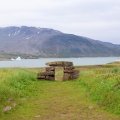
Every summer, in the heart of Alberta, in western Canada, thousands of people – between 30,000 and 50,000 in recent years, excluding the interruption caused by COVID – gather around a lake of calm waters. They come from nearby communities or after traveling hundreds of kilometers; some arrive on foot, others in caravans, many with their families.
At first glance, it may seem like another Catholic pilgrimage. A closer look, however, reveals that something distinct takes shape at Lac Ste. Anne.
Alongside crosses, there are drums. Alongside liturgical hymns, Indigenous languages. At the center stands a figure that carries a particular meaning here: Saint Anne, the mother of Mary, is also – and decisively – the grandmother.
A sacred lake before the arrival of missionaries
Long before the arrival of Christianity, this lake already held a central place in the spiritual life of the Indigenous peoples of the region – Cree, Blackfoot, Dene, and Nakota Sioux – who knew it as Wakamne, a term that can be translated as “God’s Lake” or “sacred lake.”
It was a place of encounter with the transcendent, associated with prayer, healing, and communal decision-making. Water was not understood simply as a natural element, but as a mediator between visible and invisible realms.
This point is essential for understanding the later history of the site. When European missionaries arrived in the nineteenth century, they did not encounter a landscape devoid of religious reference points, but one already layered with meaning.
The emergence of a pilgrimage
In the 1840s, Oblate missionaries, led by Father Jean-Baptiste Thibault and invited by a local convert leader, began to establish themselves in the area. In that context, the figure of Saint Anne took on a key role as a point of convergence between traditions.
Within Christianity, Saint Anne is the mother of the Virgin Mary and therefore the grandmother of Jesus. Although her presence in canonical texts is limited, devotion to her has been widely spread across different parts of the world.
In many Indigenous cultures, the grandmother holds a central place as a keeper of memory, a transmitter of knowledge, and a moral reference point. This symbolic correspondence made possible a deep identification.
Saint Anne could be understood not as a foreign figure, but as a nearby presence, recognizable within local cultural frameworks. From that convergence, pilgrimages began to take shape, and by the late nineteenth century they were already drawing significant numbers of participants. Over time, the gathering became one of the principal pilgrimages in North America.
Rituals by the water
The pilgrimage takes place annually around July 26, the feast day of Saint Anne, and extends over several days. During that period, the lake becomes the center of intense spiritual activity.
One of the most significant moments is the procession to the water. Pilgrims move slowly toward the shore, and many enter the lake. Bathing is understood as a gesture of purification and healing, deeply rooted both in Indigenous tradition and in Christian water symbolism.
Alongside liturgical celebrations – Masses, blessings, and moments of prayer – there are also practices belonging to Indigenous cultures. Among them is the pipe ceremony, a rite of major spiritual importance in several Native traditions of North America.
The pipe, regarded as a sacred object, is used in contexts of prayer and commitment. Its presence during the pilgrimage expresses a dimension of communion: with the community, with the land, and with the sacred. The rising smoke symbolizes prayer ascending, establishing a link between the human and the transcendent.
Traditional songs, drum percussion, and Indigenous languages coexist with Christian rites, shaping a ritual space that is complex yet coherent in its unfolding.
Memory, injury, and reconciliation
Canada’s recent history adds an essential dimension to the present meaning of Lac Ste. Anne. For more than a century, thousands of Indigenous children were placed in institutions – many of them run by churches – with the aim of culturally assimilating them. The consequences of this system, now extensively documented, have left a deep mark.
In this context, the pilgrimage cannot be separated from historical pain. On the contrary, it has also become a place where that past can be remembered, expressed, and, in some cases, worked through.
In July 2022, Pope Francis visited Lac Ste. Anne during his trip to Canada, a visit shaped by the acknowledgment of the suffering inflicted on Indigenous communities. His presence at the lake – where he took part in a liturgy and in moments of prayer alongside Indigenous representatives – carried strong symbolic weight.
For many, the gesture marked a significant step within a broader and more complex process of reconciliation.
Pilgrimage to the lake today
The pilgrimage to Lac Ste. Anne differs from other major itineraries. There is no single defined route: the lake is the point of convergence, reached from many different places.
The pilgrimage takes place in late July, with July 26 as its high point. The lake lies about an hour and a half by car from Edmonton. Some pilgrims cover long distances on foot, while others arrive in groups, by vehicle, or in caravans. Stays often last several days, creating a shared space where spiritual practice, daily life, and communal encounters intersect.
During those days, attendance is high, so accommodation should be arranged in advance, or camping options considered. Weather conditions can vary even in summer, so preparation for bad weather is advisable.
Beyond practical considerations, one recommendation stands above the rest: approach the place with respect and attention. Lac Ste. Anne holds deep spiritual meaning for many people, and understanding it requires an open and careful attitude.
A lake that continues to gather people
When the pilgrimage ends, when the camps are dismantled and the noise fades, the lake returns to its quiet appearance. Yet that calm is not the same as at the beginning. It remains marked by the voices, gestures, and experiences lived along its shores.
Year after year, pilgrims return. Not only out of tradition, but because they recognize in this place a particular form of presence—one that, in many cultural contexts, finds a simple and resonant expression: that of the grandmother.
AI Transparency Notice
PilgriMaps uses artificial intelligence tools to assist in the research, drafting and translation of editorial content. All AI-assisted content is reviewed, edited and verified by our editorial team before publication. We contrast information against primary sources, specialist literature and on-the-ground knowledge to ensure accuracy, cultural sensitivity and editorial integrity.
AI is one tool among many in our workflow. The judgement, curation and responsibility for everything published on this platform remain entirely human.
Viator Media S.L. — in compliance with the EU Artificial Intelligence Act (Regulation EU 2024/1689).
This post is also available in: