Some walking routes lead to more than a geographic endpoint. They carry stories of courage, vision, and personal change. In Europe, five itineraries weave landscape and contemplative heritage around women whose lives, writings, and reputations shaped parts of Western spiritual and intellectual history. These routes remain far less traveled than the Camino de Santiago, and that relative quiet is part of their appeal.
Hildegard of Bingen, Teresa of Ávila, Mary Magdalene, Bridget of Sweden, and Brigid of Kildare are separated by centuries and radically different contexts. What links them in cultural memory is a shared insistence on interior experience—whether described as vision, reform, retreat, or threshold—and the public consequences that followed. Today, trails associated with their names pass through German vineyards, the Castilian plateau, the forests of Provence, Scandinavian plains, and Irish hills. They also invite walkers to consider enduring questions about authority, imagination, resilience, and the way repetitive movement can reframe thought.
Hildegard of Bingen: Along the Nahe and the Rhine
In western Germany, a 137 km route follows sites connected to Hildegard of Bingen (1098–1179 CE), one of the most prolific figures of the medieval period. The Hildegardweg begins in Idar-Oberstein—known for gemstone traditions—and ends in Bingen on the Rhine. Between them are stages through forests, vineyards, and small towns with long-built continuity.
Hildegard was born into a noble family and entered monastic life as a child at Disibodenberg. Within the institutional limits of her era, she developed an unusually wide body of work: music, correspondence, natural history and medicine, and theological writing. She became a sought-after advisor across religious and political networks. In 2012, Pope Benedict XVI named her a Doctor of the Church (one of a small number of women to hold that title).
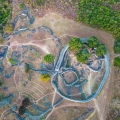
For many walkers, the emotional center of the route is the ruins of Disibodenberg, where she spent decades. The site sits in thick vegetation, with stone walls and arches emerging like exposed strata. Whatever a visitor’s beliefs, the setting encourages slow attention: wind, birds, and long corridors of silence. Interpretive panels along the trail do more than recount dates. They frame themes—care of the body, discipline, creativity, and moral responsibility—and often pose questions rather than deliver conclusions. That approach fits Hildegard’s legacy as a writer who combined practical observation with expansive cosmology.
Teresa of Ávila: A Castilian Route Between Birthplace and Burial
In central Spain, the Camino Teresiano links Ávila to Alba de Tormes in roughly 120 km, typically walked in four to five days across the Meseta. Ávila’s intact medieval walls and dense religious architecture provide a dramatic starting point; the landscape then opens into grain fields and wide sky, with long, steady lines of walking.
Teresa de Cepeda y Ahumada (1515–1582 CE) became a major reformer within the Carmelite tradition. Her critique focused on comfort and institutional drift, and her response was organizational as much as spiritual: founding new communities with stricter rules and fewer material supports. Her writing—especially on inner experience, discipline, and attention—had lasting influence and remains widely read.For a woman in 16th-century Spain, public claims about visions carried risk. The religious and political climate included surveillance and punishment for perceived heterodoxy.
Teresa navigated that environment with notable pragmatism: building alliances, negotiating permissions, and shaping communities that could endure. Walkers who complete the route can receive the “Andariega” credential—using a term Teresa applied to herself, often translated as “wanderer.” On the trail, the title reads less like romance and more like method: progress through repetition, persuasion through persistence, reform through daily logistics. The Castilian plateau reinforces that lesson. The walking is rarely dramatic, but it is steady—an environment that naturally supports introspection.
Mary Magdalene: A Provençal Itinerary from Coast to Grotto
In southern France, the Chemin de Marie-Madeleine runs about 224 km from Saintes-Maries-de-la-Mer on the Camargue coast to Saint-Maximin-la-Sainte-Baume, near the limestone massif associated with long-standing local traditions about Mary Magdalene’s later life.
Here, the route is inseparable from legend. Medieval narratives describe Mary Magdalene arriving by sea in Provence with other figures from early Christian tradition, preaching in Marseille, and later withdrawing to a cave at Sainte-Baume. Historical verification is difficult and contested, yet the story has shaped regional pilgrimage culture for centuries. In Saint-Maximin, the basilica and crypt are presented locally as a major destination, and royal pilgrimages are part of the site’s long public memory.
The modern route is notable for its variety: Camargue salt flats, Mediterranean coastline, Marseille’s urban textures, and inland hills long absorbed into Provençal imagination. The final approach into the Sainte-Baume forest is a shift in atmosphere. Protected for centuries, the area sustains a distinctive microclimate; beech and linden trees create a shaded canopy more typical of cooler regions.
The grotto itself is accessible only on foot, reached after about an hour of ascent. Inside, the space functions as both natural formation and built sanctuary, capable of holding large crowds. An annual night ascent on 22 July draws many participants and has been maintained for generations. For contemporary walkers, the cave can be approached as a devotional site, a cultural monument, or a landscape feature charged by collective memory—its impact does not depend on a single reading.
The Way of Mary Magdalene: Legend and Pilgrimage in Provence
Bridget of Sweden: Walking as a Return (Birgittaleden)
Some routes are born from revelation. Others are born from a funeral. The Birgittaleden, between Söderköping and Vadstena, belongs to the second category: human, concrete, slightly uncomfortable in its clarity. In 1374, the relics of Saint Bridget of Sweden were brought back from Rome to the north in a long journey that culminated in a procession through these territories. The modern trail does not merely “evoke” that movement—it retraces it.
The route is about 130 km, typically completed in seven days, with daily stages of roughly 13 to 21 km. It moves through open farmland, rural churches, small towns, and sections that connect with the Östgötaleden network. The landscape is not theatrical; its power comes from repetition and quiet continuity.
Vadstena is the endpoint, but also the city Bridget imagined as the center of her work and her order. For contemporary walkers, it is a destination that feels “weighty,” not because of spectacle, but because of narrative density. Walking here means accompanying a return—and noticing how often, in life, what transforms us is not leaving, but coming back.
Brigid of Kildare: Ireland of Wells, Fire, and Thresholds (Brigid’s Way)
If Bridget of Sweden represents medieval Europe writing to the powerful, Brigid of Kildare belongs to Ireland’s threshold world: between pagan memory and Christian form, between ancient myth and new symbols, between the land and what exceeds it. Her figure—saint, founder, patron alongside Patrick—resists clean definition. And perhaps for that reason, the route associated with her feels less like an itinerary and more like a rite.
Brigid’s Way (or St Brigid’s Way) connects, in several variants, Faughart—traditionally linked to Brigid’s birth in County Louth—with Kildare, the site of her monastic foundation. It is often described as an “ancient path between heaven and earth,” with daily stages of 10 to 24 km: long enough to demand presence, human enough to leave room for thought.
Here geography is already story: holy wells, fields, deep greens, and that distinctly Irish light that can change in minutes. The route also opens onto a living popular devotion—woven into seasonal observances and symbols like Brigid’s cross—where “spirituality” does not necessarily mean doctrine, but relationship: with community, with landscape, with what tradition carries forward without needing to over-explain itself.
St Brigid’s Way: a pilgrimage through the spiritual heart of Ireland
Walking as Re-reading: Why These Routes Matter Now
Across these five itineraries, the common thread is not doctrine but biography, reputation, and the ways institutions record certain lives. In recent years, more women have sought out routes connected to historic female figures—sometimes looking for models of agency, sometimes revisiting a heritage that official histories often compress or sanitize. These trails also draw men interested in forms of contemplative culture that sit outside patriarchal assumptions.
Walking in these contexts does not require religious adherence. It does require openness: to archives and legends, to landscapes shaped by agriculture and power, and to the inward effects of sustained effort. Step-by-step movement changes the scale of problems and the texture of attention. That is one reason pilgrimage routes—whether pursued for cultural, historical, or personal reasons—continue to attract modern travelers.
Teresa wrote, “The soul is like a castle made of a single diamond.” Read secularly, the metaphor still holds: walking can help locate an entrance—a threshold where daily noise falls back and better questions move forward.
AI Transparency Notice
PilgriMaps uses artificial intelligence tools to assist in the research, drafting and translation of editorial content. All AI-assisted content is reviewed, edited and verified by our editorial team before publication. We contrast information against primary sources, specialist literature and on-the-ground knowledge to ensure accuracy, cultural sensitivity and editorial integrity.
AI is one tool among many in our workflow. The judgement, curation and responsibility for everything published on this platform remain entirely human.
Viator Media S.L. — in compliance with the EU Artificial Intelligence Act (Regulation EU 2024/1689).
This post is also available in: