There are places that are visited, and places that are crossed. Petra belongs firmly to the second category. It is neither an isolated monument nor a frozen postcard, but an entire city carved, constructed, and conceived to engage with landscape, trade, and the sacred.
Visitors who arrive expecting to “see the Treasury and leave” often depart with the sense of having skimmed the surface. Those who arrive with time and curiosity encounter something else entirely: one of the great capitals of the ancient world, designed to impress, to protect, and to endure.
To visit Petra today requires more than purchasing a ticket. It calls for context, patience, and a willingness to move at the pace the site itself demands.
Reaching Petra: why the approach matters
Petra lies in southern Jordan, set among sandstone mountains and desert plateaus. It is not a place reached by chance, and never was. In antiquity, this relative isolation was a decisive strategic advantage; today, it continues to shape the visitor’s experience.
Most travelers arrive from Amman or Aqaba, after several hours on the road. The journey gradually strips the landscape of urban references, preparing the traveler for a site that was never conceived as an open city, but as a capital protected by geography.
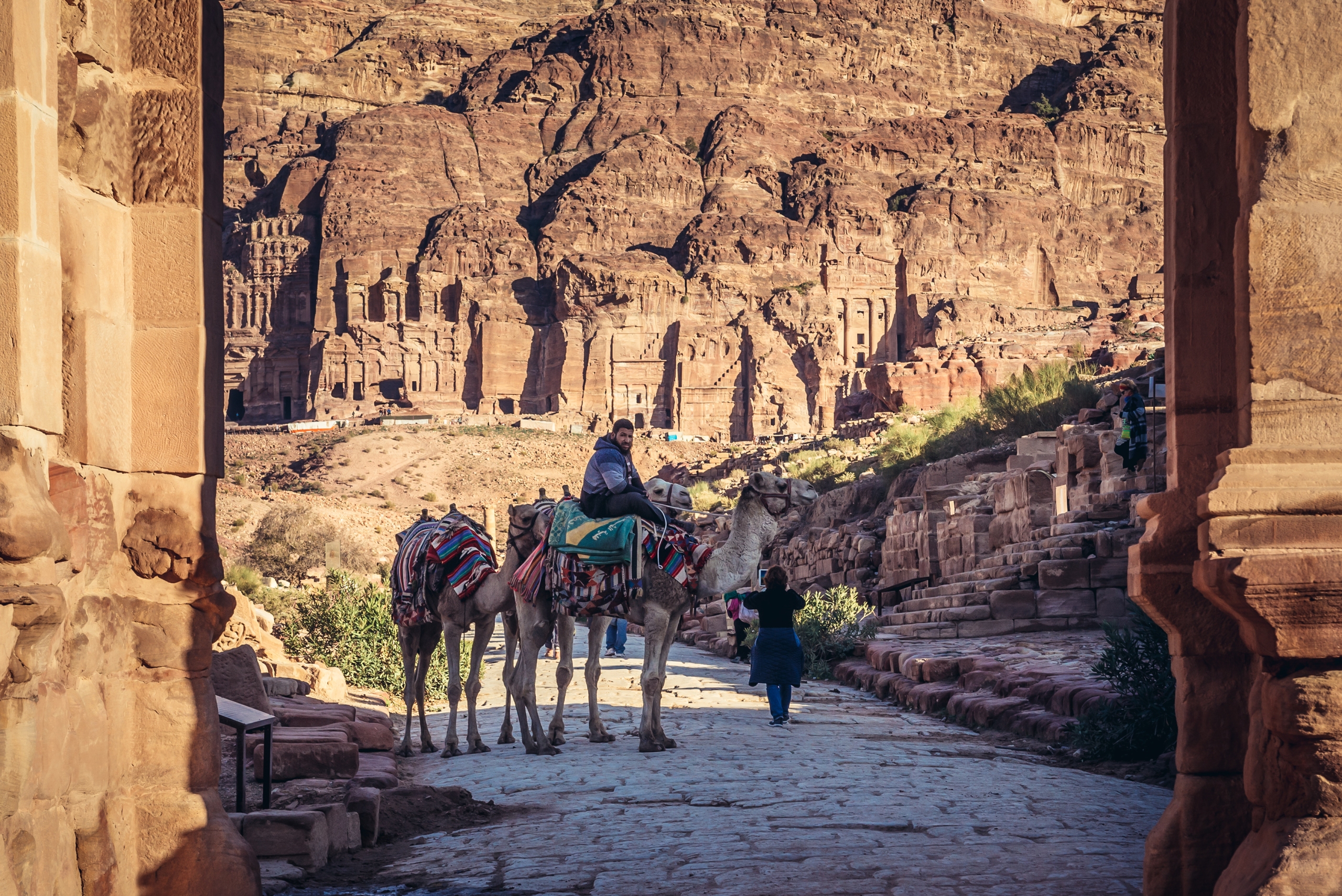
Before Petra: a long-inhabited landscape
Although Petra is inseparably associated with the Nabataeans, the valley and its surroundings were inhabited long before it became their capital. Archaeological evidence points to human presence since the Neolithic period, and biblical and Egyptian sources refer to Edomite populations settled in this region centuries before Nabataean ascendancy.
This matters. Petra did not emerge from nothing. The Nabataeans inherited a territory already dense with memory and transformed it into something radically new. Their achievement lay not in inventing the place, but in understanding it—and exploiting it—better than anyone else.
The Nabataeans and the rise of a commercial capital
The Nabataeans, an Arab semi-nomadic people, began settling in Petra between the 4th and 3rd centuries BCE. Their prosperity was tied to control of the trade routes linking southern Arabia—rich in incense and myrrh—with the Mediterranean. Petra became a strategic hub between Egypt, Syria, Mesopotamia, and Arabia.
Unlike many ancient kingdoms, Nabataean power was not built through large standing armies. It relied instead on commerce, diplomacy, and deep knowledge of desert environments. Petra functioned as their strongbox: difficult to attack, protected by terrain, and sustained by an exceptional hydraulic system.
At its height, between the 1st century BCE and the 1st century CE, Petra was a cosmopolitan city. Arab, Hellenistic, and Near Eastern traditions coexisted, and its monuments reflect this synthesis: classical columns alongside local religious symbols, theatrical façades concealing beliefs firmly rooted in the Semitic world.
Water: Petra’s defining achievement
None of this would have been possible without water management. In an arid region prone to sudden floods, the Nabataeans developed a sophisticated network of dams, channels, cisterns, and pipes capable of capturing and distributing nearly every drop of rainfall.
Walking through Petra today means walking alongside the remains of this hydraulic system, often overlooked by hurried visitors. Yet understanding it is essential. Petra is not only a city carved into rock; it is a city sustained by engineering. Its ability to function for centuries in such an environment is, in itself, a historical achievement.
The Siq: an entrance with political and ritual meaning
The main access to Petra through the Siq is not merely a natural accident. It was shaped, channeled, and ritualized. Water conduits run alongside the path, while votive niches signal that entering Petra also meant entering a space under divine protection.
The Siq functions as a symbolic threshold. Those who pass through it leave the external world behind and move into the heart of the Nabataean kingdom. Here, architecture does not proclaim power loudly; it withholds it—until the final reveal.
Al-Khazneh: stone-carved persuasion
Al-Khazneh, commonly known as the Treasury, was not a storehouse of riches but a monumental façade designed to impress. Its precise function remains debated, but its symbolic intent is clear. This was where the Nabataeans demonstrated—to merchants, envoys, and travelers alike—that they had mastered the monumental language of the Hellenistic world without abandoning their own identity.
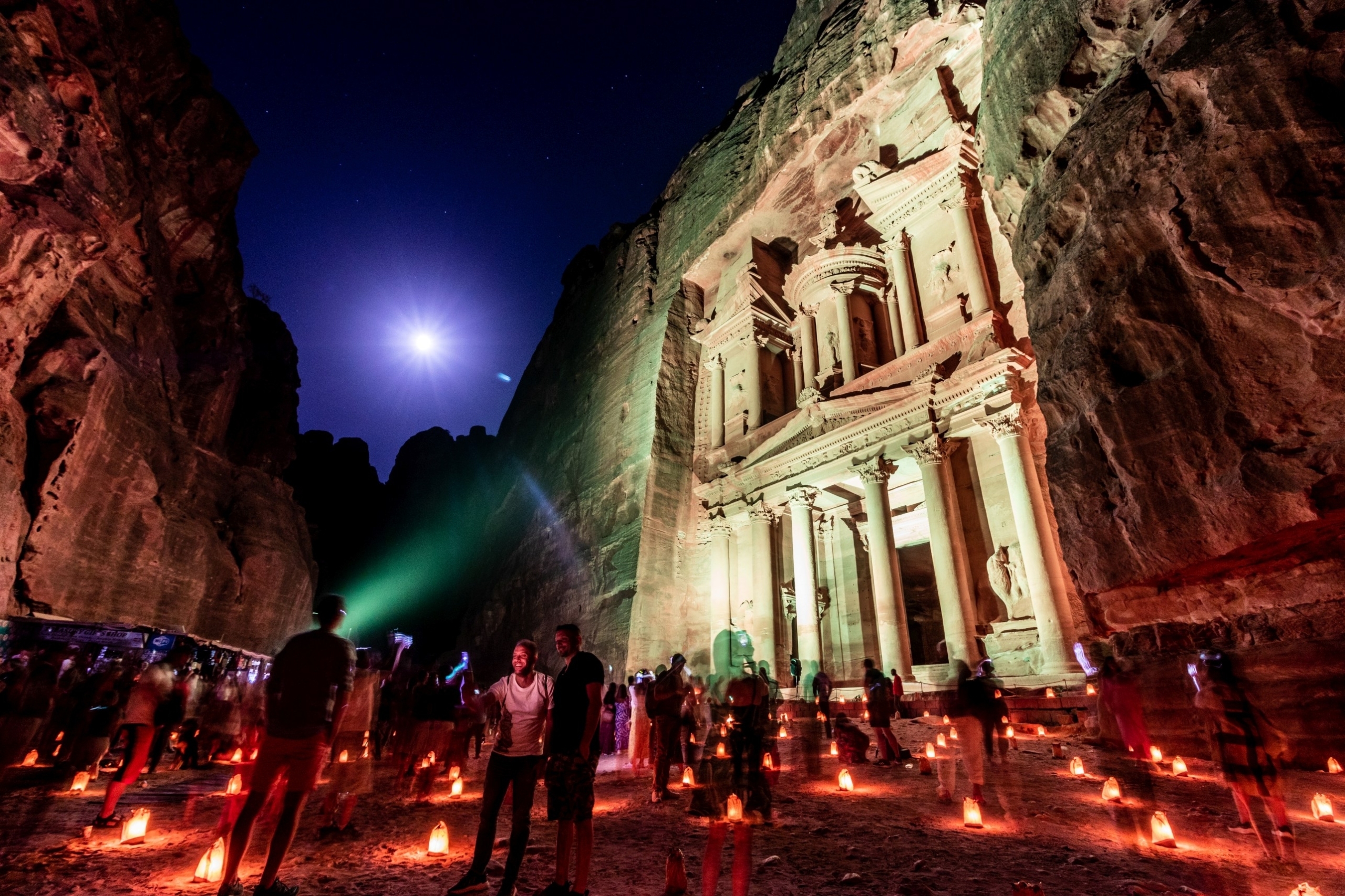
It is persuasion carved in stone, and it works.
In 106 CE, the Nabataean kingdom was peacefully annexed by the Roman Empire, and Petra became part of the province of Arabia Petraea. The city did not disappear. It adapted. Colonnaded streets, public buildings, and new temples were added to the urban fabric.
Rome did not erase Petra; it integrated it. For a time, the city continued to prosper, even as shifts in imperial trade patterns gradually weakened its role in long-distance commerce.
Decline, earthquakes, and obscurity
Petra’s decisive blow was not political but natural. A series of earthquakes, especially the one in 363 CE, severely damaged its water infrastructure. Without reliable water, Petra could no longer function as a major city. Trade routes shifted, population declined, and the site gradually lost prominence.
Although never completely abandoned, Petra faded from Western awareness until its reintroduction in 1812 by Johann Ludwig Burckhardt, who reached the site while traveling in disguise.
Petra today: walking across layers of time
Visiting Petra now means traversing multiple historical layers: Edomite settlement, Nabataean capital, Roman city, Byzantine enclave, and contemporary archaeological site. Nothing here is accidental, and little explains itself without historical context.
For this reason, Petra resists quick consumption. It demands time, attention, and a degree of humility toward what a civilization achieved by treating the desert not as an obstacle, but as an ally.
Many visitors leave with the sense that they have encountered more than monumental ruins. They have crossed a city that functioned simultaneously as capital, sanctuary, and marketplace—an enduring collective work of engineering, art, and adaptation.
Petra offers no simple conclusions. Instead, to those who walk slowly, it returns something rarer: the feeling of having touched, if only briefly, the deeper rhythm of history.
Practical tips for visiting Petra
Plan at least two days if you want to go beyond the Treasury.
Enter early: light conditions and relative quiet significantly shape the experience.
Wear sturdy footwear and carry ample water; distances are deceptive.
Expect elevation changes—Petra requires physical effort.
Look beyond the most photographed façades: notice channels, niches, and secondary paths.
Respect the site and nearby communities.
Take advantage of shifting light throughout the day.
Research carefully before including Petra by Night in your itinerary.
AI Transparency Notice
PilgriMaps uses artificial intelligence tools to assist in the research, drafting and translation of editorial content. All AI-assisted content is reviewed, edited and verified by our editorial team before publication. We contrast information against primary sources, specialist literature and on-the-ground knowledge to ensure accuracy, cultural sensitivity and editorial integrity.
AI is one tool among many in our workflow. The judgement, curation and responsibility for everything published on this platform remain entirely human.
Viator Media S.L. — in compliance with the EU Artificial Intelligence Act (Regulation EU 2024/1689).
This post is also available in: