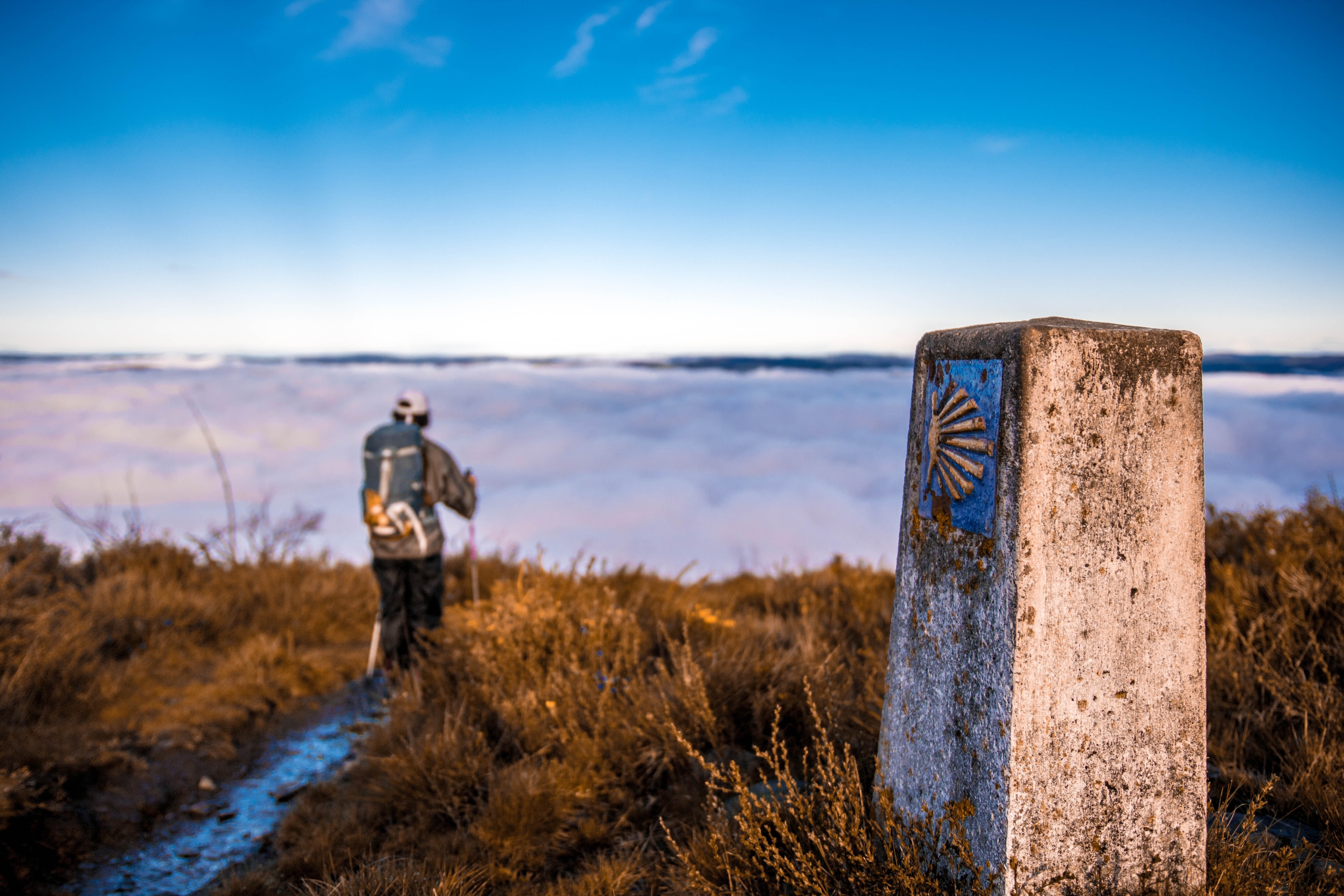
There is a precise moment when the phone loses signal and the arrow disappears from the screen. What happens next, in the body and in the mind, is more interesting than any destination.
Imagine a twelfth-century pilgrim walking the Via Francigena toward Rome. No apps. No GPS. Not even a particularly reliable map, since maps of the period were often masterpieces of geographical imagination — seas inhabited by monsters, mountains displaced by fifty leagues, rivers flowing in purely decorative directions. The pilgrim has the sun, which indicates east in the morning and west in the evening, more or less. The stars, for those who can read them. A few vague instructions gathered from a monk encountered three days earlier, who said: “Follow the river to the ford, then look for the bell tower.” And the physical sensation of the ground beneath the feet — whether it is compact and worn by previous travelers, whether there are signs of passage, whether the path feels inhabited. If so, it is probably leading in the right direction.
That sensation — reading the landscape with the entire body, with the eyes, ears, literal sense of smell, and with the way light falls on vegetation and suggests where water may be found — is something most people have almost entirely forgotten they possess. It is not an arcane skill. It is a sensory system refined by evolution over hundreds of thousands of years and rendered largely unnecessary by GPS technology in roughly three decades.
At first glance, the subject may appear to belong to nostalgia: longing for a vanished era when people disappeared hopelessly into the forests of medieval Europe, or treating improvised navigation as an ideal way of life. Yet the matter is more subtle. Getting lost, in controlled and safe circumstances, does something specific and valuable to the mind. A person walking without knowing exactly where they are must pay attention differently from someone following an arrow on a screen. They must observe. Form hypotheses, compare them with evidence, revise them if they prove wrong. They must decide. The brain becomes alert in a way assisted navigation rarely permits — and not only in the spatial sense.
In 1909, the anthropologist Arnold van Gennep published his study of rites of passage across different cultures and identified a structure that appears with remarkable consistency throughout human traditions: every major transformation unfolds in three phases. Separation from the previous state. Liminality — a threshold condition marked by ambiguity, by being “no longer this and not yet that.” And finally, return in a new state. What van Gennep understood, and what remains relevant far beyond his original context, is that the middle phase — the uncomfortable one, the one without clear definitions, the one in which one does not fully know where one stands — is the most important. That is where genuine transformation occurs. Not before. Not after. In the threshold itself.
The Aboriginal Australian walkabout is perhaps the most radical and widely known example of this principle applied to lived experience. Young people are sent alone into the bush, without maps and often without a precise destination, for periods that may last weeks or months. The point is not survival, nor arrival. The point is learning to orient oneself in the world — physically, but above all inwardly — without the habitual structures that define identity, purpose, and direction. Many initiation traditions across the world share this logic: the candidate is brought to an unfamiliar place, stripped of familiar reference points, and left alone with the landscape and with themselves. Uncertainty is not a side effect of the ritual. It is the instrument of the ritual.
There are still historic pilgrimage routes where this experience remains available, not as an artificial simulation but as a genuine characteristic of the journey. The Camino Primitivo — the oldest of the routes to Santiago, first undertaken by Alfonso II of Asturias in 829 CE — includes stretches where yellow arrows become scarce and the landscape overtakes any form of signage. Benedictine paths in the Apennines connect monasteries through forests and ridgelines where orientation still depends on reading light and terrain. Ancient pilgrimage roads cross villages where the only indication may be a faded symbol painted on a wall decades ago, requiring interpretation rather than simple reading. In all these cases, limited signage is not a logistical flaw. It is part of what the route offers.
Pilgrims who have walked these sections often describe moments of uncertainty as the most intense of the entire journey. Not because they were afraid — or not only because of fear — but because in those ten minutes when one does not know whether to turn right or continue straight ahead, when the path is examined, then the sky, then the path again, one becomes completely present. There is no room for repetitive thoughts, circular anxieties, or the internal conversations that loop endlessly through ordinary life. There is only this: where am I, what do I see, what must I decide. It is a form of attention the ordinary mind rarely reaches, and which emerges naturally on pilgrimage, without effort, as the unexpected gift of a map that ends too soon.
There is a beautiful Latin word worth recovering: errare. It means to wander, to lose one’s way, to drift without a planned course. It is also the root of the word error. In classical Latin, errare was not necessarily negative. It described the movement of someone exploring without a fixed route, allowing the landscape itself to suggest direction. The Romans had understood something that modern society is rediscovering with difficulty: that losing one’s way and making mistakes belong to the same semantic and experiential family. And that both, in the right measure, at the right moment, in the right place, are not problems to solve. They are experiences from which one returns carrying something no guidebook can provide.
A GPS algorithm never makes mistakes. That is why it teaches very little.
A digital detox: Pilgrimages can help you reclaim your natural rhythm
AI Transparency Notice
PilgriMaps uses artificial intelligence tools to assist in the research, drafting and translation of editorial content. All AI-assisted content is reviewed, edited and verified by our editorial team before publication. We contrast information against primary sources, specialist literature and on-the-ground knowledge to ensure accuracy, cultural sensitivity and editorial integrity.
AI is one tool among many in our workflow. The judgement, curation and responsibility for everything published on this platform remain entirely human.
Viator Media S.L. — in compliance with the EU Artificial Intelligence Act (Regulation EU 2024/1689).
This post is also available in: