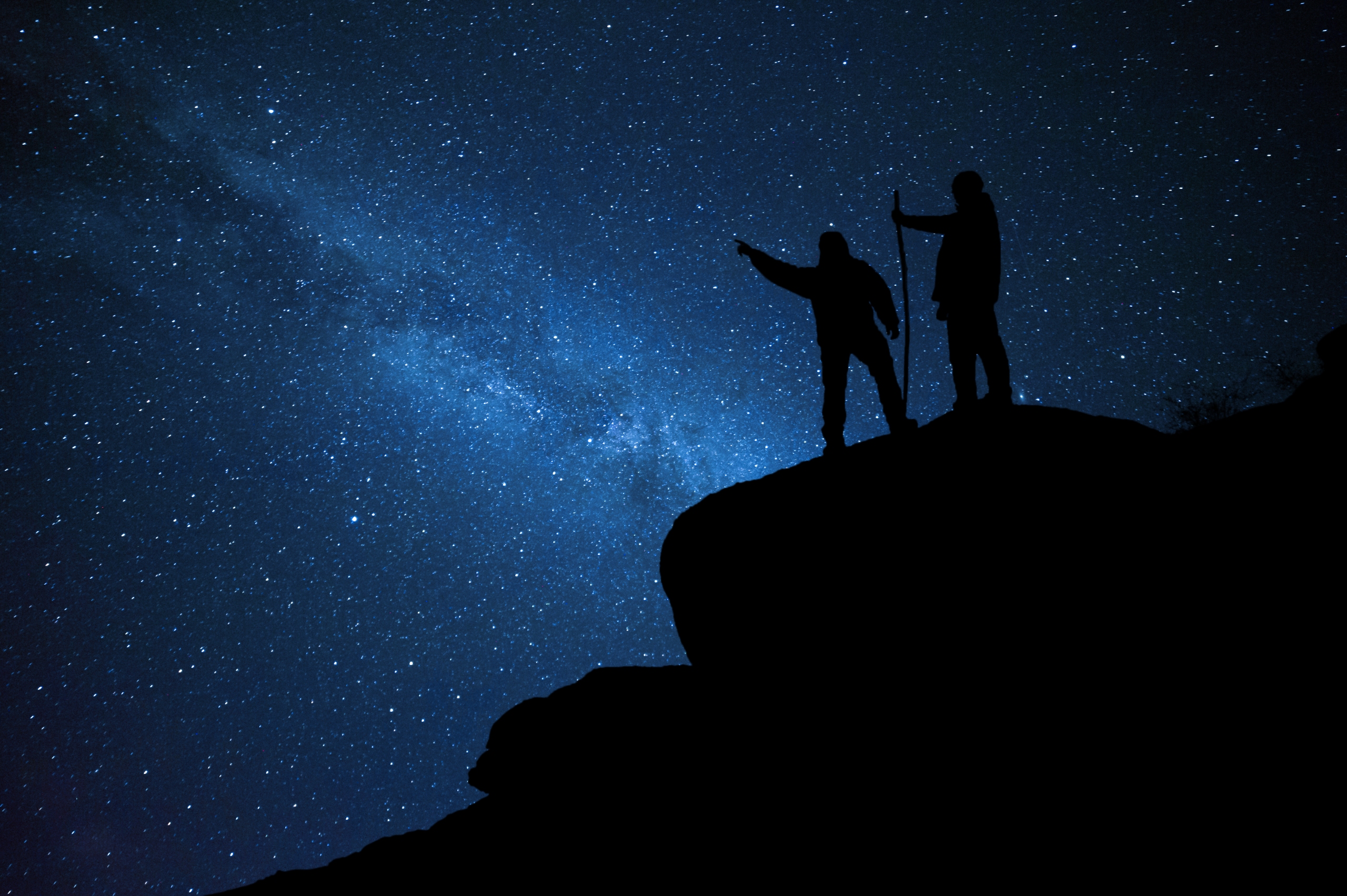
In 813 CE, a hermit named Pelagius reportedly observed unusual lights hovering above a field in Galicia—stars shining with uncommon intensity, as if marking a precise point on the ground. Following that glow, he arrived at what was believed to be the tomb of the apostle James. The site became known as Campus Stellae, the “field of the star,” today identified as Santiago de Compostela.
Legend, certainly. Yet the story reflects a durable human pattern: across cultures and centuries, people have looked to the night sky not only for spatial orientation, but for a broader sense of direction.
When stars were our navigators (and often worked better)
In 1976, as satellite navigation was entering public consciousness, a group of Hawaiian sailors undertook a seemingly improbable experiment. They built a traditional double-hulled Polynesian canoe and sailed from Hawaiʻi to Tahiti – roughly 3,000 kilometers of open ocean – without compass, sextant, or instruments.
Guiding them was Mau Piailug, a master navigator trained in a wayfinding tradition that encodes geography in the sky. Rather than memorizing maps, Piailug carried a mental star compass of roughly 150 stars, learned from childhood. He knew which stars passed directly over the Hawaiian Islands, which indicated southeastern bearings, and how specific stars rose and set at fixed points along the horizon – what navigators describe as “houses” in the sky.
In this system, the navigator’s body becomes the instrument. Subtle shifts in wave patterns, changes in wind, seabird behavior, even smell, are integrated with stellar observation. When the canoe reached Tahiti after 31 days, the voyage demonstrated that Polynesian settlement across the Pacific was neither accidental nor random, but methodical and repeatable.
That tradition remains active. In 2023, the Polynesian voyaging canoe began a multi-year circumnavigation of the Pacific – over 66,000 kilometers – using only ancestral navigation methods, supported by the Polynesian Voyaging Society.
Your brain under the stars (it slows down)
What happens when modern walkers—GPS-enabled and screen-saturated—look up?
Recent neuroscientific studies suggest that observing a dark, star-filled sky measurably reduces activity in the right prefrontal cortex, a region associated with analytical processing and stress. In practical terms, the brain shifts into a more contemplative state, with reduced cognitive load.
Large-scale population studies conducted by researchers at the University of Washington have also found that people living under darker skies report higher levels of curiosity about the universe and more frequent experiences of “awe.” This is not a vague sentiment but a well-defined emotional state associated with physiological effects.
Psychologist Dacher Keltner, author of Awe (2023), documents how this emotion correlates with lower inflammation markers, reduced heart rate, increased oxytocin levels, and heightened prosocial behavior. Exposure to vastness – cosmic or terrestrial – tends to recalibrate perspective. Daily concerns do not vanish, but their perceived urgency often diminishes.
Night Walking: The Magic, Mystery, and Mindfulness of Pilgrimage After Dark
The vanishing night sky
Approximately 80% of the world’s population now lives under light-polluted skies. For an estimated one-third of humanity, the Milky Way has never been visible. This loss has implications beyond aesthetics.
Researchers describe light pollution as an equity issue: children who grow up without visible stars are statistically less likely to ask questions about them, and astronomy often serves as an entry point into broader scientific inquiry. Beyond education, there is a subtler ecological loss. Communities with access to genuinely dark skies tend to describe the night sky not as “space,” but as an integral part of their environment – no less natural than land or sea.
The disappearance of that sky is experienced as a real form of environmental degradation.
Returning to the field of stars: A practical approach
Reconnecting with the night sky does not require ocean crossings or remote islands. Evidence-based practices suggest simple steps can restore many of the benefits:
- Reduce artificial light. Observational studies indicate that low-light environments support more exploratory, flexible thinking. Star-identification apps have their uses, but initial observation without screens allows the eyes – and attention – to adapt.
- Start small. Ten minutes is sufficient. Research on nature exposure shows that brief, regular encounters reduce anxiety and improve mood. Noticing a constellation or the Moon’s phase is enough.
- Seek the nearest darkness. Urban edges, parks, or even a balcony can suffice. Initiatives supported by the International Astronomical Union aim to make sky observation accessible regardless of location.
- Adopt a navigator’s posture. Sit or lie down, breathe slowly, and allow at least 20 minutes for full dark adaptation. The goal is not identification, but presence.
- Share the experience. Awe is amplified socially. Observing the sky with others increases feelings of connection – one reason historical pilgrims often traveled and camped together.
Stars as an inner compass
Medieval pilgrims walking toward Santiago followed markers on the ground, but also patterns overhead. The legend of Pelagius is less about discovery than memory – a reminder of the sky’s role as guide.
Modern life rarely requires stellar navigation in a literal sense. Yet the underlying need remains: orientation within a larger context. Stars offer a stable reference beyond daily fluctuations, a fixed backdrop against which movement becomes intelligible.
Piailug once remarked that the stars do not move – it is we who move beneath them. Astronomically accurate, and quietly applicable elsewhere. The night sky remains unchanged, patient, available. When someone looks up and asks, “Where am I?” it does not answer in words. It offers scale, continuity, and a path of light.
Walking that path, as always, remains a human task.
AI Transparency Notice
PilgriMaps uses artificial intelligence tools to assist in the research, drafting and translation of editorial content. All AI-assisted content is reviewed, edited and verified by our editorial team before publication. We contrast information against primary sources, specialist literature and on-the-ground knowledge to ensure accuracy, cultural sensitivity and editorial integrity.
AI is one tool among many in our workflow. The judgement, curation and responsibility for everything published on this platform remain entirely human.
Viator Media S.L. — in compliance with the EU Artificial Intelligence Act (Regulation EU 2024/1689).
This post is also available in: