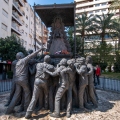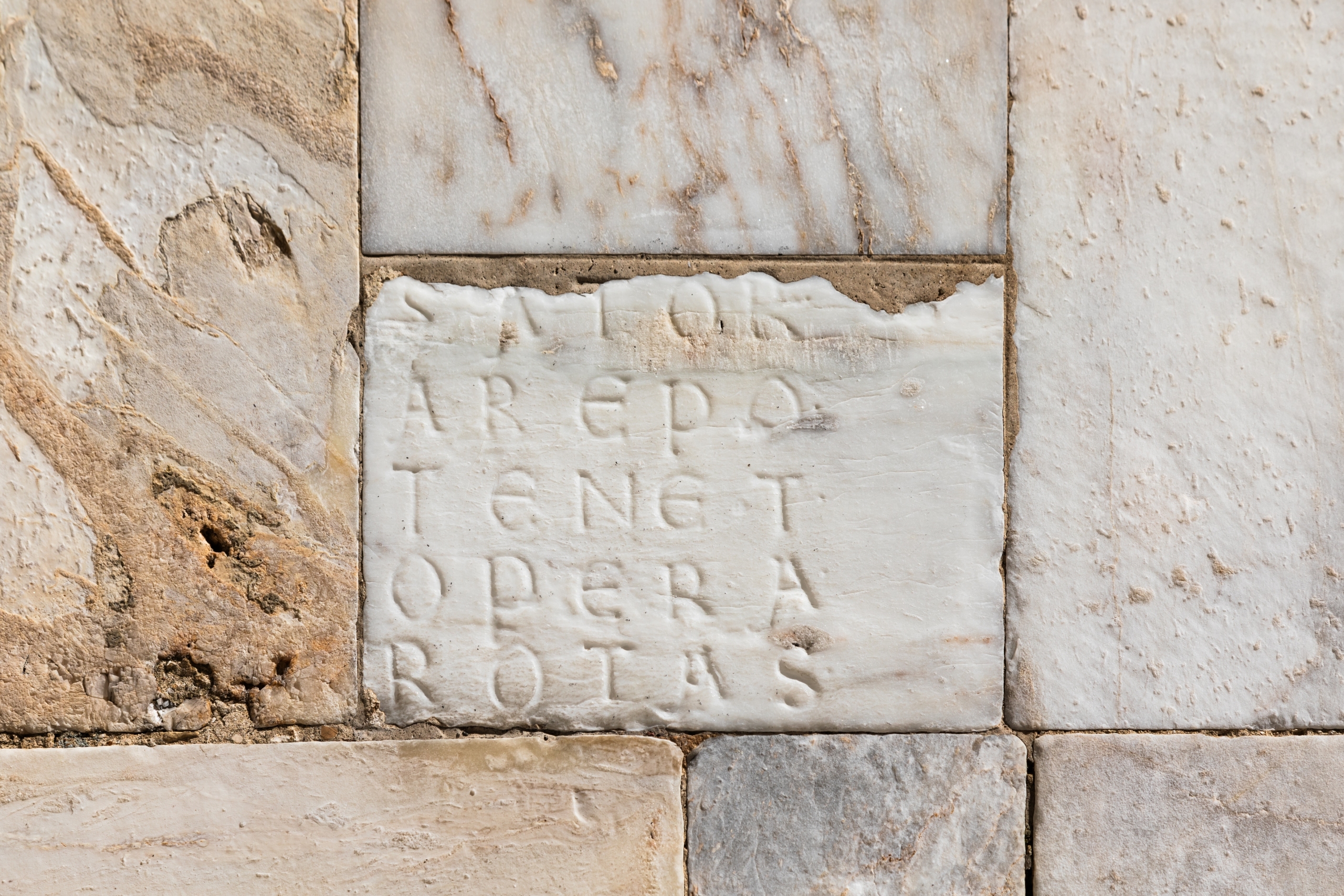
In the hills of Galicia, far from the more frequented pilgrimage routes to Santiago de Compostela, lies a unique clue to one of Europe’s most enduring epigraphic enigmas: the Sator Square. This palindromic formula, noted for its symmetrical structure and layered interpretations, appears in an unusual form in a medieval document connected to the monastery of San Juan de Caaveiro, along the English Way.
For years, some believed this inscription was once carved into the walls of Santiago Cathedral. However, no physical evidence has been found. Instead, a 1248 record preserved in the Caaveiro cartulary offers a singular version: rather than the traditional square grid, the words are arranged in a circle around a central cross. The final word, ROTAS, is not written out but represented by two drawn wheels. This visual adaptation, laden with symbolic intent, reveals that the square was not used as decoration, but as a protective formula inscribed with precision in a legal act.
A traveling inscription
The Sator Square consists of five words — SATOR AREPO TENET OPERA ROTAS — that form a 5×5 grid, legible in multiple directions. Its structure has inspired diverse interpretations across centuries. Inscriptions identical or similar in form have been found from Pompeii to rural Sweden, from Roman bricks in Hungary to illuminated manuscripts in northern France.
On pilgrimage routes, the square appears in noteworthy locations: at the Abbey of San Pietro in Oratorium, near modern-day L’Aquila along the Way of Peace; and in the Siena Cathedral, crossed by the Via Francigena. Each instance points not to a singular theological continuity, but to a circulation of signs and scripts within mobile, culturally entangled contexts.
Origins and diffusion
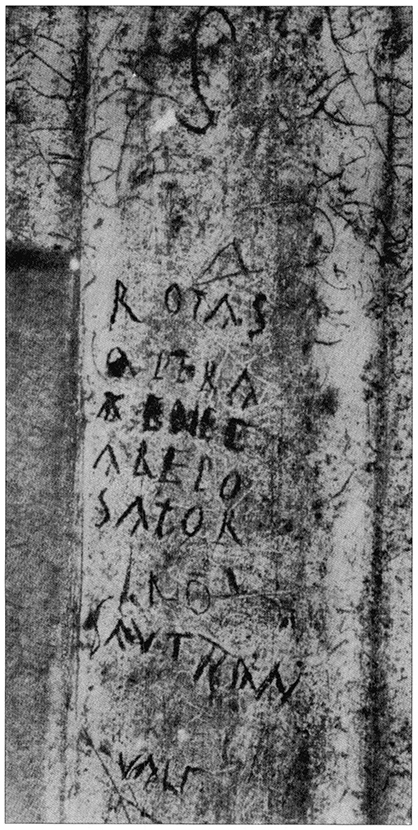
The earliest known example of the Sator Square comes from Pompeii, where multiple specimens were found inscribed on walls and columns before the eruption of 79 CE. After the collapse of the Roman Empire, the symbol was taken up by monastic communities, scribes, and medieval builders, incorporated into churches, hermitages, and manuscripts.
Its longevity suggests continual redefinition: once used in civic or domestic settings, the square came to serve an apotropaic function—protecting against harm through symbolic means. Its cruciform or circular arrangements, multi-directional readability, and semantic ambiguity made it adaptable across religious, cultural, and magical frameworks.
Interpretations in dispute
The phrase’s meaning remains contested. Some scholars take a literal approach: Sator (sower), Arepo (of unclear origin), Tenet (holds), Opera (works), Rotas (wheels). One traditional reading suggests: “The sower Arepo guides the wheels with effort,” evoking a rural image.
Other interpretations propose symbolic or cryptographic meanings. In one reading, the word TENET forms a central cross within the grid, flanked by remaining letters that can be rearranged to spell PATER NOSTER (Latin for “Our Father”) twice, with the letters A and O left over—interpreted by some as Alpha and Omega. Though this view attracted attention in medieval scriptoria, it remains speculative and rooted in specific symbolic systems.
Prayer, cipher, or protective charm?
There is no scholarly consensus on the square’s original function. Two major interpretive currents dominate: one sees it as a concealed emblem of Christian belief—coded expressions of devotion or identity, especially under conditions of persecution or monastic discipline. The other views it as a magical charm: a written talisman used to ward off evil, disease, or misfortune.
As with the formula Abracadabra, the Sator Square was etched into doorframes, hidden in amulets, and inserted into documents. Its repetition, symmetrical design, and hidden geometry made it effective, in the eyes of its users, as a protective device.
This ambiguity between prayer and spell has even reached contemporary cinema: in the film Tenet (2020) by Christopher Nolan, the director draws directly from the five words of the square —Sator, Arepo, Tenet, Opera, and Rotas— to name characters, companies, and places, constructing a labyrinthine narrative where time folds in on itself. A clear sign that this ancient enigma continues to ignite the imagination and challenge the boundaries of reason.
A persistent enigma
From Italy to France, England, Portugal, and Sweden, the Sator Square has appeared across half the continent, often in settings marked by spirituality, secrecy, or marginality. Some theories link it to pre-Christian cults, the Roman deity Saturn, or medieval esoteric traditions. No single explanation has gained full acceptance.
Its power may lie in precisely this ambiguity. As in the case of Caaveiro, where monks rendered it as a protective seal, the Sator Square continues to evoke fascination. Whether interpreted as a hidden cross, a cryptic charm, or a mystical riddle, it recalls a historical moment when faith, superstition, and scholarship intersected—and from which we still have much to learn.
AI Transparency Notice
PilgriMaps uses artificial intelligence tools to assist in the research, drafting and translation of editorial content. All AI-assisted content is reviewed, edited and verified by our editorial team before publication. We contrast information against primary sources, specialist literature and on-the-ground knowledge to ensure accuracy, cultural sensitivity and editorial integrity.
AI is one tool among many in our workflow. The judgement, curation and responsibility for everything published on this platform remain entirely human.
Viator Media S.L. — in compliance with the EU Artificial Intelligence Act (Regulation EU 2024/1689).
This post is also available in: