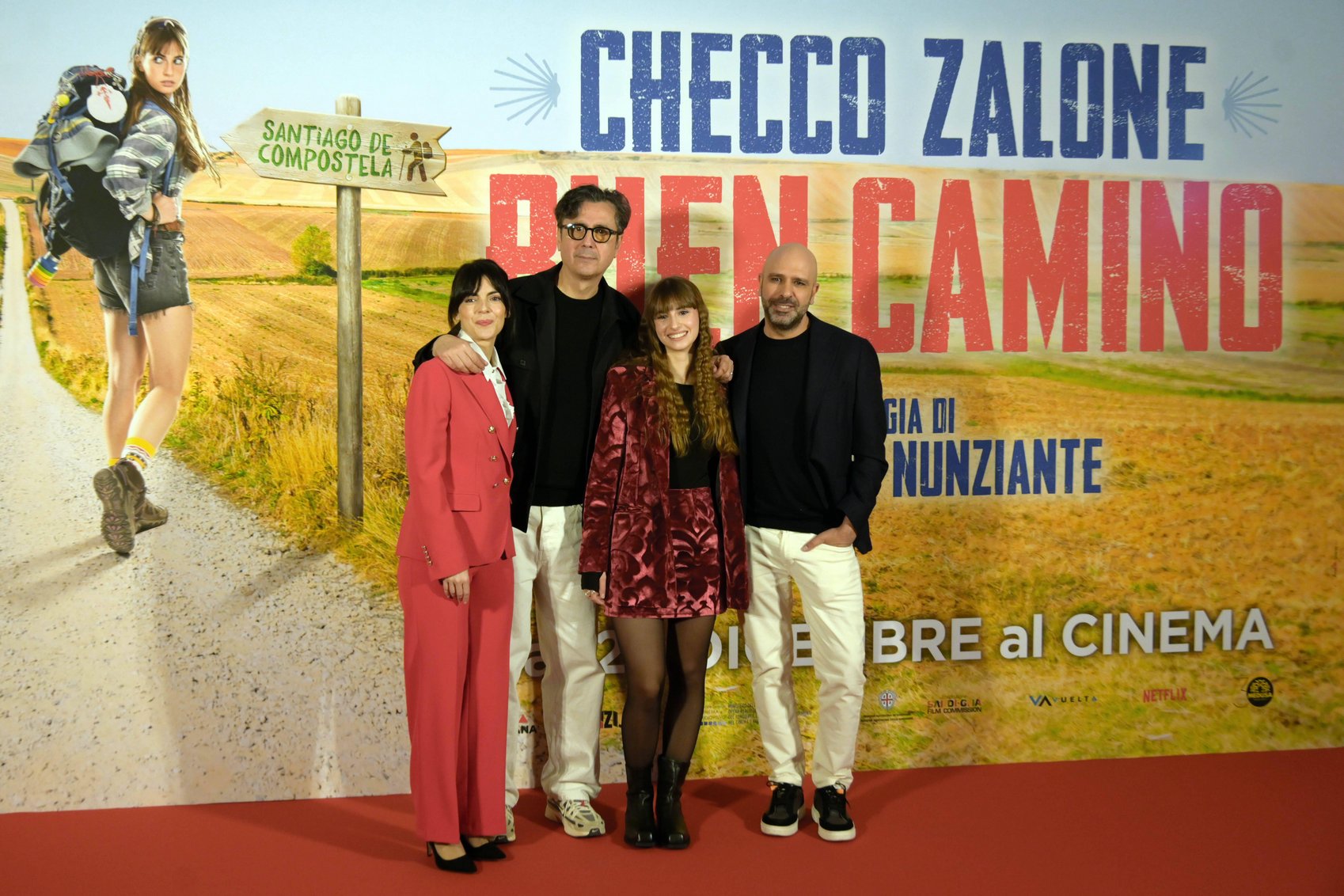
The latest film by Checco Zalone, now the highest-grossing title in Italian cinema history, follows a father and the still-unformed relationship with his teenage daughter along the Camino de Santiago.
Each year, roughly half a million people walk the Camino de Santiago. They arrive from across the world, some carrying overloaded backpacks or wearing brand-new shoes, each propelled by reasons that are often difficult to articulate. Zalone, Italy’s most commercially successful comedian, has chosen to engage with this collective experience through his own distinctive lens. The result, Buen Camino, has already become the most successful film ever released in Italy.
For audiences unfamiliar with Zalone, he can be loosely compared to a Mediterranean version of Adam Sandler – though with a singular ability to embody what many Italians simultaneously aspire to and reject in themselves. His characters are naïve, opportunistic, parochial, and often uninformed. Above all, they are disarmingly likable and emotionally accessible. Over two decades, Zalone has built his career by satirizing an Italy that dreams of wealth without labour, equates security with status, and mistakes cleverness for intelligence – yet remains capable of affection, self-doubt, and change.
In Buen Camino, directed by long-time collaborator Gennaro Nunziante, Zalone plays Checco, heir to a sofa-manufacturing fortune who has never worked a day in his life. His existence unfolds in excess: yachts, luxury cars, and tasteless parties. In his fifties, he has an ex-wife and a strikingly younger partner. When his teenage daughter Cristal – named, pointedly, after champagne – leaves home to walk the Camino de Santiago, Checco decides to follow her. He frames the decision as paternal responsibility. He wants to bring her back
The narrative setup is familiar. Physical hardship as a pathway to moral recalibration is a cinematic convention as old as the medium itself. What sets Buen Camino apart from much contemporary Italian comedy, however, is its emotional restraint. Zalone and Nunziante resist the temptation to turn the film into a lecture on simple living or a promotional fantasy of “spiritual tourism” for the affluent. The Camino remains what it is: demanding, uncomfortable, and populated by eccentric fellow walkers sleeping in crowded hostels that smell unmistakably of exhaustion.
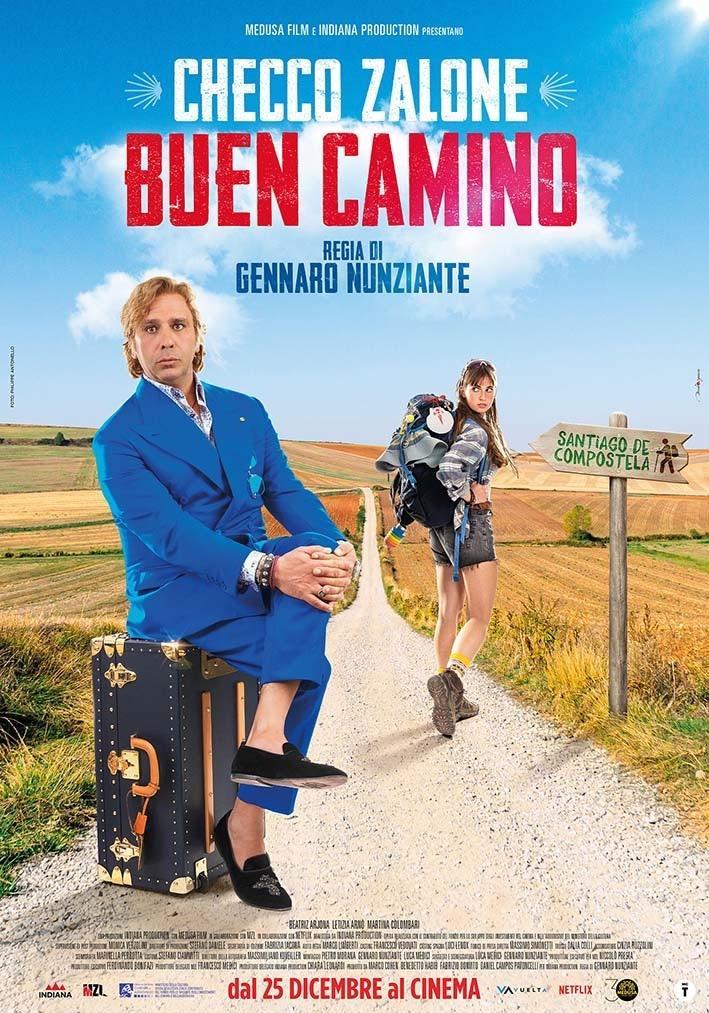
As Checco moves toward Santiago, he encounters deteriorating hostels and awkward situations, repeatedly attempting to use money to regain comfort. The Camino, however, is indifferent to privilege. If the film had a tagline, it might be this: the Camino offers no discounts. Blisters operate democratically; they hurt the wealthy as reliably as everyone else.
Italian critics have been divided. Some accuse Zalone of softening, of abandoning the provocative irreverence that defined his earlier work. “Where is the iconoclast?” they ask. The answer may be simple: walking. There is something inherently humbling about placing one foot in front of the other for weeks at a time. It is difficult to maintain a posture of provocation when recovering from a fever in a Galician hostel.
This perceived gentleness is, paradoxically, the film’s strength. Zalone does not abandon satire—his observations on masculinity, food culture, and Italy’s uneasy relationship with work remain sharp. What he adds is a second register: unguarded emotion. When Checco and his daughter finally speak after kilometres of strained silence, the moment works not in spite of the preceding comedy, but because of it. Laughter clears space for empathy.
The Camino de Santiago has evolved over more than a millennium. Originating as a medieval Christian pilgrimage, it became a central symbol of European religiosity, survived reformations and secularisation, and today accommodates believers and non-believers alike. Contemporary walkers include endurance athletes, burned-out professionals, young adults in transition, and travellers motivated by curiosity rather than faith. All walk toward the same destination, yet rarely for the same reason. Buen Camino captures this plurality with deceptive lightness, using comedy to explore how people seek meaning, connection, and repair.
Checco begins the journey in pursuit of a daughter he barely knows. He does not understand her interests, her friendships, or her reasons for choosing 500 miles of walking over a villa with a swimming pool. Like many fathers, he equates financial provision with care. The Camino confronts him with a simple truth: presence cannot be purchased. It can only be offered, step by step.
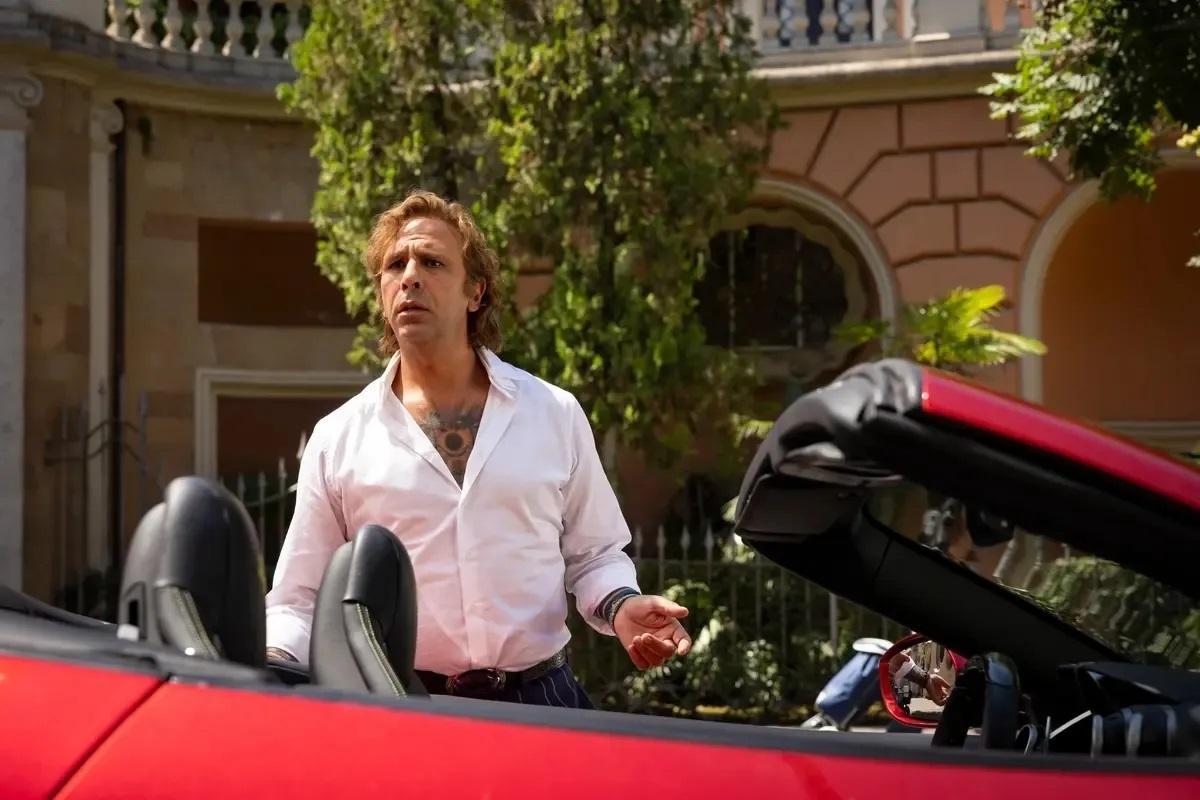
Box-office figures tell their own story. In a country often described as reluctant to return to cinemas, audiences have filled theatres for weeks – families, couples, groups of friends – watching a man with a conspicuously artificial hairpiece who imagined walking the Camino in a Ferrari, then gradually relinquishes every form of excess. There may be something cathartic in watching someone else struggle. Or perhaps, in a society defined by speed and uncertainty, the idea of slowing down to walking pace exerts a quiet appeal.
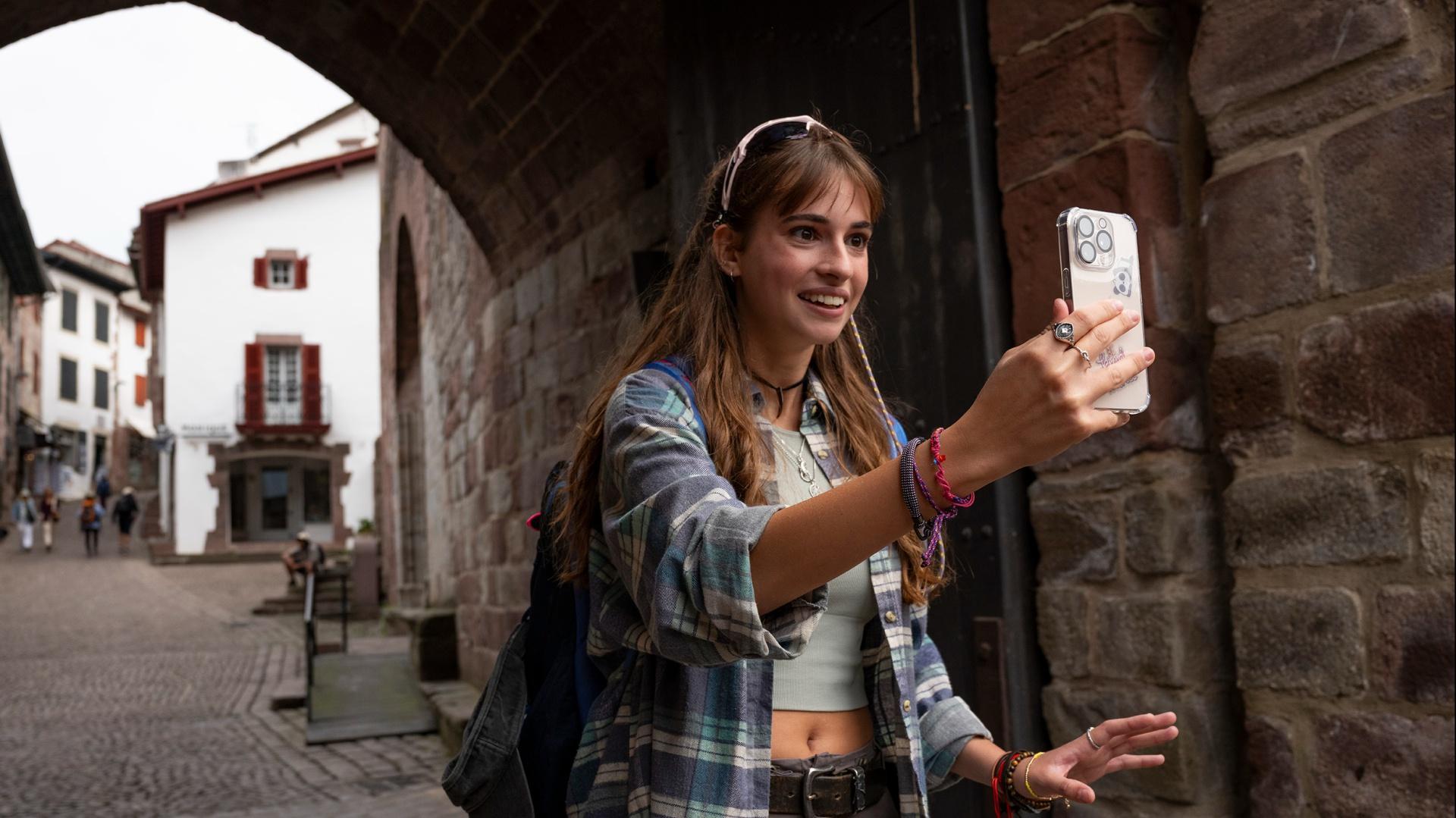
Nunziante recently remarked in an interview: “A happy ending is necessary. The purpose of life is joy.” It is a striking statement in a cultural moment that often treats optimism as naïveté. Buen Camino takes the risk of suggesting that people can change, relationships can be repaired, and 800 kilometres can matter. Judging by its success, audiences were willing to take that risk with it.
There is a final irony in the film’s reception. Checco is heir to a sofa empire – a symbol of comfort, immobility, and rest. The Camino represents the opposite: discomfort, effort, continuous movement. Millions of Italians left their sofas to watch a man abandon his own metaphorical one and begin walking. If that is not poetry, it comes close.
At the film’s conclusion, Checco arrives in Santiago. He is exhausted, dirty, and missing his hairpiece. He embraces his daughter. He does not deliver a revelation. None is required. Some understandings emerge only through shared movement.
Buen Camino is a rare achievement: a popular Italian comedy that balances humour with emotional credibility and suggests – without sermon or sentimentality – that losing one’s way may be a prerequisite for finding it. Preferably on a dusty path, with blistered feet and no certainty about where the night will be spent. The Camino, after all, makes no exceptions. Not even for billionaires with bad hair.
AI Transparency Notice
PilgriMaps uses artificial intelligence tools to assist in the research, drafting and translation of editorial content. All AI-assisted content is reviewed, edited and verified by our editorial team before publication. We contrast information against primary sources, specialist literature and on-the-ground knowledge to ensure accuracy, cultural sensitivity and editorial integrity.
AI is one tool among many in our workflow. The judgement, curation and responsibility for everything published on this platform remain entirely human.
Viator Media S.L. — in compliance with the EU Artificial Intelligence Act (Regulation EU 2024/1689).
This post is also available in: