In the low green hills of the Boyne Valley in eastern Ireland stands Newgrange, a Neolithic monument older than Stonehenge and the pyramids of Giza. Built around 3200 BCE, this massive passage tomb remains one of Europe’s most significant prehistoric sites. While its original function is not fully known, its architectural precision and astronomical alignment continue to draw thousands of visitors annually—especially during the winter solstice, when a rare and dramatic interplay of sunlight and stone occurs.
This gathering is not a pilgrimage in the conventional religious sense. There is no dogma or prescribed ritual. Yet for many, the annual solstice illumination at Newgrange carries a sense of reverence, reflecting a deep human fascination with time, mortality, and the cosmos.
A monument of prehistoric engineering
Newgrange forms part of Brú na Bóinne, a UNESCO World Heritage Site that includes two other large tombs, Knowth and Dowth. The structure itself is a circular mound over 80 meters in diameter, ringed by kerbstones engraved with spirals and abstract motifs. A narrow 19-meter passage leads into a cruciform chamber with a corbelled roof, constructed without mortar and still intact after more than 5,000 years.
The monument is best known for its solar alignment: during the days surrounding the winter solstice, the rising sun sends a shaft of light through a small opening known as the roof box, illuminating the inner chamber. This phenomenon lasts just over 17 minutes and occurs only on clear mornings near the solstice. The design required precise understanding of seasonal light cycles, marking Newgrange not merely as a burial site, but as a cosmic marker—an observatory woven into ritual architecture.
A contemporary pilgrimage of observation
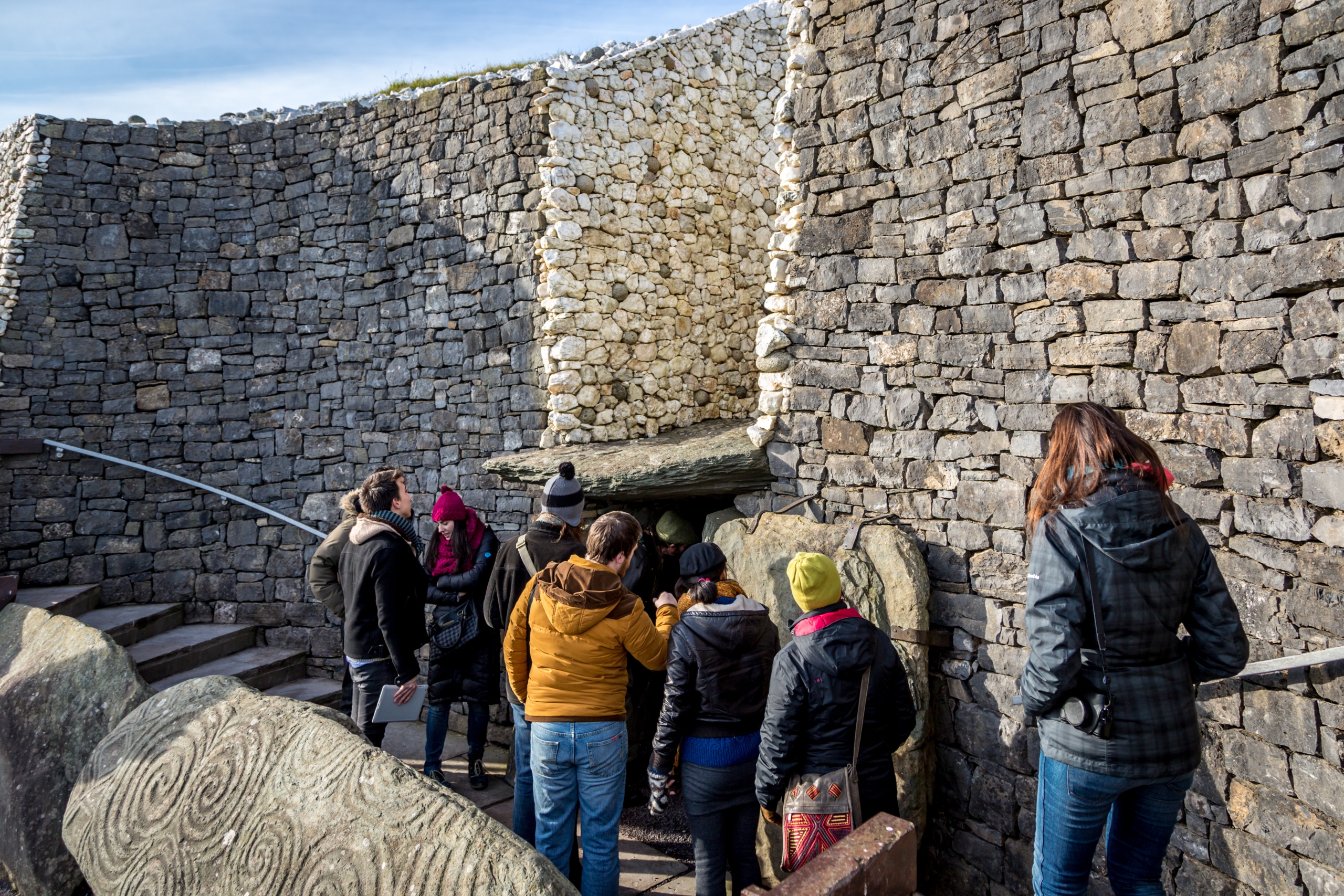
Each December, thousands enter a national lottery for the chance to witness the solstice light inside the tomb. Just a handful are selected to attend each morning over a five-day window. For those present, the experience is strikingly quiet and intimate: as dawn breaks, a golden beam creeps across the stone floor, gradually lighting the chamber’s center—an event unchanged for millennia.
For many attendees, this moment is less about spectacle than about connection—to the landscape, to ancient craftsmanship, and to the human impulse to measure time in light. Some come with a sense of personal or spiritual meaning; others approach it as a rare intersection of archaeology and astronomy. What unites them is a shared journey, often made in midwinter, to stand where people once stood 5,000 years ago, waiting for the sun to return.
Outside the chamber, larger gatherings take place around the mound, with visitors observing from the grass-covered hill and participating in informal solstice celebrations. These events often include music, storytelling, and symbolic rituals rooted in modern Druidic or earth-based spiritual practices, though these are unofficial and vary widely in tone and intent.
Interpretations and uncertainties
Despite its grandeur, Newgrange resists full explanation. Its builders left no written records. While excavation in the 20th century confirmed the site’s funerary use—human remains, grave goods, and votive objects were found—its precise function remains the subject of scholarly debate. Was it a tomb, a temple, a calendar, or all of these at once?
This ambiguity is part of what makes Newgrange compelling. It invites interpretation, yet defies ownership. For archaeologists, it is a monument of extraordinary technical achievement. For spiritual seekers, it is a site of deep time and cosmic alignment. For others, it is a cultural landmark, connecting present-day Ireland to its prehistoric roots.
A site of return
Unlike institutional pilgrimage centers, Newgrange does not promise intercession, revelation, or healing. Instead, it offers something subtler: a calibrated moment of alignment between earth, sun, and structure—a window into the worldview of ancient builders who understood the rhythms of their environment and inscribed them in stone.
In that sense, Newgrange functions as a ritual landscape, one that draws modern visitors across disciplines and beliefs. The winter solstice, marking the turning point of the year, becomes not just a celestial event, but a reason to gather, observe, and reflect. In doing so, the monument sustains a tradition of seasonal return, where the light that once guided Neolithic ritual continues to spark wonder and meaning today.
AI Transparency Notice
PilgriMaps uses artificial intelligence tools to assist in the research, drafting and translation of editorial content. All AI-assisted content is reviewed, edited and verified by our editorial team before publication. We contrast information against primary sources, specialist literature and on-the-ground knowledge to ensure accuracy, cultural sensitivity and editorial integrity.
AI is one tool among many in our workflow. The judgement, curation and responsibility for everything published on this platform remain entirely human.
Viator Media S.L. — in compliance with the EU Artificial Intelligence Act (Regulation EU 2024/1689).
This post is also available in: