In the early 20th century, Mejorada del Campo—a rural municipality east of Madrid—was defined by its fertile lands. The confluence of the Jarama and Henares rivers created ideal conditions for cultivating tomatoes and other vegetables, sustaining a way of life that reflected the agricultural character of the region.
Amid this environment, on 20 September 1925, Justo Gallego was born. A century later, his name remains inseparable from a singular creation: the unfinished yet monumental “Catedral de Justo,” constructed almost entirely from recycled materials. Despite its popular name, this building is not officially recognized as a place of worship, since it was never consecrated by the bishop of the diocese.
Gallego’s life defies simple categorization. Farmer, builder, architect without formal training—he has also been remembered as a visionary or dismissed as eccentric. What is certain is that his determination transformed his hometown into a place of global artistic interest.
A Turn Toward Construction
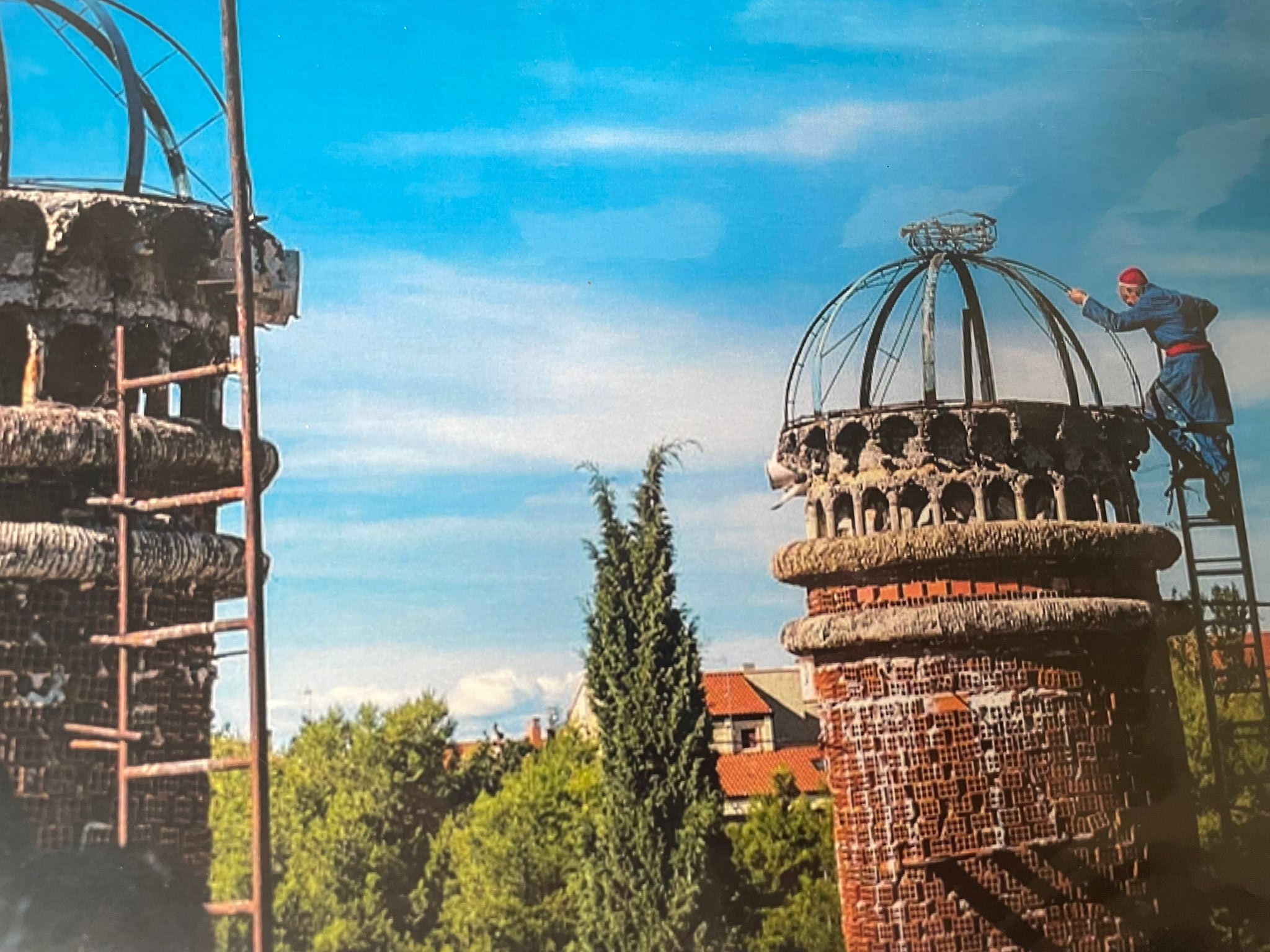
After Spain’s Civil War, Gallego joined the monastic community of Santa María de Huerta, pursuing a vocation shaped by discipline and devotion. His time there ended abruptly when, at age 36, he contracted tuberculosis. For the protection of the community, he was asked to leave. He returned to Mejorada del Campo, recovering slowly while reflecting on his next steps.
On inherited land, he resolved to dedicate himself to building a temple. Lacking architectural experience, he turned to books in Latin on Romanesque architecture and medieval castles. He studied St. Peter’s Basilica in Rome, admired neoclassical structures, and fused these inspirations with his own improvisations. On 12 October 1961, he laid the first stone.
From that moment until the end of his life, construction became his daily rhythm. Without blueprints, budgets, or institutional backing, he developed an intuitive style marked by bold experimentation and the use of discarded materials—steel drums, chemical containers, tires, and surplus from local factories. His motto was practical: whatever could be reused, would be reused.
Growth of a Monument
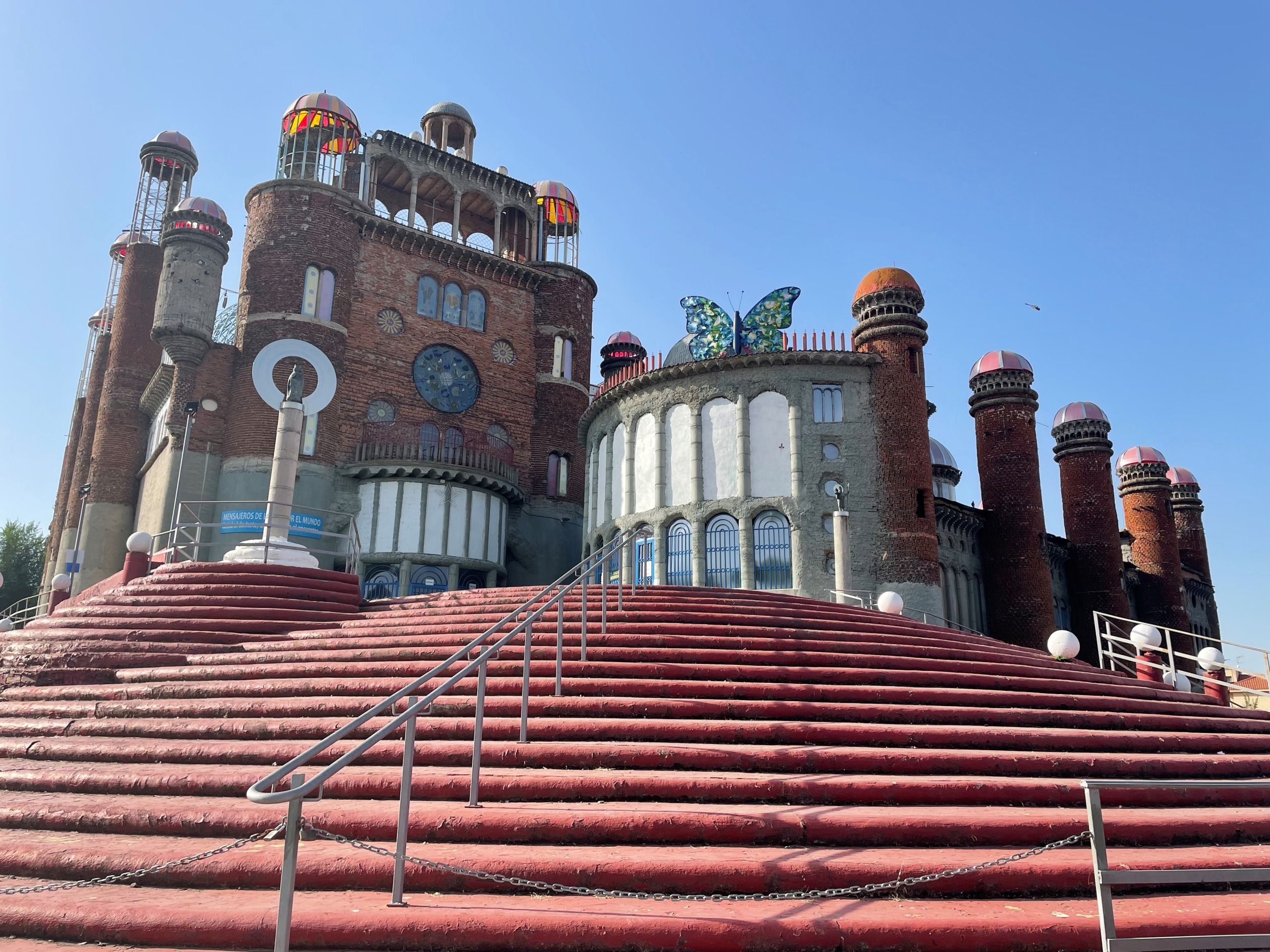
By the 1980s, the cathedral’s silhouette began to rise above Mejorada’s flat horizon. Domes, arches, and towers emerged, built with a mixture of resourcefulness and endurance. Family, neighbors, and volunteers contributed, expanding the project beyond an individual endeavor.
Gradually, the wider world took notice. Gallego’s work was featured at New York’s Museum of Modern Art, highlighted in international media, and included in an advertising campaign that gave his project global recognition. Coverage in The New York Times and later documentaries, such as a Channel 4 feature in 2019, reinforced the image of the cathedral as a feat of resilience and imagination.
Transition and Legacy
In 2021, shortly before his death, Gallego transferred the building to the NGO Mensajeros de la Paz. Under their stewardship, the space has been maintained not only as a site of worship but also as a venue for interreligious dialogue and social programs, including food assistance for local families.
The building itself is vast: 4,700 square meters of constructed space, rising 35 meters high and stretching 50 meters long. Its features include two cloisters, a crypt, a baptistery, 28 domes, 12 towers, and more than 1,200 stained-glass windows. Every section reveals improvisation: columns reinforced with spiral iron, rounded interiors designed to avoid corners, and stained glass assembled from disparate fragments.

A Place of Wonder
To enter the cathedral is to encounter a structure that challenges conventional expectations. The scale astonishes, but so too does the individuality of each element. Visitors move through unfinished chambers, makeshift staircases, and spaces filled with a sense of both precariousness and vitality.
The building resists easy definition. It is at once a personal project, a collective symbol, and an evolving urban landmark. For many, it embodies persistence in the face of limitation; for others, it illustrates how imagination can shape the built environment in unforeseen ways.
Erasmus once wrote in In Praise of Folly that “the best ideas come not from reason but from a lucid and visionary madness.” The Cathedral of Justo Gallego resonates with this sentiment. Whether regarded as art, architecture, or experiment, it stands as a monument to human determination—an unfinished work that continues to inspire awe and reflection.
AI Transparency Notice
PilgriMaps uses artificial intelligence tools to assist in the research, drafting and translation of editorial content. All AI-assisted content is reviewed, edited and verified by our editorial team before publication. We contrast information against primary sources, specialist literature and on-the-ground knowledge to ensure accuracy, cultural sensitivity and editorial integrity.
AI is one tool among many in our workflow. The judgement, curation and responsibility for everything published on this platform remain entirely human.
Viator Media S.L. — in compliance with the EU Artificial Intelligence Act (Regulation EU 2024/1689).
This post is also available in: