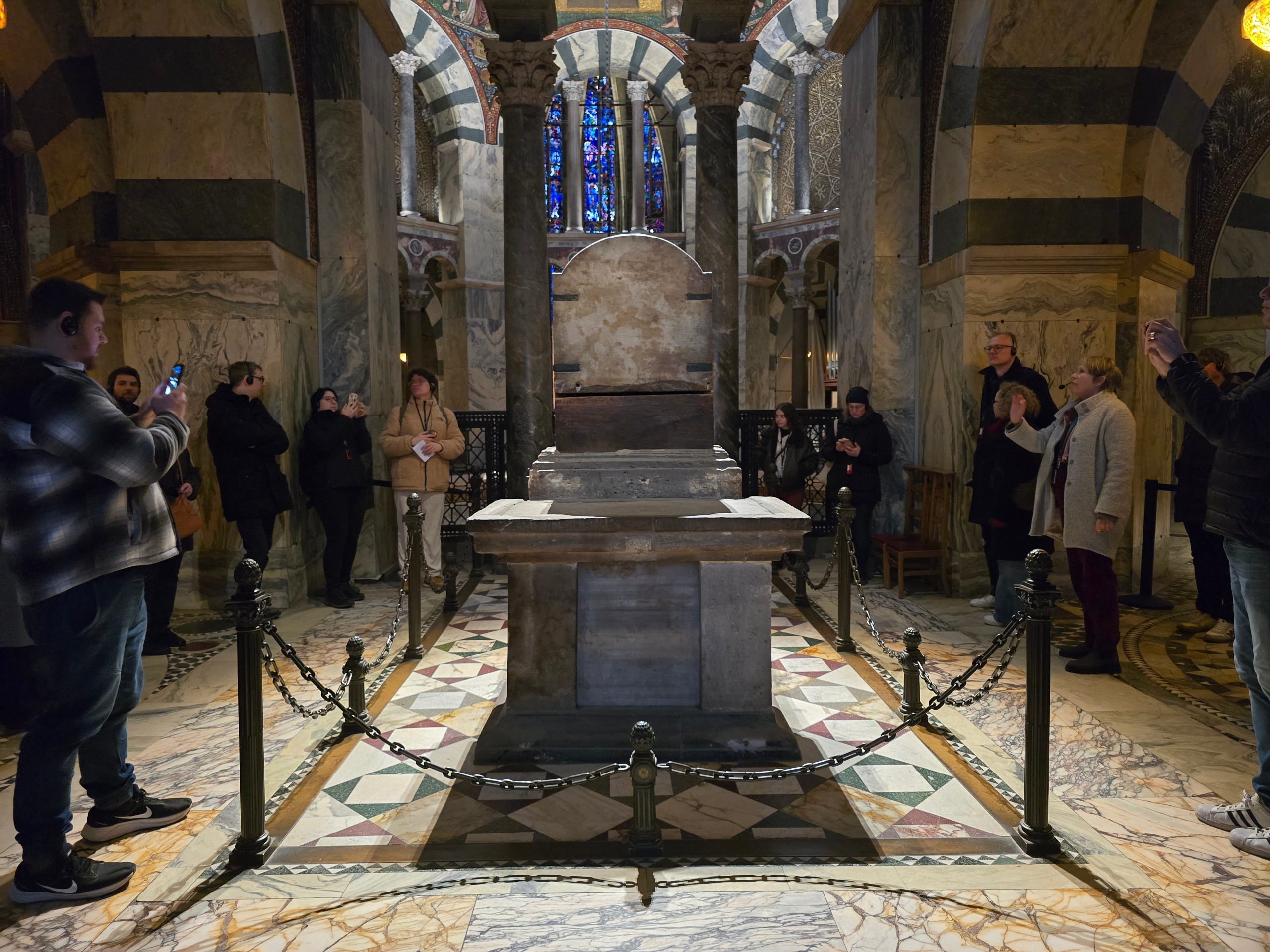
When Charlemagne settled his capital at Aachen near the close of the eighth century, he did what ambitious Christian rulers had done since Constantine: he made his city worth the journey. The instrument was relics. Around 799, when Pope Leo III consecrated the Palatine Chapel — an octagon of dark stone modelled on San Vitale at Ravenna, and the boldest vault raised north of the Alps for centuries — Charlemagne set about furnishing it with the one commodity that mattered in a sacral economy: fragments of holiness. By gift, purchase, and the diplomatic pressure available to a man newly crowned emperor, he drew cloth relics from Jerusalem and Rome into his new church, and his heirs kept up the habit. In time Aachen would rank as the fourth great pilgrimage destination of Latin Christendom, behind only Jerusalem, Rome, and Santiago de Compostela.
Four textiles came to anchor the cult — the Four Great Relics, as they are still called. They are the cloak of the Virgin, the swaddling clothes of the infant Christ, the loincloth said to have been worn at the crucifixion, and the cloth on which the severed head of John the Baptist was laid. None is a bone or a body. All four are contact relics: cloth that had touched holiness rather than holiness itself, which is precisely what made them portable, divisible, and inexhaustible in their appeal. Unremarkable to look at — yellowed, fraying, easily mistaken for laundry — they were guarded more jealously than almost any relics in Europe, and for most of the Middle Ages kept from view entirely.
Then the plague arrived. From 1349, the year the Black Death reached the Rhineland, the relics were lifted from the Marienschrein — the golden Shrine of Saint Mary completed around 1239 — and shown to the faithful, at first irregularly, then on a fixed cycle of every seven years. The Heiligtumsfahrt, the “sacred journey,” has run on that rhythm ever since, interrupted only by war and contagion. Its scale is hard to overstate. The Queen of Hungary is recorded arriving in 1337 with an escort of seven hundred knights; the pilgrimage of 2023 drew well over a hundred thousand people to a single small German city. For two weeks every seventh year, the textiles Charlemagne gathered remain the reason the crowds come.
What gives Aachen its peculiar shape, though, is the second movement — the one Charlemagne did not plan. The collector became the collected.

He died in 814 and was buried in his own chapel. For three centuries he was a dead emperor, venerated unofficially. Then, in 1165, Frederick Barbarossa — needing a sacred ancestor to dignify a contested throne — had the antipope Paschal III declare Charlemagne a saint, and presided over the exhumation and re-enshrinement of the imperial bones. The manoeuvre was as political as it was pious, and the Church treated it accordingly: when the Third Lateran Council annulled all of Paschal’s acts in 1179, the canonisation fell with them. Rome has never ratified it. Charlemagne survives, with a certain diplomatic tact, as Blessed rather than Saint — venerated at Aachen, unrecognised everywhere else.
The cult outlived the legal doubt. In 1215 Frederick II sealed the Karlsschrein, the goldsmiths’ shrine that still holds the bulk of Charlemagne’s remains. But the body did not stay whole. The crown of his skull was set into a silver-gilt reliquary bust around 1349 — the famous Karlsbüste, its crowned head gazing out over the treasury — and an arm bone was enclosed in a separate reliquary, a gift of Louis XI of France in 1481. The emperor who had spent his reign assembling the scattered holiness of others was, in his turn, exhumed, divided, plated in gold and silver, and carried through the streets he had built. The logic he had used on the saints was simply applied to him.
This is the quiet irony on which Aachen stands. A relic works by the part standing in for the whole — a thread for the Virgin, a cranium for the emperor — so that holiness can be present in many places at once, distributed without being diminished. Charlemagne understood that economy perfectly; he built a capital on it. What he could not foresee was that the same appetite would close over him: that the man who drew the bodies of the holy toward Aachen would end up scattered through its reliquaries, an object of the very traffic he had set in motion. The city remembers him twice over — as the hand that gathered, and as one more thing gathered. Pilgrims still come for both.
AI Transparency Notice
PilgriMaps uses artificial intelligence tools to assist in the research, drafting and translation of editorial content. All AI-assisted content is reviewed, edited and verified by our editorial team before publication. We contrast information against primary sources, specialist literature and on-the-ground knowledge to ensure accuracy, cultural sensitivity and editorial integrity.
AI is one tool among many in our workflow. The judgement, curation and responsibility for everything published on this platform remain entirely human.
Viator Media S.L. — in compliance with the EU Artificial Intelligence Act (Regulation EU 2024/1689).
This post is also available in: