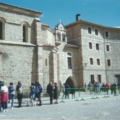
Inchcolm Abbey, founded in the 12th century by King David I, is one of the best preserved medieval monastic complexes in Scotland. The foundation of the Abbey has its roots in a stormy crossing of the Forth during which David I and his brother Alexander I sought refuge on the island. Alexander promised to build a monastery in gratitude for saving his life, but died in 1124 before fulfilling his promise. His brother David I invited the Augustinians to establish a priory, which was elevated to an abbey in 1235. During the 14th century, the island suffered from English attacks, which led to the temporary abandonment of the place on several occasions. After the Reformation, the monastic community was disbanded and the island was used as a fortress during the two world wars.
Today the monastic buildings at Inchcolm, accessible by ferry from Hawes Pier in South Queensferry, are a major tourist attraction. The cloister, chapter house, boiler room and refectory are in excellent condition, while the church is the most dilapidated part. The views from the bell tower are not to be missed, as is the 13th century fresco depicting a funeral procession, one of the artistic gems of the place.
- Address
Inchcolm island, Aberdour, UK - Web
https://www.historicenvironment.scot/visit-a-place/places/inchcolm-abbey/ - Visiting Hours
Everyday from 9:30 to 17:00, accesible by ferry - What to see
Ruins of medieval abbey
AI Transparency Notice
PilgriMaps uses artificial intelligence tools to assist in the research, drafting and translation of editorial content. All AI-assisted content is reviewed, edited and verified by our editorial team before publication. We contrast information against primary sources, specialist literature and on-the-ground knowledge to ensure accuracy, cultural sensitivity and editorial integrity.
AI is one tool among many in our workflow. The judgement, curation and responsibility for everything published on this platform remain entirely human.
Viator Media S.L. — in compliance with the EU Artificial Intelligence Act (Regulation EU 2024/1689).
This post is also available in: